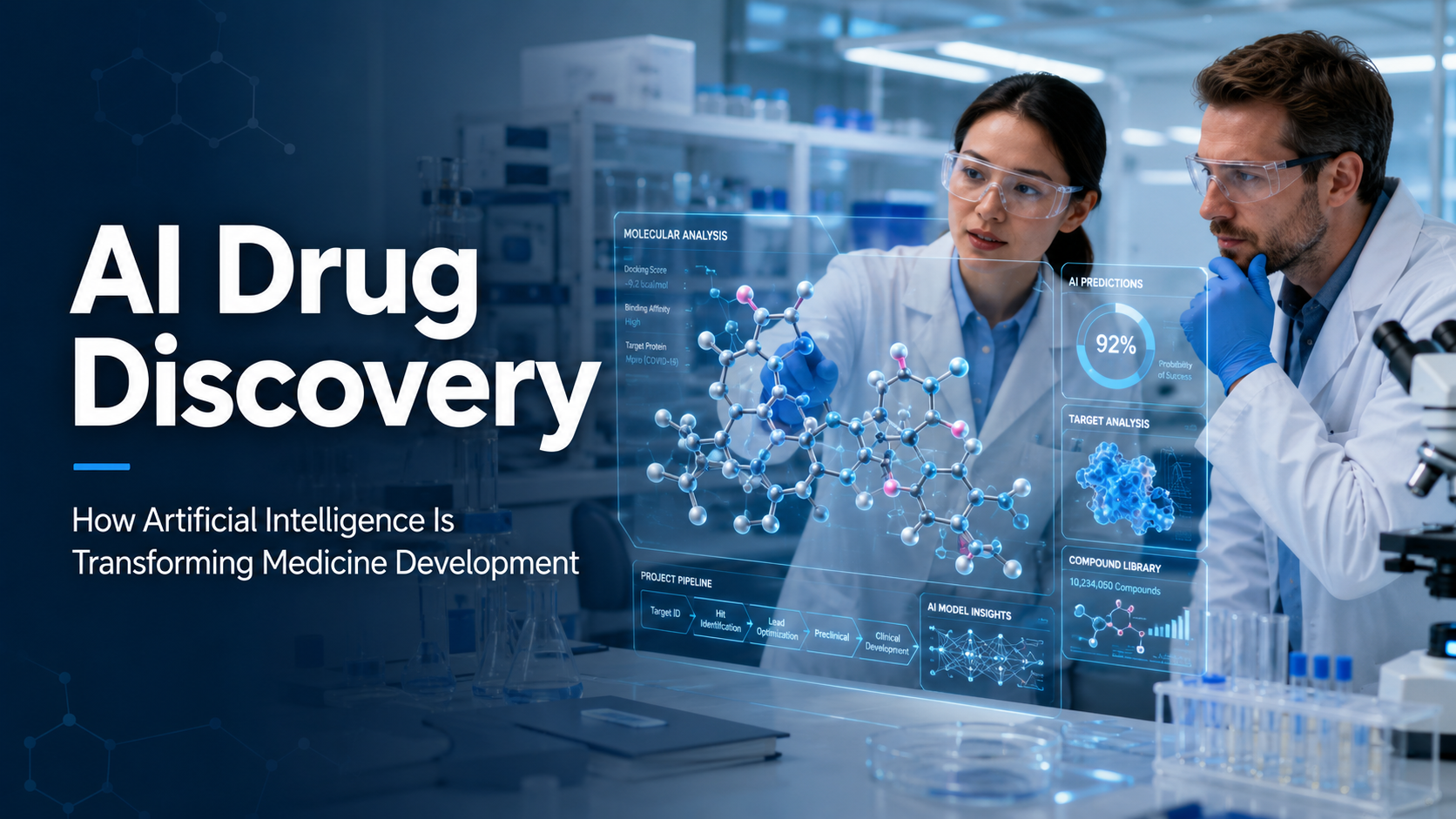
AI Drug Discovery: How Artificial Intelligence Is Transforming Medicine Development
AI drug discovery is becoming one of the most important technology trends in healthcare and life sciences. Developing a new medicine has traditionally been a long, expensive, and risky process. Researchers must identify disease targets, design potential drug molecules, test them in laboratories, study safety, run clinical trials, and meet strict regulatory requirements before a treatment can reach patients.
Artificial intelligence is changing this process by helping scientists analyze biological data, predict protein structures, design new molecules, screen drug candidates, identify patient groups, and improve clinical trial planning. Instead of replacing scientists, AI works as a powerful research tool that can process massive amounts of data faster than traditional methods.
The U.S. Food and Drug Administration has recognized the growing use of AI in drug development and published draft guidance in 2025 on using artificial intelligence to support regulatory decision-making for drug and biological products. This shows that AI is moving from experimental research into more serious pharmaceutical development workflows. Source: FDA Artificial Intelligence for Drug Development
What Is AI Drug Discovery?
AI drug discovery refers to the use of artificial intelligence, machine learning, deep learning, generative models, knowledge graphs, and data analytics to support the discovery and development of new medicines. These tools can help researchers understand diseases, identify promising biological targets, design drug-like molecules, and predict how compounds may behave in the body.
Traditional drug discovery depends heavily on laboratory experiments, expert knowledge, trial-and-error testing, and years of research. AI does not remove the need for laboratory validation, but it can help researchers make better decisions earlier in the process. By narrowing down the most promising options, AI may reduce wasted time and resources.
A review published in 2025 described AI-driven drug discovery platforms as moving from theoretical promise toward clinical utility, with AI-designed therapeutics already entering human trials in different disease areas. Source: ScienceDirect review on AI-driven drug discovery platforms
Why AI Drug Discovery Matters
Drug development is one of the most complex processes in modern science. A potential medicine must be effective, safe, stable, manufacturable, and clinically useful. Many promising compounds fail before reaching the market because they are not effective enough, cause unacceptable side effects, or do not perform well in human trials.
AI drug discovery matters because it can help address some of these challenges. AI can analyze complex biological systems, compare large chemical libraries, detect patterns in patient data, and generate new molecular designs. This may improve the quality of early-stage decisions and help researchers focus on candidates with a higher chance of success.
AI also matters because healthcare needs are growing. Many diseases still lack effective treatments, including rare diseases, neurodegenerative conditions, certain cancers, antimicrobial-resistant infections, and chronic inflammatory diseases. Faster and smarter discovery tools could help researchers explore more therapeutic possibilities.
1. AI Helps Identify Better Drug Targets
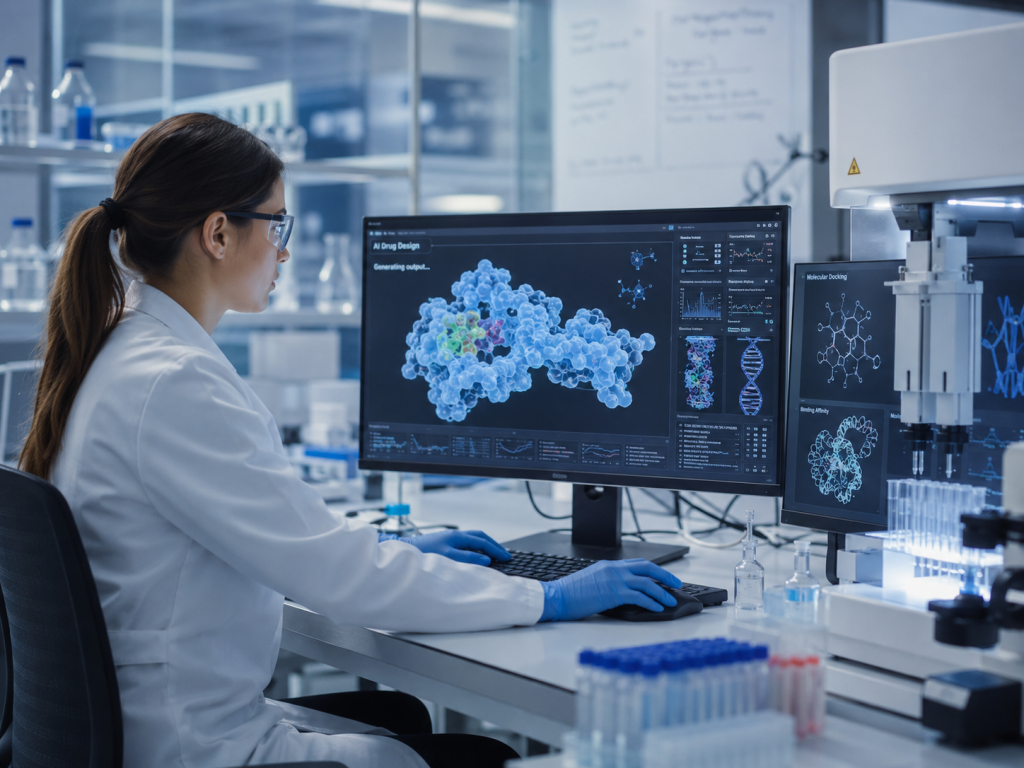
A drug target is usually a molecule in the body, such as a protein, gene, receptor, or enzyme, that plays an important role in a disease. Choosing the right target is one of the most important steps in drug discovery. If the target is wrong, even a well-designed drug may fail.
AI can help identify potential drug targets by analyzing genetic data, protein networks, disease pathways, scientific literature, clinical data, and biological databases. Machine learning models can look for relationships that may be difficult for humans to detect manually.
For example, AI can compare gene expression patterns between healthy and diseased tissues, identify proteins associated with disease progression, and suggest targets that may be suitable for therapeutic intervention. This can help researchers discover new biological mechanisms and generate stronger research hypotheses.
2. AI Improves Protein Structure Prediction
Proteins are essential to biology, and their three-dimensional structures influence how they function. Understanding protein structure is important for designing drugs that can bind to the right target effectively.
One of the most famous breakthroughs in this area is AlphaFold, developed by Google DeepMind. AlphaFold has shown how artificial intelligence can predict protein structures with remarkable accuracy, helping scientists better understand the shapes and functions of proteins. DeepMind describes AlphaFold as a system that predicts the 3D structure of a protein from its amino acid sequence. Source: Google DeepMind AlphaFold
Better protein structure prediction can support drug discovery by helping researchers understand where a drug molecule may bind, how a target changes shape, and how to design compounds with stronger interactions. This is especially useful for structure-based drug design.
3. Generative AI Can Design New Molecules
Generative AI is one of the most exciting areas in AI drug discovery. Instead of only searching existing chemical libraries, generative models can propose new molecular structures that may have desired properties.
These models can be trained on chemical data and guided toward specific goals, such as stronger target binding, better solubility, lower toxicity, improved stability, or easier synthesis. In theory, this allows researchers to explore chemical space more creatively and efficiently.
However, AI-generated molecules still require validation. A molecule that looks promising in a model must be synthesized, tested in the lab, evaluated for safety, and studied in biological systems. AI can suggest ideas, but experimental science must confirm whether those ideas work.
4. AI Accelerates Virtual Screening
Virtual screening is the process of using computational tools to evaluate many potential drug compounds before physical testing. Traditional screening can require large libraries and extensive laboratory work. AI can help rank compounds more efficiently and identify promising candidates faster.
Machine learning models can predict whether a compound may bind to a target, whether it may be toxic, whether it has drug-like properties, and whether it is likely to be absorbed by the body. This can help researchers prioritize which molecules to test first.
AI-powered screening is especially useful when dealing with huge chemical libraries. Instead of testing millions of compounds randomly, researchers can focus on a smaller set of candidates that appear more promising based on model predictions.
5. AI Supports Drug Repurposing
Drug repurposing means finding new uses for existing medicines. Since approved drugs already have known safety profiles, repurposing can sometimes be faster than developing a completely new drug from the beginning.
AI can support drug repurposing by analyzing disease pathways, clinical data, published research, molecular interactions, and real-world evidence. It can look for unexpected connections between existing drugs and new disease targets.
For example, a machine learning model may identify that a drug originally developed for one condition could influence a biological pathway involved in another disease. Researchers can then test whether the connection is clinically meaningful.
6. AI Helps Predict Safety and Toxicity
Safety is one of the biggest reasons drug candidates fail. A compound may work well against a target but still cause harmful side effects. Predicting toxicity earlier can help researchers avoid risky candidates before investing too much time and money.
AI models can analyze chemical structures, biological assay results, historical toxicity data, and known safety signals to estimate potential risks. These predictions can help scientists improve molecules before they reach later stages of development.
The FDA has noted that AI and machine learning may have potential impact across the drug development process, including areas related to safety, quality, manufacturing, novel drug development, and personalized treatment approaches. Source: FDA discussion paper on AI/ML in drug development
7. AI Can Improve Clinical Trial Design
Clinical trials are essential for proving whether a drug is safe and effective in humans. However, trials are often expensive, time-consuming, and difficult to manage. AI can help improve clinical trial planning by analyzing patient data, eligibility criteria, biomarkers, disease progression, and previous trial results.
One major use of AI is patient selection. If researchers can identify the patients most likely to benefit from a treatment, clinical trials may become more efficient and informative. This is especially important in precision medicine, where treatments are designed for specific patient groups.
AI may also help predict trial risks, optimize dosing strategies, monitor patient data, and identify patterns in trial outcomes. While AI cannot replace clinical evidence, it can help design smarter studies and reduce avoidable failures.
8. AI Drug Discovery and Personalized Medicine
Personalized medicine aims to match treatments to individual patients based on genetics, biomarkers, lifestyle, disease subtype, and treatment response. AI drug discovery can support this shift by analyzing complex patient data and identifying patterns that are difficult to see with traditional methods.
For example, AI can help researchers understand why some patients respond well to a drug while others do not. It can also help identify biomarkers that predict treatment response or side effects.
In cancer research, AI can support target discovery, biomarker discovery, treatment matching, and trial optimization. This may help create more precise therapies that are better suited to specific patient populations.
9. AI and Laboratory Automation
AI drug discovery becomes even more powerful when combined with laboratory automation. Automated labs can run experiments, collect data, test compounds, and feed results back into AI models. This creates a cycle sometimes called design-make-test-analyze.
In this workflow, AI designs or prioritizes molecules, robots or automated systems help synthesize and test them, and the results are used to improve the next round of predictions. This can make discovery more iterative and data-driven.
The combination of AI, robotics, cloud platforms, and automated experimentation may help pharmaceutical research move faster while generating more consistent data.
10. Challenges of AI Drug Discovery
Although AI drug discovery is promising, it also faces major challenges. The first challenge is data quality. AI models are only as good as the data used to train them. If the data is incomplete, biased, inconsistent, or poorly labeled, the model may produce unreliable results.
Another challenge is biological complexity. Human biology is extremely complicated. A compound may behave differently in a computer model, a cell culture, an animal study, and a human patient. This is why laboratory and clinical validation remain essential.
Explainability is also important. In regulated industries, researchers and regulators often need to understand why a model made a prediction. Black-box AI systems can be difficult to trust if their reasoning is unclear.
Cost and infrastructure are additional barriers. Building AI drug discovery platforms requires strong computational resources, scientific expertise, data engineering, and collaboration between biologists, chemists, clinicians, and AI specialists.
Regulatory Considerations for AI in Drug Development
Because drug development affects patient safety, AI must be used carefully in regulated settings. Companies need to define how AI models are used, what decisions they support, what evidence proves their reliability, and how risks are managed.
In January 2025, the FDA announced draft guidance titled “Considerations for the Use of Artificial Intelligence To Support Regulatory Decision-Making for Drug and Biological Products.” The guidance provides recommendations for using AI-generated information or data to support regulatory decisions about drug safety, effectiveness, or quality. Source: Federal Register FDA draft guidance announcement
This does not mean every AI tool must be submitted to regulators. However, when AI supports decisions that affect drug approval, safety, quality, or clinical evidence, companies need strong documentation, model validation, risk assessment, and transparency.
The Future of AI Drug Discovery
The future of AI drug discovery will likely be shaped by better biological data, stronger foundation models, more automated laboratories, improved clinical trial analytics, and clearer regulatory frameworks. AI will become more integrated into the full medicine development lifecycle, from early target discovery to clinical development and manufacturing.
Large investments in AI-driven drug discovery companies show continued confidence in this field. Reuters reported that Isomorphic Labs, a company spun out of Google DeepMind, raised major funding to scale its AI-powered drug design engine and advance drug discovery programs. Source: Reuters on Isomorphic Labs
Still, AI will not magically eliminate the difficulty of drug development. The most successful approaches will combine machine intelligence with human scientific judgment, experimental validation, clinical expertise, and regulatory discipline.
Final Thoughts
AI drug discovery is transforming how scientists search for new medicines. It can support target identification, protein structure prediction, molecule design, virtual screening, drug repurposing, safety prediction, clinical trial planning, and personalized medicine.
The promise is significant: faster research, better candidate selection, more efficient trials, and new opportunities for treating difficult diseases. However, AI drug discovery still depends on high-quality data, laboratory testing, clinical validation, regulatory review, and responsible use.
For researchers, pharmaceutical companies, healthcare innovators, and technology leaders, AI drug discovery represents a powerful shift in medicine development. The future of drug discovery will not be AI alone, but AI working together with scientists to create safer, smarter, and more effective treatments for patients.