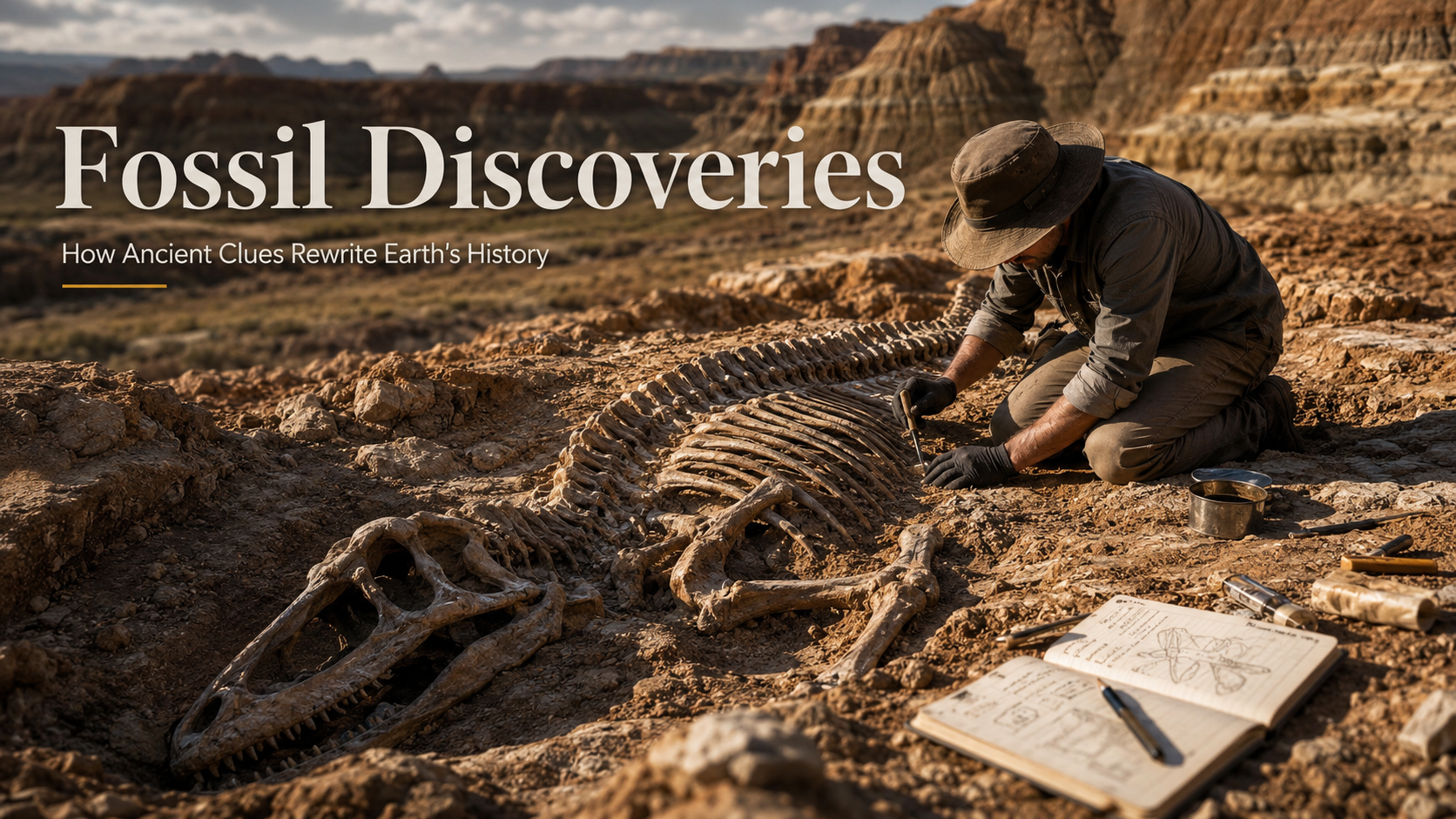
Fossil Discoveries: How Ancient Clues Rewrite Earth’s History
Fossil discoveries are more than spectacular dinosaur bones displayed in museums. They are scientific evidence preserved in stone, amber, ice, tar, sediment, and ancient seabeds. Every fossil is a message from the past, carrying information about extinct animals, ancient plants, lost ecosystems, climate change, evolution, and the deep history of life on Earth.
A single fossil can change how scientists understand an entire species. A complete skeleton can reveal how an animal moved. A tiny tooth can identify a predator. A fossilized footprint can show behavior. A preserved shell can tell researchers about ancient oceans. Even microscopic fossils can help reconstruct past climates and environmental conditions.
According to the Smithsonian’s Human Origins Program, fossil discoveries have shown that the human family tree is much more complex than a simple straight line of evolution. Instead, human evolution involved many branches, extinct relatives, and overlapping species. Source: Smithsonian Human Origins
Article Brief: Fossil discoveries help scientists reconstruct extinct life, ancient environments, evolutionary relationships, and major changes in Earth’s history. Modern paleontology combines fieldwork, anatomy, geology, CT scanning, isotope analysis, digital modeling, and comparative biology.
What Are Fossils?
Fossils are preserved remains, traces, or impressions of ancient organisms. They can include bones, teeth, shells, leaves, wood, footprints, burrows, eggs, skin impressions, feathers, pollen, spores, and microscopic organisms. Some fossils preserve the physical body of an organism, while others preserve evidence of its activity.
Most fossils form when an organism is buried quickly by sediment after death. Over time, minerals may replace organic material, sediments harden into rock, and the remains become part of the geological record. This process can take thousands to millions of years.
Fossils are not evenly distributed across Earth. They are more likely to form in environments where burial is rapid, oxygen is limited, and sediment accumulates. Ancient riverbeds, lake deposits, marine sediments, volcanic ash layers, caves, tar pits, and coastal basins can all preserve fossil evidence.
Why Fossil Discoveries Matter
Fossil discoveries matter because they provide direct evidence of life that no longer exists. Without fossils, scientists would know far less about dinosaurs, ancient mammals, early birds, marine reptiles, prehistoric plants, extinct sharks, early humans, and the organisms that lived before complex animals evolved.
Fossils also help scientists understand change over time. They show how species appear, adapt, migrate, diversify, and disappear. They reveal mass extinctions, climate shifts, ancient ecosystems, predator-prey relationships, and evolutionary experiments that never survived into the modern world.
The Natural History Museum in London regularly describes new fossil species and highlights how museum collections continue to generate scientific discoveries. In 2025, the museum reported newly named fossil shark species among hundreds of newly described species, showing that even long-collected specimens can still reveal new information. Source: Natural History Museum
Discovery Log: Fossils Are Not Always Found by Scientists First
Many important fossil discoveries begin with trained paleontologists, but others start with local residents, construction workers, miners, hikers, farmers, or museum volunteers noticing something unusual. A strange-looking rock, an exposed bone, or a pattern in stone can lead to a major scientific investigation.
This is why context is critical. A fossil is scientifically valuable not only because of what it is, but because of where it was found. The surrounding rock layer, sediment type, nearby fossils, and geological position help scientists understand the age and environment of the organism.
A fossil removed without documentation may lose much of its scientific meaning. Paleontologists record location, rock layer, orientation, associated material, and environmental context before removing fossils from the field. In paleontology, the fossil is evidence, but the site is also evidence.
The Main Types of Fossil Discoveries
Not all fossil discoveries are the same. Some reveal new species. Others clarify known species, preserve behavior, capture soft tissues, or provide environmental information. Professional paleontology often treats fossils as data points inside a much larger historical puzzle.
| Type of Fossil Discovery | What It Can Reveal |
|---|---|
| Body Fossils | Bones, teeth, shells, and preserved body parts that reveal anatomy and identity. |
| Trace Fossils | Footprints, burrows, bite marks, nests, and tracks that show behavior. |
| Microfossils | Tiny fossils such as pollen, spores, foraminifera, and plankton used in climate and age studies. |
| Soft-Tissue Fossils | Rare preservation of skin, feathers, organs, or soft body structures. |
| Molecular or Chemical Evidence | Chemical traces that can suggest diet, environment, temperature, or biological relationships. |
Case File One: Dinosaurs Still Have New Stories to Tell
Dinosaur fossils remain some of the most popular and scientifically important fossil discoveries. New dinosaur finds can change how researchers understand evolution, movement, diet, growth, reproduction, and ancient geography.
A dinosaur fossil does not need to be a complete skeleton to be important. A skull can reveal feeding behavior. A limb bone can suggest size and movement. Vertebrae can help classify species. Teeth can show diet. Trackways can preserve group behavior or walking speed.
The Natural History Museum announced a new dinosaur species named Enigmacursor mollyborthwickae in 2025, describing it as the most complete named specimen of its kind. The museum noted that the species helped resolve a long-standing taxonomic problem involving small plant-eating dinosaurs. Source: Natural History Museum
This type of discovery shows an important point: paleontology is not only about finding something big. It is also about finding enough detail to solve a scientific problem.
Case File Two: Marine Fossils Reveal Ancient Oceans
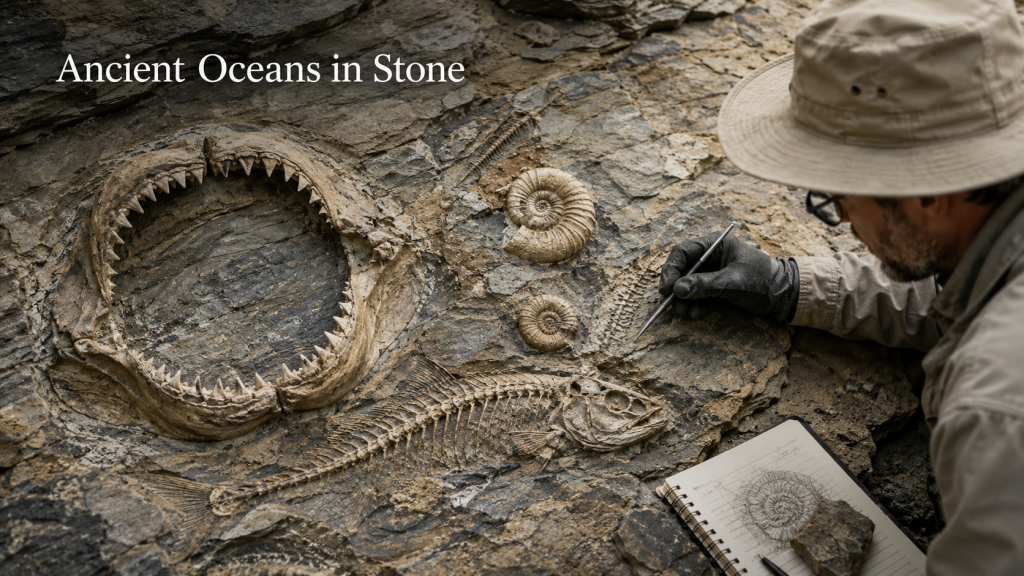
Marine fossils are among the most common and informative fossils because many ancient organisms lived in seas, and marine sediments are often excellent at preserving remains. Fossil shells, corals, ammonites, fish, sharks, marine reptiles, and microscopic plankton can all reveal information about ancient ocean life.
Marine fossils help scientists reconstruct sea levels, ocean temperature, food webs, extinction events, and the movement of ancient coastlines. Because oceans have changed dramatically over geological time, marine fossils can also help researchers understand how life responds to environmental stress.
Reuters reported in 2025 that paleontologists in Peru unveiled a nearly complete 9-million-year-old fossil of Cosmopolitodus hastalis, a relative of the great white shark, found in the Pisco Basin. The fossil was preserved with remains of sardines, offering clues about diet and ancient marine ecosystems. Source: Reuters
Finds like this are valuable because they connect anatomy with ecology. A fossil shark is not just a skeleton. It is evidence of an ancient predator, its prey, and the ocean world it lived in.
Case File Three: Human Fossils and the Branching Family Tree
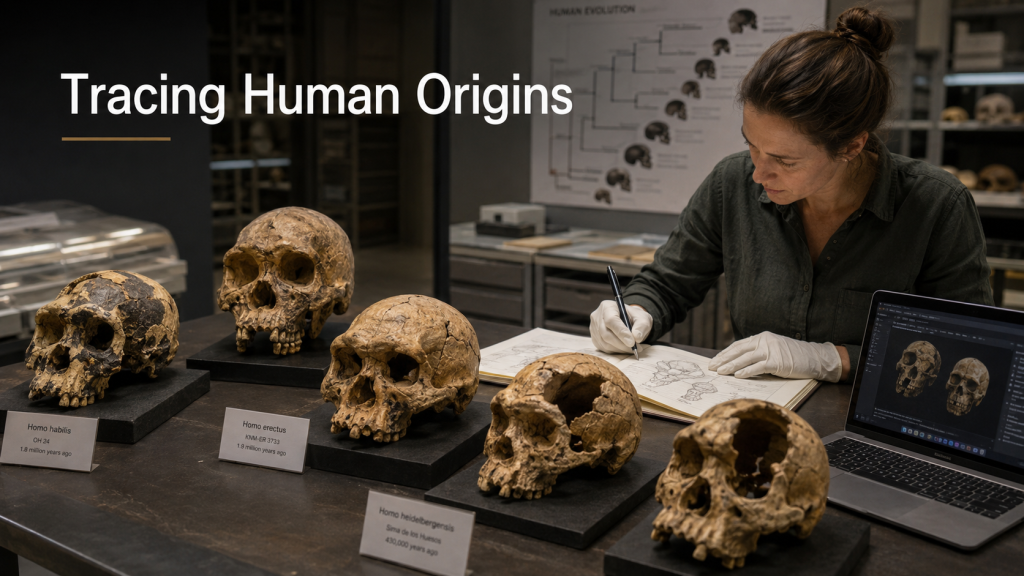
Human fossils are among the most carefully studied fossil discoveries because they help explain where modern humans came from and how our extinct relatives lived. Skulls, teeth, pelvis bones, limb bones, tools, and footprints can all provide evidence about movement, diet, brain size, social behavior, and adaptation.
The old idea of human evolution as a simple straight line is now outdated. Fossils show that the human story is more like a branching tree, with multiple hominin species living at different times and sometimes overlapping geographically or chronologically.
The Smithsonian explains that fossil discoveries have revealed a more diverse human family tree than scientists once believed, with deeper roots and more branches. Source: Smithsonian Human Origins
This makes human fossil discoveries especially powerful. They do not only tell us about extinct species. They also challenge assumptions about what it means to be human.
Field Method: How Paleontologists Find Fossils
Fossil discovery often begins with geology. Paleontologists study maps, rock formations, erosion patterns, and known fossil-bearing layers to identify promising field sites. Fossils are usually found in sedimentary rocks, such as sandstone, shale, limestone, and mudstone.
Field teams may search exposed cliffs, dry riverbeds, badlands, quarries, caves, deserts, coastal outcrops, and construction sites. When a fossil is found, scientists document its exact location and geological context before excavation.
Excavation is slow work. Fragile fossils may be cleaned with brushes, dental tools, stabilizing chemicals, and protective plaster jackets. Large fossils may take weeks or months to remove safely. After transport to a lab, preparation can take even longer.
This is why museum collections are so important. A fossil collected decades ago may still be studied with new tools today, producing discoveries long after the original excavation.
Laboratory Work: The Discovery Continues After Excavation
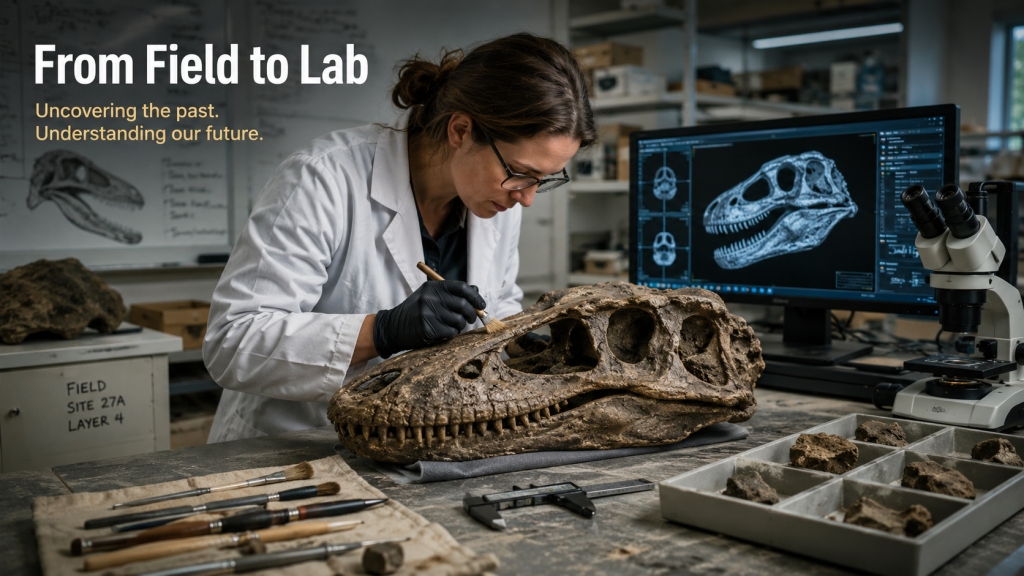
Finding a fossil in the field is only the beginning. Much of the real discovery happens in the lab. Fossil preparation removes surrounding rock, stabilizes delicate material, and exposes anatomical details. Researchers then compare the fossil with known species, measure features, and analyze its structure.
Modern paleontology uses advanced technology. CT scanning can reveal internal bone structure without destroying the fossil. 3D modeling allows scientists to reconstruct missing parts. Isotope analysis can provide clues about diet, migration, and climate. Microscopy can reveal growth patterns, tissue structure, or tiny wear marks.
This means fossil discoveries are increasingly interdisciplinary. Paleontologists may work with geologists, chemists, biologists, imaging specialists, data scientists, and climate researchers.
Research Lens: A fossil is not valuable only because it is old. It is valuable because it can be placed into a testable scientific context: anatomy, age, environment, evolutionary relationship, and ecological meaning.
Dating Fossils: How Scientists Estimate Age
One of the most important questions in fossil research is age. Scientists need to know when an organism lived in order to understand evolution and environmental change. Fossil dating usually combines relative dating and absolute dating methods.
Relative dating places fossils in sequence by comparing rock layers. In general, deeper sedimentary layers are older than layers above them, although geological folding and erosion can complicate interpretation. Index fossils can also help correlate rock layers across regions.
Absolute dating uses radioactive isotopes in certain minerals to estimate numerical ages. This method is often applied to volcanic ash layers above or below fossil-bearing sediments. The fossil itself may not always be directly dated, but the surrounding rock layers can provide age constraints.
Accurate dating is essential because evolution is historical. A fossil’s meaning depends on where it fits in time.
Exceptional Fossil Preservation
Most fossils preserve hard parts such as bones, teeth, and shells. Soft tissues usually decay quickly. That is why exceptionally preserved fossils are so important. They may preserve feathers, skin impressions, stomach contents, embryos, soft-bodied organisms, or delicate anatomical features.
Exceptional preservation can occur in special environments such as fine-grained sediments, oxygen-poor waters, amber, tar pits, frozen ground, or rapid burial events. These fossils can reveal details that ordinary bones cannot.
Science News highlighted 2025 fossil finds ranging from Cambrian organisms to unusual preserved impressions, showing how rare preservation can provide detailed views of ancient life. Source: Science News
Exceptional fossils are valuable because they can preserve behavior, biology, and ecology that would otherwise disappear completely.
Fossils and Evolutionary Relationships
Fossils help scientists build evolutionary trees. By comparing anatomical features, researchers can infer relationships between extinct and living organisms. For example, feathered dinosaur fossils helped strengthen the connection between dinosaurs and birds.
However, evolutionary relationships are not always obvious. Some fossils contain a mix of primitive and advanced traits. Others may represent transitional forms, side branches, or convergent evolution, where unrelated organisms evolve similar features.
This is why paleontologists use careful anatomical comparison and increasingly combine fossil evidence with molecular data from living species. Fossils provide the historical record, while living organisms provide genetic context.
What Makes a Fossil Discovery Scientifically Important?
A fossil discovery becomes scientifically important when it answers a question, fills a gap, challenges an assumption, or provides unusually complete evidence. Size alone does not determine importance. A tiny fossil can be more significant than a giant skeleton if it reveals something new.
Important fossil discoveries often have one or more of these qualities:
- They represent a new species or a rare group.
- They preserve anatomical features not seen before.
- They come from a poorly understood time period or region.
- They show behavior through tracks, nests, burrows, or bite marks.
- They help clarify evolutionary relationships.
- They preserve soft tissues, stomach contents, or delicate structures.
- They reveal information about ancient environments or climate.
In professional paleontology, the best fossil discoveries do not simply add more specimens. They improve explanation.
Fossil Discoveries and Ancient Climate
Fossils are also climate records. Plants, pollen, shells, plankton, corals, and marine microfossils can reveal past temperature, rainfall, sea level, ocean chemistry, and atmospheric conditions.
For example, fossil pollen can show what kinds of plants once lived in a region. Marine microfossils can help reconstruct ocean temperatures. Coral fossils can preserve evidence of ancient reef conditions. Fossil leaves can indicate climate patterns based on shape and structure.
This makes fossil discoveries relevant to modern climate science. By studying how life responded to past warming, cooling, extinction events, and environmental disruption, scientists can better understand risks facing modern ecosystems.
The Role of Museums in Fossil Research
Museums are not just places where fossils are displayed. They are research institutions that preserve specimens, support scientific study, train researchers, and protect collections for future generations.
A museum fossil may be studied repeatedly as new technologies become available. A specimen collected in the 19th or 20th century can still produce new discoveries in the 21st century through CT scanning, chemical analysis, digital reconstruction, or revised comparison with newly discovered fossils.
This is one reason museum collections are scientifically powerful. They store not only fossils, but also future research opportunities.
Ethics, Fossil Trade, and Scientific Responsibility
Fossil discoveries also raise ethical questions. Fossils can have scientific, cultural, educational, and commercial value. When fossils are removed from the ground without proper permits, documentation, or public access, scientific knowledge can be lost.
Professional paleontology emphasizes legal collection, site documentation, collaboration with local institutions, respect for cultural heritage, and long-term preservation in accessible research collections.
Commercial fossil trade can be controversial, especially when scientifically important specimens enter private collections and become unavailable for study. Public museums and research institutions play a key role in keeping important fossils accessible to science.
Future of Fossil Discoveries
The future of fossil discoveries will be shaped by both field exploration and technology. Many regions of the world remain underexplored paleontologically, especially areas where political, logistical, or environmental challenges limit research access.
At the same time, existing museum collections will continue to produce new discoveries. Advanced imaging, machine learning, geochemical methods, and digital databases are making it possible to study fossils in greater detail and compare specimens across institutions.
Future fossil discoveries may answer major questions: how early animals evolved, how dinosaurs diversified, how mammals recovered after extinction events, how ancient ecosystems responded to climate shifts, and how human ancestors spread across different environments.
The fossil record is incomplete, but it is not silent. Each new discovery adds another piece to Earth’s long biography.
FAQ: Fossil Discoveries
Are fossils always bones?
No. Fossils can be bones, teeth, shells, leaves, footprints, burrows, eggs, pollen, spores, skin impressions, or microscopic remains.
Where are fossils most commonly found?
Fossils are often found in sedimentary rocks, especially in ancient riverbeds, lake deposits, marine sediments, deserts, cliffs, quarries, and exposed rock formations.
Can fossils still contain DNA?
Very ancient fossils usually do not preserve DNA. DNA degrades over time. Younger remains preserved in cold or dry environments may sometimes contain ancient DNA, but dinosaur DNA has not been recovered in a scientifically reliable way.
Why are fossil footprints important?
Footprints are trace fossils. They can reveal movement, speed, group behavior, body posture, and interactions with ancient environments.
Do scientists still discover new fossils?
Yes. New fossil species and new interpretations of known fossils are announced every year. Many discoveries come from both new fieldwork and old museum collections.
Final Assessment
Fossil discoveries are essential for understanding the history of life on Earth. They reveal extinct organisms, ancient ecosystems, evolutionary pathways, climate change, mass extinctions, and the deep connections between geology and biology.
The most valuable fossil discoveries do more than impress the public. They help scientists test ideas, revise evolutionary trees, reconstruct lost environments, and understand how life responded to change across millions of years.
As technology improves and more fossil sites are studied, paleontology will continue to rewrite parts of Earth’s story. The past is not finished speaking. It is still buried in rock, waiting for the right question, the right tools, and the right discovery.