Marine Biology: Exploring Life Beneath the Ocean Surface
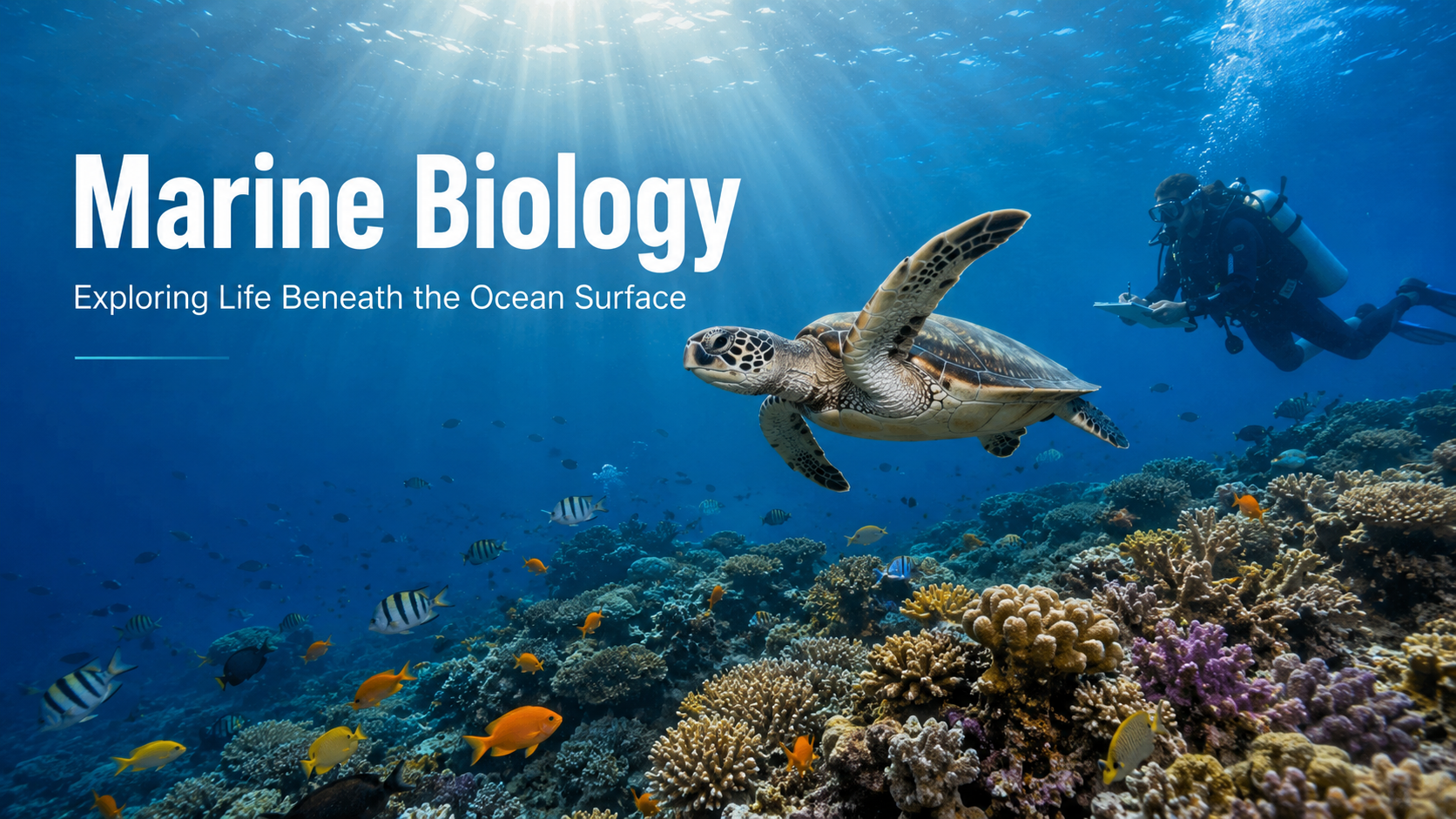
Marine biology is the scientific study of life in the ocean and other saltwater environments, from microscopic plankton drifting near the surface to whales moving across entire ocean basins. It is a field that connects biology, ecology, oceanography, chemistry, climate science, conservation, fisheries, and even advanced technology.
The ocean covers most of Earth’s surface, but much of it remains poorly understood. Beneath the waves are coral reefs, deep-sea trenches, kelp forests, mangroves, seagrass meadows, hydrothermal vents, open-ocean food webs, polar ecosystems, and countless species that play important roles in the planet’s health.
Marine biology is not only about studying beautiful animals. It is also about understanding how ocean life supports oxygen production, food security, climate regulation, medicine, biodiversity, coastal protection, and human economies. NOAA describes the ocean, coasts, and estuaries as home to diverse living things, from single-celled plankton to the largest animals on Earth. Source: NOAA Marine Life
Article Brief: Marine biology studies ocean life at every scale, from genes and cells to ecosystems and global ocean processes. Its value is growing as climate change, pollution, overfishing, habitat loss, and biodiversity decline reshape marine environments.
What Is Marine Biology?
Marine biology is the study of organisms that live in saltwater environments, including oceans, seas, estuaries, coastal wetlands, coral reefs, and deep-sea habitats. It includes marine animals, plants, algae, microbes, plankton, fish, invertebrates, seabirds, marine mammals, and entire ecological communities.
A marine biologist may study how coral reefs respond to warming seas, how whales communicate, how plankton influence the carbon cycle, how fish populations move, how deep-sea organisms survive without sunlight, or how pollution affects coastal ecosystems.
Marine biology is often closely connected with oceanography. Oceanography studies the physical, chemical, geological, and biological properties of the ocean. Marine biology focuses more specifically on living organisms and how they interact with their environment. NOAA notes that marine scientific research may include physical oceanography, marine chemistry, marine biology, fisheries research, and scientific drilling. Source: NOAA Marine Scientific Research
Why Marine Biology Matters
Marine biology matters because ocean life is deeply connected to life on land. Tiny phytoplankton help produce oxygen through photosynthesis. Fish and shellfish support food systems and coastal economies. Coral reefs and mangroves protect coastlines from storms. Marine organisms influence nutrient cycles, carbon storage, and global climate processes.
The ocean also supports extraordinary biodiversity. Smithsonian Ocean explains that marine organisms live in environments ranging from warm equatorial waters to icy polar regions, and from sunlit surface waters to the dark deep sea. Source: Smithsonian Ocean
From a scientific perspective, the ocean is a living laboratory. It helps researchers understand evolution, adaptation, symbiosis, disease, migration, reproduction, ecosystem resilience, and biological responses to environmental stress.
From a practical perspective, marine biology helps society make better decisions about fisheries, marine protected areas, coastal development, pollution control, climate adaptation, and biodiversity conservation.
Field Notes: The Ocean Is Not One Single Habitat
A common mistake is to imagine the ocean as one huge body of water with similar conditions everywhere. In reality, the ocean is a mosaic of highly different habitats. Light, temperature, pressure, salinity, oxygen, nutrients, depth, currents, and seafloor structure all shape where organisms can live.
National Geographic describes marine ecosystems as saltwater aquatic environments including the open ocean, deep-sea ocean, and coastal marine ecosystems, each with different physical and biological characteristics. Source: National Geographic Education
For example, a coral reef in shallow tropical water is bright, warm, and crowded with species. A deep-sea trench is dark, cold, high-pressure, and far from sunlight. A mangrove forest is shaped by tides, roots, mud, and brackish water. A polar sea is influenced by ice, seasonal sunlight, and cold-adapted organisms.
This diversity of habitats is one reason marine biology is so broad. Studying ocean life means studying many worlds within one ocean.
Coral Reefs: Biodiversity Hotspots Under Pressure
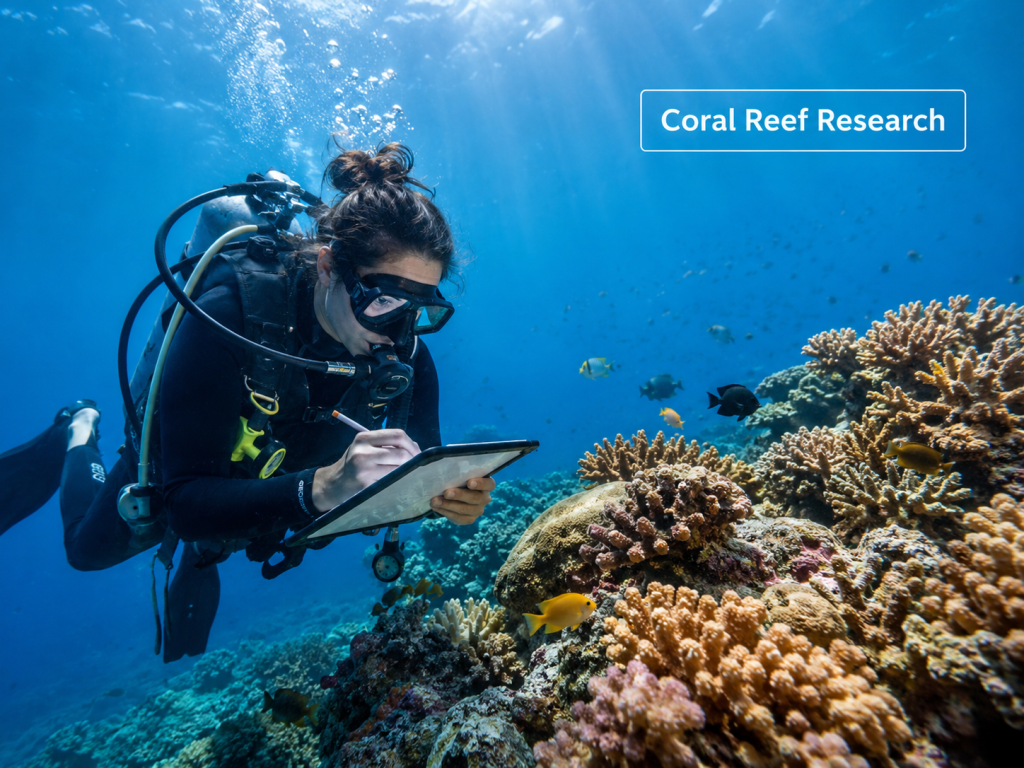
Coral reefs are among the most famous marine ecosystems. They are built by tiny coral animals that live in partnership with photosynthetic algae. This relationship allows reefs to grow in nutrient-poor tropical waters and support a stunning variety of marine life.
Reefs provide habitat for fish, crustaceans, mollusks, sponges, sea turtles, sharks, and countless other organisms. They also protect coastlines by reducing wave energy and support tourism and fisheries.
However, coral reefs are highly vulnerable to warming oceans, bleaching, pollution, sedimentation, overfishing, and ocean acidification. When water temperatures remain too high, corals can lose their symbiotic algae and turn white, a process known as bleaching. If stress continues, corals may die.
For marine biologists, coral reefs are important research sites because they reveal how biodiversity, symbiosis, climate stress, and ecosystem recovery interact.
The Deep Sea: Life Without Sunlight
The deep sea is one of the least explored regions on Earth. It begins below the sunlit zone and extends into cold, dark, high-pressure environments. For a long time, scientists assumed the deep ocean had little life. Modern exploration has proved otherwise.
Deep-sea ecosystems include strange and highly adapted organisms such as anglerfish, giant isopods, deep-sea corals, bioluminescent animals, tube worms, and microbes that can survive extreme conditions.
One of the most fascinating deep-sea habitats is the hydrothermal vent. These vents release mineral-rich hot fluids from the seafloor. Instead of relying on sunlight, many vent ecosystems are powered by chemosynthesis, where microbes use chemical energy to support food webs.
The deep sea is important for marine biology because it challenges assumptions about where life can exist. It also raises urgent questions about deep-sea mining, biodiversity protection, and the limits of human disturbance.
Plankton: The Small Organisms With Planetary Influence
Plankton are organisms that drift with ocean currents. They include phytoplankton, which photosynthesize, and zooplankton, which feed on other organisms. Although many plankton are microscopic, their ecological importance is enormous.
Phytoplankton form the base of many marine food webs. They are eaten by small zooplankton, which are then eaten by fish, whales, seabirds, and other marine animals. They also play a role in the carbon cycle by absorbing carbon dioxide through photosynthesis.
Because plankton respond quickly to changes in temperature, nutrients, light, and chemistry, marine biologists often study them as indicators of ocean health. Changes in plankton communities can affect fisheries, oxygen levels, harmful algal blooms, and climate feedbacks.
Research Lens: In marine biology, small organisms can have large consequences. A shift in plankton abundance may affect entire food webs, from tiny larvae to commercial fish and large whales.
Marine Mammals: Intelligence, Migration, and Conservation
Marine mammals include whales, dolphins, seals, sea lions, manatees, dugongs, sea otters, and polar bears. These animals breathe air, nurse their young, and show a wide range of adaptations for life in marine environments.
Marine biologists study marine mammals to understand communication, migration, diving physiology, feeding behavior, reproduction, social structure, and conservation threats. For example, whale songs, dolphin echolocation, seal diving behavior, and sea otter feeding patterns all provide insight into how animals adapt to ocean life.
Many marine mammals face threats from ship strikes, entanglement in fishing gear, underwater noise, habitat change, pollution, and climate-driven shifts in prey. Conservation biology is therefore a major part of marine mammal research.
Fisheries Science and Sustainable Seafood
Marine biology also plays an important role in fisheries science. Fisheries researchers study fish populations, reproduction rates, migration patterns, habitat needs, food webs, and the impact of fishing pressure.
Sustainable fisheries require good data. Scientists need to estimate how many fish can be harvested without causing long-term population decline. This involves stock assessments, tagging studies, genetic analysis, ecosystem modeling, and monitoring of fishing activity.
Overfishing can reduce fish populations, disrupt food webs, and damage ecosystems. On the other hand, well-managed fisheries can support food security, livelihoods, and healthy oceans. Marine biology helps balance ecological protection with human needs.
Marine Microbes: The Invisible Engine of the Ocean
Marine microbes are often invisible to the naked eye, but they are essential to ocean function. They include bacteria, archaea, viruses, fungi, and microscopic algae. These organisms drive nutrient cycling, decomposition, nitrogen fixation, carbon cycling, and chemical transformations in seawater.
Microbes can also form partnerships with larger organisms. Coral health, sponge metabolism, fish digestion, and deep-sea vent ecosystems can all depend on microbial communities.
Modern DNA sequencing has transformed marine microbiology. Scientists can now study microbial communities by analyzing environmental DNA from seawater, sediment, and host organisms. This has revealed a hidden world of biodiversity and biological activity.
Tools Marine Biologists Use
Marine biology has become increasingly technology-driven. Traditional field observation is still important, but modern research often uses advanced tools to collect data across large and difficult environments.
| Research Tool | How It Helps Marine Biology |
|---|---|
| Remotely Operated Vehicles | Explore deep-sea habitats and collect samples without sending humans underwater. |
| Autonomous Underwater Vehicles | Map seafloor areas, measure water conditions, and survey marine habitats. |
| Satellite Remote Sensing | Tracks sea surface temperature, chlorophyll, ocean color, and large-scale ocean changes. |
| Environmental DNA | Detects species from genetic material left in water or sediment. |
| Animal Tags | Reveals migration routes, diving behavior, feeding zones, and habitat use. |
These tools allow scientists to study places that are too deep, too remote, too dangerous, or too large for traditional observation alone. They also help marine biologists understand long-term trends rather than isolated snapshots.
Climate Change and Marine Life
Climate change is one of the biggest challenges facing marine ecosystems. Rising ocean temperatures, ocean acidification, oxygen loss, sea-level rise, changing currents, and extreme marine heatwaves are already affecting marine life.
Warming waters can shift species distributions, pushing fish and plankton toward cooler regions. Ocean acidification can make it harder for corals, shellfish, and some plankton to build calcium carbonate shells and skeletons. Deoxygenation can reduce suitable habitat for fish and other animals.
Climate impacts are not uniform. Some species may adapt or move, while others may decline. Some ecosystems may show resilience, while others may cross ecological thresholds. Marine biologists study these changes to help predict future risks and guide conservation strategies.
Pollution, Plastics, and Human Impact
Marine biology also examines how human activities affect ocean life. Pollution can come from plastics, oil spills, chemicals, sewage, agricultural runoff, heavy metals, noise, and abandoned fishing gear.
Plastic pollution is especially visible, but chemical and noise pollution can be equally serious. Microplastics may be consumed by plankton, fish, seabirds, turtles, and marine mammals. Excess nutrients from runoff can fuel harmful algal blooms and low-oxygen dead zones.
Underwater noise from ships, construction, and industrial activity can interfere with marine animals that rely on sound for communication, navigation, and feeding. This is especially important for whales and dolphins.
Understanding these impacts requires careful fieldwork, laboratory testing, long-term monitoring, and policy collaboration.
Marine Protected Areas and Conservation Biology
Marine protected areas are zones where human activity is managed to protect ecosystems, species, habitats, or cultural resources. They can help conserve biodiversity, rebuild fish populations, protect spawning areas, and preserve vulnerable habitats.
However, not all protected areas are equally effective. Strong conservation outcomes depend on good design, enforcement, local support, ecological connectivity, and long-term monitoring. A protected area on paper is not the same as a protected ecosystem in practice.
The UN Decade of Ocean Science for Sustainable Development, running from 2021 to 2030, aims to stimulate ocean science and knowledge generation to reverse the decline of the ocean system and support sustainable development. Source: UNESCO Ocean Decade
Marine biology provides the scientific evidence needed to design better conservation policies and evaluate whether they work.
Careers in Marine Biology
Marine biology careers can be highly diverse. Some marine biologists work at universities, research institutes, government agencies, aquariums, conservation organizations, fisheries departments, environmental consulting firms, or marine technology companies.
Common roles include marine ecologist, fisheries scientist, coral reef researcher, marine mammal scientist, ocean conservation specialist, environmental impact analyst, aquaculture researcher, marine microbiologist, and science communicator.
The field can be competitive, and many roles require strong scientific training. Useful skills include biology, statistics, data analysis, GIS, programming, diving, field sampling, taxonomy, molecular biology, scientific writing, and environmental policy.
For students, marine biology can be exciting, but it is important to understand that the work is not always tropical field trips. It may involve long hours of data cleaning, lab analysis, grant writing, statistical modeling, and careful observation. The ocean is beautiful, but the science is rigorous.
The Future of Marine Biology
The future of marine biology will be shaped by technology, climate change, conservation needs, and global cooperation. New tools such as environmental DNA, AI-assisted species identification, ocean robots, remote sensing, acoustic monitoring, and big-data models are changing how researchers study marine life.
At the same time, the urgency is increasing. Marine ecosystems face pressures from warming, acidification, pollution, overfishing, habitat loss, and expanding industrial activity. Marine biology will be essential for understanding these changes and helping societies respond.
Future research will likely focus more on ecosystem resilience, restoration ecology, deep-sea biodiversity, blue carbon habitats, sustainable aquaculture, ocean health indicators, and the connection between marine biodiversity and climate regulation.
In professional terms, marine biology is moving from descriptive science toward predictive and applied science. Researchers are not only asking “what lives there?” They are also asking “how is it changing, why does it matter, and what can we do about it?”
FAQ: Marine Biology
Is marine biology only about dolphins and whales?
No. Marine biology includes all ocean life, from microbes and plankton to fish, corals, algae, invertebrates, seabirds, reptiles, and marine mammals.
Is marine biology the same as oceanography?
Not exactly. Oceanography studies the ocean as a whole, including physical, chemical, geological, and biological processes. Marine biology focuses mainly on living organisms and ecosystems.
Why is plankton important?
Plankton form the base of many marine food webs and influence oxygen production, carbon cycling, fisheries, and ocean health.
What threats do marine ecosystems face?
Major threats include climate change, overfishing, plastic pollution, chemical pollution, habitat destruction, ocean acidification, invasive species, and underwater noise.
Can marine biology help protect the ocean?
Yes. Marine biology provides evidence for conservation, fisheries management, pollution control, habitat restoration, protected areas, and climate adaptation strategies.
Final Assessment
Marine biology is one of the most important scientific fields for understanding the ocean and protecting the future of life on Earth. It reveals how marine organisms survive, interact, evolve, and respond to changing environments.
The field is scientifically rich because it covers everything from microscopic plankton to global migration, from coral symbiosis to deep-sea adaptation, and from fisheries to climate regulation. It is also socially important because human well-being is closely tied to healthy marine ecosystems.
As the ocean changes, marine biology will become even more essential. The next generation of ocean science will depend on strong research, better technology, international cooperation, and a clearer understanding that the ocean is not separate from human life. It is part of the system that keeps the planet alive.