AI Protein Design: How Artificial Intelligence Is Rewriting the Building Blocks of Biology
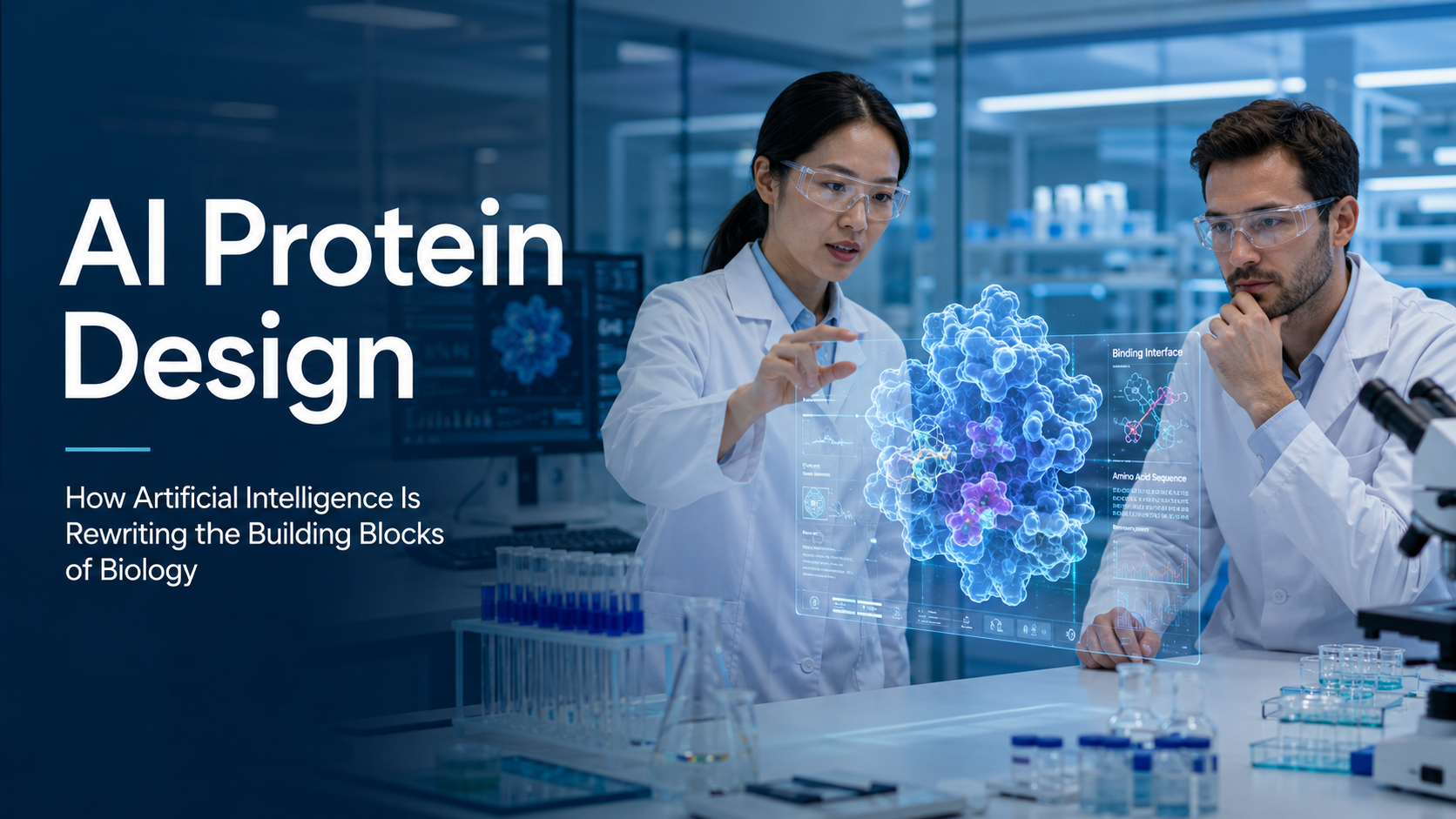
AI protein design is one of the most exciting frontiers in biotechnology, medicine, and synthetic biology. Proteins are the molecular machines of life. They help cells communicate, fight infections, digest food, repair tissue, transport oxygen, build structures, and control countless biological processes. For decades, scientists have tried to understand how proteins fold, how they function, and how they can be engineered for useful purposes.
Today, artificial intelligence is making that challenge more achievable. AI systems can help predict protein structures, design new protein sequences, model molecular interactions, create enzymes, optimize antibodies, and explore biological possibilities that would be extremely difficult to test manually. Instead of only studying proteins found in nature, scientists can now begin designing new proteins with specific shapes and functions.
The importance of this field became especially clear when the 2024 Nobel Prize in Chemistry was awarded to David Baker for computational protein design, and to Demis Hassabis and John Jumper for developing AlphaFold, an AI model that predicts protein structures from amino acid sequences. The Nobel Prize organization described these discoveries as having enormous potential for chemistry, biology, and medicine. Source: Nobel Prize Chemistry 2024
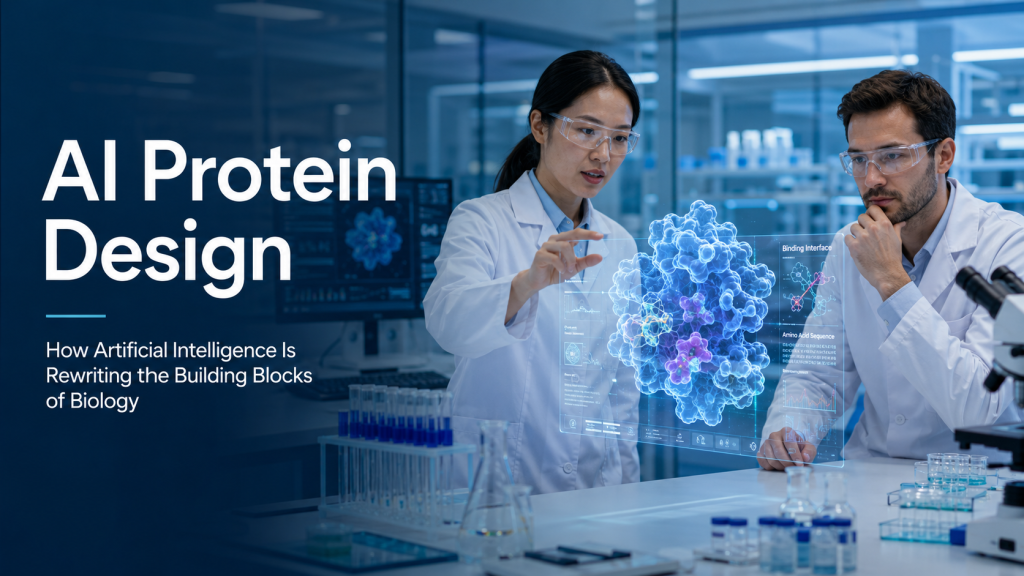
What Is AI Protein Design?
AI protein design refers to the use of artificial intelligence, machine learning, deep learning, diffusion models, generative AI, and computational biology tools to create or optimize proteins. These systems can help researchers design amino acid sequences that fold into desired three-dimensional structures or perform specific biological functions.
A protein is made from a chain of amino acids. The order of these amino acids determines how the protein folds, and the folded shape strongly influences what the protein does. This relationship between sequence, structure, and function is one of the central problems in biology.
Traditional protein engineering often relied on trial and error. Scientists would modify natural proteins, test many variants, and gradually improve performance. AI changes this process by helping researchers search through enormous design spaces more efficiently. It can generate candidate proteins, predict their structures, evaluate potential functions, and help scientists decide which designs should be tested in the laboratory.
Why AI Protein Design Matters
AI protein design matters because proteins are involved in almost every major process in living organisms. If scientists can design proteins more accurately, they may be able to create better medicines, more effective vaccines, improved enzymes, new biomaterials, advanced diagnostics, and environmentally useful biotechnologies.
For example, a designed protein might bind tightly to a disease-related target, helping researchers develop a new therapy. Another protein might act as a custom enzyme that breaks down plastic waste or supports greener chemical manufacturing. A different protein could become part of a biosensor that detects disease markers, toxins, or environmental pollutants.
AI protein design is also important because biological design space is enormous. The number of possible protein sequences is far beyond what humans could test experimentally. AI does not remove the need for laboratory validation, but it can help narrow the search and identify candidates that are more likely to work.
1. AI Helps Predict Protein Structures
One of the most important breakthroughs behind AI protein design is protein structure prediction. For many years, predicting how a protein folds from its amino acid sequence was considered one of biology’s most difficult problems. The shape of a protein determines how it interacts with other molecules, so structure prediction is essential for understanding function.
AlphaFold, developed by Google DeepMind, became a major milestone because it can predict the three-dimensional structure of proteins from amino acid sequences. Google DeepMind says AlphaFold has predicted more than 200 million protein structures, covering nearly all catalogued proteins known to science, and the AlphaFold Protein Structure Database makes this information widely available to researchers. Source: Google DeepMind AlphaFold
Structure prediction does not automatically solve protein design, but it provides a powerful foundation. If researchers can predict whether a designed sequence will fold into the intended structure, they can evaluate designs before spending time and money on laboratory experiments.
2. AI Can Generate New Protein Structures
Beyond predicting natural protein structures, AI can also help generate entirely new protein structures. This is where AI protein design becomes especially powerful. Instead of starting with an existing protein and making small changes, researchers can ask AI systems to create new shapes that may not exist in nature.
One important tool in this area is RFdiffusion, an open-source method for generating protein structures. The RFdiffusion project describes it as a method for structure generation that can work with or without conditional information, such as a motif or target. Source: RosettaCommons RFdiffusion
A research paper published in Nature described RFdiffusion as a major improvement in de novo protein design, showing that it can generate diverse designs that are predicted accurately by AlphaFold2. Source: Nature RFdiffusion paper
This type of generative protein design can support many applications, including therapeutic binders, enzymes, vaccine components, molecular scaffolds, and nanoscale materials.
3. AI Supports Inverse Protein Folding
Protein folding usually asks: given an amino acid sequence, what structure will it form? Inverse protein folding asks the opposite question: given a desired structure, what amino acid sequence could create it?
This is a core challenge in AI protein design. If researchers want a protein with a specific shape, they need to find a sequence that will fold into that shape reliably. AI models can help generate candidate sequences for target structures and evaluate whether those sequences are likely to be stable.
A 2025 review on artificial intelligence methods for protein folding and design explains that machine learning has transformed protein structure prediction and design, with models such as AlphaFold2, RoseTTAFold, and ESMFold influencing innovations in protein design methods. Source: Current Opinion in Structural Biology review
Inverse folding is especially useful when combined with laboratory testing. AI can propose sequences, scientists can synthesize the best candidates, and experimental data can then improve the next round of designs.
4. AI Protein Design Can Create Therapeutic Binders
One of the most promising medical applications of AI protein design is the creation of therapeutic binders. These are proteins designed to attach to a specific biological target, such as a disease-related protein, receptor, or viral surface protein.
Protein binders can potentially block harmful interactions, activate useful pathways, deliver drugs, support diagnostics, or help the immune system recognize disease. Compared with traditional small-molecule drugs, designed proteins may offer high specificity and flexible biological functions.
In drug discovery, AI-designed binders may help researchers move faster from target selection to candidate testing. Instead of screening huge libraries randomly, AI can generate proteins that are shaped to match a target surface. However, these designs must still be tested for binding strength, stability, safety, manufacturability, and biological activity.
5. AI Can Improve Enzyme Design
Enzymes are proteins that speed up chemical reactions. They are essential in biology and extremely useful in industry. Enzymes are used in medicine, food production, textiles, detergents, biofuels, agriculture, and chemical manufacturing.
AI protein design can help scientists create or optimize enzymes for specific tasks. For example, researchers may want enzymes that work at higher temperatures, operate in unusual chemical conditions, break down pollutants, or produce valuable compounds more efficiently.
Designing enzymes is difficult because function depends not only on overall shape, but also on precise active-site geometry, flexibility, stability, and interactions with substrates. AI can help explore enzyme variants and predict which changes may improve performance.
In the long term, AI-designed enzymes could support greener manufacturing by replacing harsh chemical processes with cleaner biological reactions.
6. AI Protein Design May Improve Vaccines
Vaccines often depend on presenting the immune system with the right molecular target. Protein design can help create vaccine components that display key parts of viruses, bacteria, or other pathogens in ways that produce stronger immune responses.
AI can support vaccine design by modeling protein structures, designing stable antigen scaffolds, improving immune target presentation, and helping researchers understand how antibodies may bind to a vaccine candidate.
For future outbreaks, faster protein design tools could help scientists respond more quickly. AI may help identify important pathogen proteins, design candidates, and evaluate immune-relevant structures before laboratory testing begins.
This does not mean vaccines can be created instantly. Safety testing, clinical trials, manufacturing, and regulatory review remain essential. But AI protein design can support the early discovery and design stages.
7. AI Protein Design Supports Materials Science
Proteins are not only useful in medicine. They can also be used to build advanced materials. Natural proteins already form strong fibers, shells, adhesives, and nanoscale structures. AI may help scientists design new protein-based materials with useful properties.
Examples could include biodegradable materials, nanoscale cages, molecular delivery systems, sensors, self-assembling structures, or protein-based coatings. These materials may be valuable in medicine, electronics, environmental technology, and manufacturing.
The Nobel Prize organization noted that computational protein design has opened possibilities for creating proteins with new functions, including applications in pharmaceuticals, vaccines, nanomaterials, and sensors. Source: Nobel Prize popular information
8. AI Protein Design and Synthetic Biology
Synthetic biology aims to design and build biological systems for useful purposes. AI protein design fits naturally into this field because proteins are the functional components of many biological systems.
Researchers may use AI-designed proteins to build biosensors, engineer cells, create new metabolic pathways, improve gene-editing tools, or develop biological circuits. These applications could support healthcare, agriculture, environmental monitoring, and sustainable manufacturing.
For example, a designed protein could help a cell detect a chemical signal and respond by producing a useful molecule. Another designed protein might improve the efficiency of a microbial production system. As AI tools improve, synthetic biology may become more programmable and predictable.
9. The AI Protein Design Workflow
A typical AI protein design workflow may begin with a design goal. Researchers first define what they want the protein to do, such as binding a target, catalyzing a reaction, stabilizing a structure, or forming a material.
Next, AI tools may generate candidate protein structures or sequences. These candidates are evaluated using computational models for stability, folding, binding, solubility, and other properties. The best candidates are selected for laboratory testing.
In the lab, scientists synthesize genes, express proteins in cells, purify them, and test whether they behave as expected. Experimental results are then used to refine the model or guide another round of design.
This cycle of design, prediction, synthesis, testing, and learning is one of the reasons AI can accelerate protein engineering. The goal is not to replace experiments, but to make experiments more focused and informative.
10. Challenges of AI Protein Design
Although AI protein design is powerful, it still faces important challenges. The first challenge is that protein function is more complex than protein structure. A model may predict that a sequence folds correctly, but the protein may still fail to perform the desired function in a real biological environment.
Another challenge is dynamics. Proteins are not rigid objects. They move, flex, change shape, and interact with water, membranes, ions, metabolites, and other molecules. Capturing these dynamic behaviors is difficult for AI models.
Laboratory validation is also essential. AI-generated designs can look promising on a computer, but they must be tested for stability, expression, binding, activity, immunogenicity, toxicity, and manufacturability.
Data quality is another issue. AI systems depend on training data, and biological data can be incomplete, biased, or inconsistent. Models may perform well on familiar design problems but struggle in new biological contexts.
Ethical and Safety Considerations
AI protein design also raises ethical and safety questions. Because proteins can affect living systems, researchers must consider how designed proteins are used, tested, shared, and controlled. Safety is especially important when designing proteins with biological activity.
Responsible AI protein design requires careful laboratory practices, biosafety review, secure data handling, transparent reporting, and appropriate regulation. Scientists and companies must balance innovation with risk management.
There are also questions about access. AI protein design tools could create enormous benefits, but access to advanced platforms, data, computing power, and laboratory infrastructure may be uneven. Ensuring that the technology supports broad scientific progress will be important.
The Future of AI Protein Design
The future of AI protein design will likely move toward more accurate models, better functional prediction, stronger integration with automated laboratories, and broader real-world applications. Instead of only predicting structure, future systems may better predict activity, stability, binding, immune response, manufacturability, and behavior inside living organisms.
Generative AI models may make it easier to design proteins from natural language or high-level goals. Researchers may eventually describe a desired function, and AI systems may propose structures, sequences, and experimental plans.
AI protein design may also become more connected with AI drug discovery, precision medicine, biomaterials, climate technology, and industrial biotechnology. As the field matures, the most valuable tools will be those that combine computational creativity with experimental reliability.
Final Thoughts
AI protein design is changing how scientists understand and engineer the molecules of life. By combining artificial intelligence, structural biology, chemistry, and laboratory testing, researchers can design proteins with new shapes, functions, and applications.
The field has already achieved major milestones, from AlphaFold’s protein structure predictions to generative tools such as RFdiffusion. These advances suggest a future where scientists can design medicines, enzymes, vaccines, sensors, and materials more intelligently.
However, AI protein design is not magic. It still depends on high-quality data, careful experiments, biological insight, safety review, and responsible use. The most important progress will come from AI and scientists working together to create proteins that solve real problems in health, industry, and the environment.