Qing China Did Not Turn Away from the Sea: The Maritime History Hidden Behind Zheng He
When people think of China and the sea, the first name that often comes to mind is Zheng He.
That is hardly surprising. In the early 15th century, the Ming admiral led seven great voyages across the Indian Ocean, reaching Southeast Asia, South Asia, the Middle East and even the coast of East Africa. The scale of those expeditions was so impressive that Zheng He has long stood as the most dazzling symbol of China’s maritime past. He is often compared with Christopher Columbus or Vasco da Gama, as if he embodied a lost Chinese spirit of oceanic ambition and outward-looking exploration.
But this is also where the problem begins.
Zheng He’s image is so brilliant that the maritime history after him often appears almost silent. Many people assume that, after Zheng He, China simply turned away from the sea. This view becomes especially strong when we speak of the Qing dynasty. The empire’s attention seems to shift entirely inland: to the grasslands, the frontiers, the Great Wall, cavalry warfare and continental administration. In this narrative, the Qing was a classic land-based empire. It no longer looked to the ocean, and it no longer understood the sea. When Western warships arrived in the 19th century, the Qing defeat then seems to have a simple explanation: China lacked maritime consciousness and had no real naval power.
Yet this story is too neat, and far too easy.
An empire with such a long coastline could never truly remove the sea from its world. Waves broke every day against the shores of Fujian, Guangdong, Zhejiang and Taiwan. Fishermen made their living from the water. Merchants waited for ships and cargo. Smugglers, pirates, local officials and foreign traders all searched for opportunity in the same maritime world. The Qing may not have continued Zheng He’s grand expeditions, but that does not mean it abandoned the sea.
The more important question is not whether the Qing cared about the ocean. It is how the Qing lived with it.
The Sea Was Not a Frontier That Could Be Fully Conquered
For an empire, land is relatively easy to understand. It can be measured, divided, taxed, garrisoned and registered. Mountains, roads, walls and relay stations can all be folded into an administrative system.
The sea is different.
The sea is fluid. It has no stable borders and obeys no human command. A calm surface today may become a storm tomorrow. A merchant ship anchored in port may become part of a smuggling network the next day. A fisherman protected by the state in one moment may be forced to pay protection money to pirates in the next. Storms, merchants, fishermen, pirates and smugglers all operated in spaces where state authority could never fully reach.
This is why every maritime empire has had to face the same reality: the sea brings wealth, but it also brings disorder. It connects nations and separates them at the same time. It opens trade routes, but it also blurs legal boundaries. This was true for Britain, Spain and Portugal. It was also true for the Qing.
The Qing relationship with the sea was not a simple matter of conquest or retreat. It was a long negotiation. The empire tried to control the ocean, yet was constantly constrained by the ocean’s uncertainty. The court wanted the profits of maritime trade, but feared the disorder that the maritime world could unleash.
After Zheng He, Did Qing China Really Stop Looking Seaward?
Zheng He’s voyages remain one of the most powerful maritime memories in Chinese history. But if we measure China’s relationship with the sea only through Zheng He, we fall into a trap: we begin to assume that only grand fleets, long-distance voyages and overseas displays of power count as real maritime history.
But maritime history does not exist only in spectacular expeditions. It also exists in ports, customs houses, smuggling routes, pirate fleets, temples, fishing boats, banquets and everyday life.
It is true that the Qing did not send out treasure fleets like Zheng He’s. It is also true that the Qing empire of the 18th century did not build an oceanic naval system like those of European colonial powers. Yet Qing coastal society never separated itself from the sea. Officials had to handle customs and trade. Naval forces had to patrol against pirates. Local communities had to live with storms and shipwrecks. Merchants depended on ports and shipping. Wealthy households brought the ocean to their tables through shark fin, sea cucumber, abalone and other marine delicacies.
In other words, Qing China did not stop looking at the sea. It simply lived with the sea in a different way.
Its maritime world was no longer the dramatic world of Zheng He’s voyages. It was more complicated, more ordinary, and much harder to reduce to a simple story.
From Maritime Bans to Canton: How the Qing Managed Overseas Trade
When the Qing took power, it inherited not only the throne in Beijing but also the coastal problems left behind by the late Ming. Taiwan, in particular, remained a serious concern because of the Zheng family’s power there. To weaken the Zheng regime and cut off the links between Ming loyalists and overseas trade, the early Qing court imposed harsh maritime bans.
These policies devastated coastal communities. Many villages were forced to move inland. Houses were destroyed. Boats were burned. People who had long depended on fishing, shipping and trade were suddenly torn away from their livelihoods. The court hoped that, by cutting people off from the sea, it could also cut rebel forces off from the outside world.
But the ocean does not stop moving because of an imperial order.
Goods continued to circulate. Foreign merchants still wanted to trade with China. Coastal residents still needed to survive. The bans did not truly seal off the sea. Instead, they encouraged the growth of smuggling networks. Where official trade was prohibited, underground trade flourished. Where legal exchange was blocked, grey-market commerce filled the gap.
By 1683, after the Qing conquered Taiwan and defeated the Zheng regime, the court had gradually come to understand that completely closing the sea was unrealistic. The empire could not confront the ocean through prohibition alone. It had to learn how to manage it.
Maritime trade was therefore brought back into the system. Government offices were established, customs duties were collected, shipping rules were formalised, and a form of commerce once treated as a threat to dynastic security was gradually transformed into an important source of revenue.
This logic of control was most clearly expressed in the Canton System.
After 1757, Canton became the most important window for Qing foreign trade. In traditional Western narratives, the Canton System is often described as a narrow, backward and short-sighted “one-port trade” arrangement. But from another perspective, it was not simply a closed door. It was also an institutional attempt to manage the risks of maritime commerce.
Foreign ships anchored at Whampoa. Customs officials boarded vessels to inspect cargo. Cohong merchants handled business with foreign traders. Translators, brokers, credit networks and ritual rules all helped sustain the system. Tea, silk and porcelain flowed out of Canton, while silver from Japan, the Americas and Southeast Asia entered China.
The Canton System was a compromise. The Qing court wanted the wealth that trade could bring, but it did not want foreigners moving freely into the interior. It needed the world market, but feared maritime disorder. Canton therefore became a carefully managed boundary: open and restricted at the same time, welcoming wealth while guarding against chaos.
This was the central tension of Qing maritime policy.
Pirates, Smuggling and the Limits of Imperial Power
If Canton represented the Qing attempt to bring maritime trade into order, pirates and smugglers constantly reminded the empire that the sea would never fully submit to order.
Along the Qing coast, the line between commerce and crime was not always clear. A person could be treated as a merchant in one place and condemned as a smuggler in another. Goods such as salt, silk and tea were not inherently criminal. They became illegal only when they moved outside official channels. For many coastal residents, smuggling was not necessarily a criminal choice. Sometimes it was simply a way to survive.
Cai Qian was a classic figure from this grey maritime world.
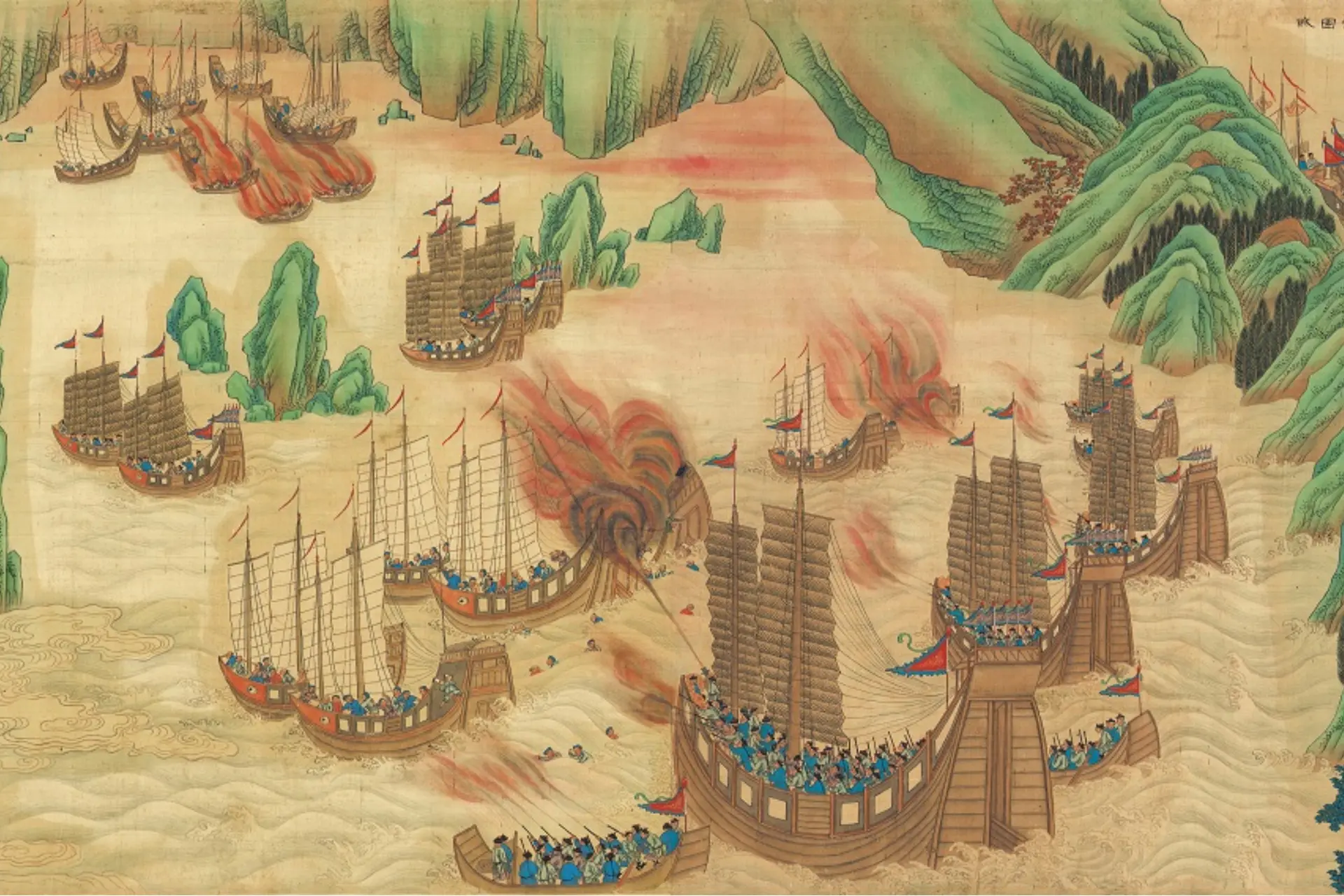
Active around Fujian and Guangdong in the late 18th century, Cai commanded fast-moving fleets. He raided coastal towns, collected protection money, traded with merchants and sometimes cooperated secretly with local powers. Official histories naturally described him as a pirate and rebel. Yet in coastal memory, figures like Cai were often remembered in more complicated ways. They were predators, but also providers of a kind. They were feared, but they could also be relied upon.
Cai’s career shows that Qing power at sea did exist, but it was never complete. Officials could issue orders, send out naval forces and post proclamations. Yet in the actual maritime world, authority often had to compromise with local interests, commercial needs and armed networks.
Even more legendary was Zheng Yi Sao.
In 1807, she took control of her husband’s fleet and turned it into a vast maritime organisation. She commanded hundreds of vessels and tens of thousands of followers. She imposed strict discipline, regulated the distribution of plunder, punished those who disobeyed orders and fought Qing naval forces for years. Far from being quickly crushed, she forced the Qing court into negotiation.
The fact that a woman could rise to such extraordinary power in the Qing maritime world tells us something important about the sea itself. Social order, gender hierarchy and bureaucratic authority did not always operate at sea in the same way they did on land. The ocean created danger, but it also created opportunity. It exposed the weaknesses of the Qing state while opening routes to power that land society rarely offered.
The stories of Cai Qian and Zheng Yi Sao are not merely pirate legends. They show that Qing maritime governance was not a simple matter of strength or weakness. It was a process of constant adjustment. The empire had authority, but that authority was conditional, negotiable and repeatedly exposed to forces it could never fully control.
Mazu, Shipwrecks and the Spiritual World of Coastal Communities
For the government, the sea meant customs revenue, trade, piracy and coastal defence. For ordinary coastal residents, however, the sea first meant livelihood — and danger.
Fishermen lived by the sea. Merchants grew rich from it. Sailors crossed it for work and opportunity. But the same sea could swallow ships, cargo and human lives in a single night. A calm morning could turn into a violent afternoon. One sudden storm could snap a mast and send an entire vessel into the waves.
This is why religion was never a mere ornament in coastal society. It was a way for people to understand the ocean, confront fear and give meaning to death.
Mazu worship was the most important example.
According to tradition, Mazu was born Lin Moniang in Fujian. She was believed to protect sailors, calm storms and guide lost ships. As people from Fujian, Guangdong, Zhejiang, Taiwan and overseas Chinese communities migrated and traded across the seas, Mazu worship spread with them. By the Qing period, Mazu temples could be found throughout the southeastern coast and far beyond, even in Chinese communities across Southeast Asia.
In a coastal port, the red walls of a Mazu temple might be among the first things a traveller saw. Incense filled the air. Divine images were draped in silk. Before setting out to sea, fishermen offered rice, paper boats or incense. Merchants who returned safely from Manila, Batavia or other overseas ports might pay for repairs to a temple or leave a plaque of gratitude. The sound of waves, rituals and markets blended into the daily rhythm of coastal life.
Mazu was not the only sea deity. Dragon Kings governed wind and rain. Guanyin was invoked by fishermen seeking rescue and compassion. Some local shrines honoured sailors and ancestors who had died at sea. Different ports had different traditions, and different communities practised different rituals. No single deity ruled the ocean completely, just as no single government could completely control it.
Shipwrecks revealed the importance of this spiritual world with particular force. Local gazetteers from Guangdong and Fujian often recorded fleets scattered by storms, corpses washed ashore and cargo lost beneath the waves. In response, survivors and villagers buried the dead, offered food and incense, and raised memorial tablets or steles. In some places, major shipwrecks even led to the construction of temples.
These rituals were not simply superstition. They were a way of rebuilding social order. They transformed inexplicable disaster into something that could be remembered, mourned and collectively endured. Human beings were small before the sea. Through ritual, they created a bearable meaning for an uncontrollable world.
Qing officials sometimes viewed popular religion with suspicion, fearing heterodoxy or local mobilisation. Yet local officials often supported temples and rituals because they helped maintain social order. By funding a shrine, an official could display both piety and benevolence, while drawing local society back into the symbolic world of the dynasty.
The Qing relationship with the sea therefore did not exist only in customs houses and naval patrols. It also lived in Mazu temples, incense smoke, ritual offerings, memories of shipwrecks and local ceremonies.
Shark Fin, Sea Cucumber and Abalone: The Sea on the Imperial Table
There was another, often overlooked dimension to the Qing encounter with the sea: the dining table.
The ocean did not bring only trade and danger. It also produced desire. Fishermen risked their lives to harvest marine creatures. Merchants dried, packed and transported them. Cooks transformed them into delicacies. Finally, officials, merchants and wealthy families consumed them in brightly lit banquet halls.
Shark fin is the most famous example.
For fishermen, sharks were dangerous predators. But in elite kitchens, their fins were transformed into expensive ingredients. Shark fin was not valued for a strong flavour of its own. Its prestige lay in its texture and in its ability to absorb the essence of other broths and ingredients. For precisely that reason, it became a food that demanded refined appreciation.
At a banquet in Canton, Suzhou or Beijing, a bowl of shark fin soup was not merely a dish. It was a statement of status. It showed that the host had wealth, connections and the ability to command an entire supply chain: from dangerous capture at sea, to inland transport, to elaborate preparation in the kitchen. Banqueting itself was never just about eating. It was a stage for sociability, alliance-building, status display and the maintenance of hierarchy.
Sea cucumber, abalone and fish maw worked in similar ways. Harvested from coastal waters or more distant seas, they were dried, transported and eventually served at elite urban tables. Behind every delicacy lay a chain of divers, fishermen, port merchants, river transporters, cooks and guests.
This tells us that the sea entered the Qing empire not only through war and trade, but also through taste. It entered daily life through luxury consumption and became part of social hierarchy.
What the elites consumed was not just shark fin or abalone. They consumed the symbolic transformation of maritime risk. Dangerous labour, distant ecologies, complex transport and high prices were all converted into taste, wealth and status at the banquet table.
In this sense, Qing China did not merely touch the sea. It absorbed the sea into its social order.
The Qing Did Not Abandon the Sea. It Simply Did Not Embrace It in Zheng He’s Way
If we look only for grand ocean-going fleets after Zheng He, it is easy to conclude that China abandoned the sea after the Ming.
But if we shift our attention from treasure fleets to coastlines, ports, fishing boats, temples and banquet tables, the story changes completely.
The Qing did not simply turn away from the ocean. It tried to seal the sea through maritime bans, failed, and then brought trade back under regulation. It used the Canton System to control foreign merchants and customs revenue, while also drawing China deeply into the global economy. It sent naval forces against pirates, but had to confront the grey zones of maritime identity. It tolerated, and sometimes used, Mazu worship to fold the uncertainties of the sea into a ritual order shared by local communities and imperial authority. Its elites turned shark fin, sea cucumber and abalone into symbols of taste, rank and power.
None of this looks like Zheng He’s magnificent voyages. But it is maritime history all the same.
More importantly, it reminds us that the sea has never been a passive backdrop to history. It is not an empty space waiting to be conquered by human beings. It shapes institutions, unsettles order, creates wealth and takes lives. It blurs the boundaries between legality and crime, trade and survival, faith and governance, appetite and power.
The Qing maritime experience tells us that an empire does not need to send fleets across the ocean in order to have a deep relationship with the sea. It may be tied to the ocean through customs duties, smuggling routes, pirate networks, temples, shipwrecks and banquets.
After Zheng He, China did not fall silent. Its maritime history simply stopped appearing in the form of giant ships and spectacular expeditions. Instead, it hid in Canton’s customs records, in Fujian’s Mazu temples, in Guangdong’s pirate stories, and in the porcelain bowls of banquets in Suzhou and Beijing.
So rather than asking why the Qing did not continue Zheng He’s voyages, we might ask a better question:
How did the Qing maintain order, extract wealth, soothe fear and live with uncertainty in a maritime world that could never be fully conquered?
That question may bring us much closer to the real maritime history of Qing China.