
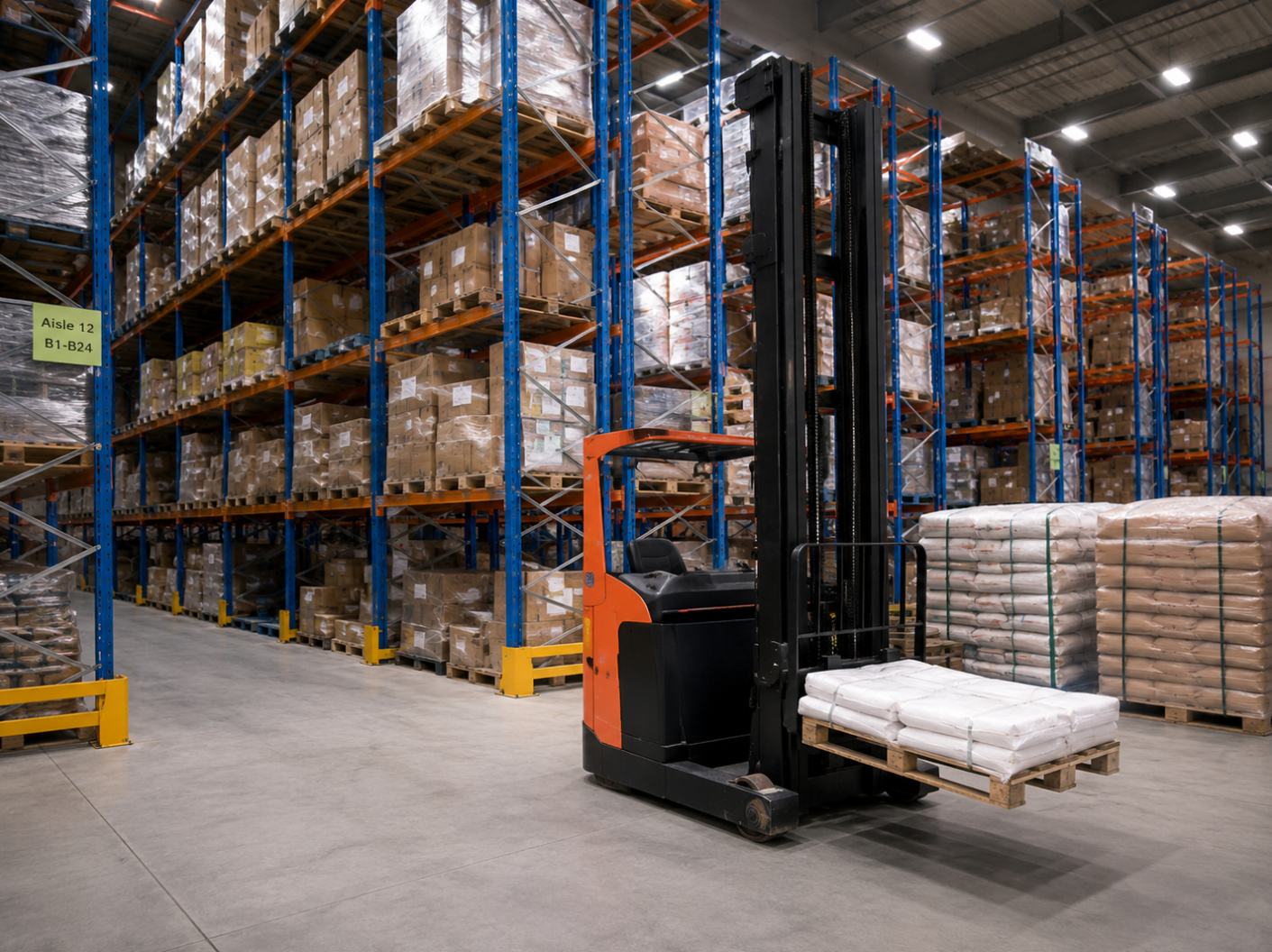
Forklift Warehouse Guide: Improving Safety, Efficiency, and Logistics Performance
Article Summary: Forklift warehouses play a central role in modern logistics, helping businesses store, move, organize, and distribute goods efficiently. Forklifts make it possible to handle heavy loads, move inventory quickly, use vertical storage space, and support high-volume warehouse operations. However, these benefits come with real challenges, including equipment maintenance, operator training, space optimization, safety management, and adapting to fast-changing demand. A well-managed forklift warehouse depends on clear traffic flow, trained operators, regular inspections, smart racking systems, inventory visibility, clean work areas, and strong safety procedures. As automation, data analytics, e-commerce fulfillment, and smarter warehouse systems continue to grow, forklift warehouse operations are becoming more flexible, technology-driven, and performance-focused.
Warehouses are often the invisible engine behind modern commerce. Customers may only see a product after it arrives at a store, factory, job site, or doorstep, but long before that moment, the item has usually passed through a carefully managed warehouse environment. Inside that environment, forklifts often do the heavy lifting, both literally and operationally.
A forklift warehouse is not simply a building with shelves and machines. It is a moving system of people, equipment, inventory, space, safety rules, loading schedules, and delivery deadlines. When this system works well, goods move smoothly from receiving to storage, from picking to packing, and from staging to shipping. When it works poorly, delays, accidents, damaged products, and wasted labor can quickly appear.
Forklifts are valuable because they allow warehouses to handle materials that would be too heavy, too bulky, or too slow to move manually. They help businesses stack goods vertically, move pallets quickly, load trucks, unload containers, and keep inventory flowing through the supply chain. For retail, manufacturing, wholesale, construction, food distribution, and e-commerce, this efficiency can directly affect customer satisfaction.
At the same time, forklift operations require discipline. A warehouse with forklifts must think carefully about traffic lanes, operator training, equipment checks, aisle width, lighting, signage, pedestrian safety, load stability, and workflow design. The goal is not only to move faster. The goal is to move faster without creating unnecessary risk.
What Is a Forklift Warehouse?
A forklift warehouse is a storage and distribution environment where forklifts are used to move, lift, stack, load, and organize materials. These warehouses may handle raw materials, finished goods, pallets, cartons, industrial components, retail products, construction supplies, food items, or returned merchandise.
Forklifts are especially useful when goods are stored on racks, moved in palletized loads, or transferred between receiving docks, storage zones, picking areas, and shipping docks. Without forklifts, many warehouses would need far more manual labor, more floor space, and longer handling times.
A well-designed forklift warehouse considers both storage and movement. It is not enough to fill the building with racks. Managers must think about how forklifts enter aisles, how operators turn safely, where pedestrians walk, where trucks are loaded, where goods are staged, and how often inventory needs to be accessed.
The best forklift warehouse layouts support a simple idea: every movement should have a purpose. Unnecessary travel, crowded aisles, poor product placement, and unclear traffic flow can waste time and increase risk. Good design makes the warehouse easier to operate every hour of the day.
Why Forklifts Matter in Warehouse Operations
Forklifts improve warehouse productivity by reducing the time and effort needed to move heavy or high-volume goods. A single trained operator can move palletized inventory much faster than a team working manually. This helps warehouses process more orders, unload trucks more quickly, and keep stock moving through the facility.
Another major benefit is vertical storage. Floor space is expensive, and many warehouses cannot simply expand whenever inventory grows. Forklifts allow companies to use racking systems and stack products upward, making better use of warehouse height. This can increase storage capacity without requiring a larger building.
Forklifts also help businesses respond to changing demand. During peak seasons, such as holiday shopping periods, warehouses may need to handle more goods in less time. During product returns or supply surges, forklifts help move inventory quickly to the right zones. This flexibility can have a direct impact on delivery speed and customer experience.
Common Challenges in Forklift Warehouses
Forklift warehouses can improve efficiency, but they also create operational challenges. One of the biggest is maintenance. Forklifts are heavy-duty machines that operate in demanding environments. They lift heavy loads, travel repeatedly across warehouse floors, and often work for long shifts. Without regular inspections and maintenance, performance problems and safety risks increase.
Operator training is another major challenge. A forklift is powerful equipment, not a simple vehicle. Operators need to understand load capacity, turning radius, stability, visibility, speed control, aisle navigation, pedestrian awareness, and emergency procedures. Untrained or careless operation can lead to injuries, product damage, equipment damage, and costly downtime.
Space constraints also create pressure. Many warehouses need to store more inventory without expanding the building. This can lead to narrow aisles, crowded staging areas, blocked pathways, and inefficient travel routes. If the layout is not planned carefully, forklifts may spend too much time maneuvering instead of moving goods productively.
Another challenge is balancing speed and safety. Warehouses often face tight schedules, especially in e-commerce, retail distribution, and manufacturing supply chains. When pressure increases, shortcuts become tempting. A strong operation makes safety part of productivity rather than treating it as a separate burden.
Warehouse Reminder
A forklift warehouse should never measure productivity by speed alone. The best operations move goods quickly, but they also protect people, equipment, inventory, and long-term workflow stability.
Safety Practices Every Forklift Warehouse Needs
Safety is one of the most important responsibilities in a forklift warehouse. Forklifts operate near people, racks, pallets, trucks, dock edges, and valuable inventory. Even a small mistake can create serious consequences. A safe warehouse begins with clear rules and consistent enforcement.
Operator certification and training should be treated as essential, not optional. Operators should understand the specific forklift models they use, the types of loads they handle, and the layout of the warehouse. Training should also cover hazard recognition, speed control, load stability, parking rules, and communication with pedestrians.
Daily equipment inspections are also important. Before use, operators should check tires, forks, brakes, steering, warning lights, horn, fluid levels, battery or fuel system, and any visible damage. If a forklift shows signs of unsafe operation, it should be removed from service until properly repaired.
The physical warehouse environment matters too. Aisles should be clear, floors should be maintained, lighting should be strong, signs should be visible, and pedestrian walkways should be clearly marked. Clutter, poor lighting, blind corners, and blocked paths increase the chance of accidents.
Optimizing Warehouse Layout for Forklift Efficiency
Layout design has a direct impact on forklift productivity. A forklift can only be efficient if the warehouse gives it enough room to move safely and logically. Poor layout creates extra travel, traffic congestion, blind spots, difficult turns, and unnecessary handling.
A good layout begins with product flow. Goods should move through the warehouse in a clear path from receiving to storage, then to picking, packing, staging, and shipping. When this flow is interrupted, forklifts may cross paths too often or travel longer distances than necessary.
Inventory placement also matters. Fast-moving products should usually be stored closer to picking or shipping areas. Slow-moving items can be placed in less accessible zones. This reduces travel time and helps forklifts spend more time moving valuable inventory instead of driving across the warehouse repeatedly.
Vertical storage should be used strategically. Racking systems can increase storage density, but they must match forklift type, aisle width, load weight, and retrieval frequency. A very dense storage system may save space, but if it slows operators too much, the overall benefit may be reduced.
Inventory Management and Forklift Productivity
Forklift productivity is closely tied to inventory accuracy. If operators cannot find products quickly, movement slows down. If stock locations are wrong, workers waste time searching. If inventory records are outdated, picking errors, shipping delays, and customer complaints may increase.
A warehouse management system can help by tracking stock levels, item locations, receiving activity, order picking, replenishment needs, and shipping status. When forklift operators and warehouse teams have reliable information, they can move more confidently and avoid unnecessary trips.
Barcode scanning, RFID systems, mobile devices, and real-time inventory dashboards can improve visibility. These tools help connect physical movement with digital records. Every time inventory is received, relocated, picked, or shipped, the system should reflect the change accurately.
Accurate inventory also supports better purchasing and storage decisions. Managers can identify fast-moving items, slow-moving stock, overstocked products, and seasonal patterns. This information helps the warehouse prepare space and labor more effectively.
Efficiency Tip
Forklifts move faster when inventory locations are accurate. A strong warehouse management system can reduce searching, prevent misplaced stock, and make daily forklift routes more efficient.
Forklift Maintenance and Equipment Reliability
Forklift maintenance is one of the simplest ways to protect warehouse productivity. A broken forklift can delay receiving, slow picking, interrupt shipping, and force workers to use less efficient methods. If a warehouse depends heavily on forklifts, equipment downtime can quickly affect the entire operation.
Preventive maintenance should include scheduled inspections, lubrication, battery care, tire checks, brake checks, hydraulic system review, fork inspection, and replacement of worn parts. Electric forklifts require attention to battery charging habits and charging station safety. Fuel-powered forklifts require proper fuel handling, ventilation, and engine maintenance.
Maintenance records are useful because they show patterns. If one forklift needs repairs more often than others, it may be overused, misused, aging, or not suited to the work. Data from maintenance records can help managers decide whether to repair, replace, or rebalance equipment usage.
Operators should also be encouraged to report problems early. A small issue, such as unusual noise, weak brakes, or steering trouble, should not be ignored. Early reporting can prevent larger failures and reduce safety risks.
Technology Trends Reshaping Forklift Warehouses
Warehouse operations are becoming more technology-driven. One major trend is automation. Automated guided vehicles and autonomous mobile robots are being introduced in some facilities to move goods with less direct human control. These systems can help reduce repetitive travel and support operations during labor shortages.
Data analytics is another important trend. Warehouses can now track equipment usage, order volume, travel time, picking speed, stock movement, maintenance patterns, and labor productivity. This data helps managers see where time is being lost and where processes can be improved.
E-commerce has also changed forklift warehouse operations. Many warehouses are no longer shipping only full pallets or large wholesale orders. They may need to process smaller orders, faster picking cycles, more returns, and tighter delivery windows. This requires flexible layouts, faster replenishment, and better inventory visibility.
Smaller forklifts, narrow-aisle equipment, dynamic shelving, real-time warehouse systems, and automated picking support can help warehouses adapt. The future forklift warehouse will likely combine human operators, smart software, connected equipment, and automation in a more coordinated workflow.
Best Practices for Managing Forklift Warehouses
Strong forklift warehouse management begins with training. Operators should not only learn how to drive equipment, but also how to work safely within the specific warehouse layout. Refresher training should be provided regularly, especially after incidents, equipment changes, layout changes, or long breaks from operation.
The second best practice is routine review. Warehouse managers should regularly evaluate travel routes, picking speed, loading times, traffic congestion, near-miss reports, and maintenance issues. Small inefficiencies can become expensive when repeated hundreds of times per day.
The third best practice is clear communication. Operators, pickers, dock workers, supervisors, and inventory teams should understand priorities and safety expectations. When teams communicate poorly, forklifts may arrive at crowded staging areas, loads may be misplaced, or shipments may be delayed.
Finally, continuous improvement should be part of the culture. A forklift warehouse should not assume that last year’s layout, process, or equipment plan is still ideal. Product mix, order volume, labor availability, and customer expectations change. Warehouse operations should adapt with them.
Common Mistakes to Avoid
One common mistake is ignoring forklift maintenance until equipment breaks down. Reactive repair may seem cheaper in the short term, but unexpected downtime can delay orders, disrupt schedules, and increase safety risk. Preventive maintenance is usually a smarter long-term strategy.
Another mistake is treating training as a one-time requirement. Warehouse conditions change, equipment changes, and habits can weaken over time. Regular refreshers help keep safety and correct operation at the front of everyone’s mind.
A third mistake is using space without planning flow. A warehouse may store more pallets by squeezing aisles and staging areas, but if forklifts cannot move efficiently, the operation may become slower and more dangerous. Storage density must be balanced with safe movement.
Finally, many warehouses fail to use data. Without measuring travel time, equipment use, picking errors, downtime, and inventory accuracy, managers may rely on guesswork. Good data helps identify problems that are not always obvious from the office.
Final Thoughts
Forklift warehouses are essential to modern logistics. They help companies move products quickly, store goods efficiently, respond to demand changes, and support reliable distribution. When forklifts, warehouse layout, inventory systems, and trained workers operate together, the result is a smoother and more productive supply chain.
The challenge is that forklift operations require constant attention. Equipment must be maintained, operators must be trained, aisles must stay clear, inventory must be accurate, and safety rules must be followed. A single weak area can affect the whole warehouse.
As technology continues to change logistics, forklift warehouses will become more connected, automated, and data-driven. Businesses that combine strong safety practices with smart layout design, inventory visibility, equipment reliability, and continuous improvement will be better prepared to handle the speed and complexity of modern supply chains.
Final Reminder: A successful forklift warehouse is built on balance. Move inventory quickly, but never at the expense of safety. Train operators, maintain equipment, design clear traffic flow, keep inventory accurate, review performance data, and improve the operation continuously. Efficiency and safety should work together, not compete with each other.