Mathematics Is Not a Lamp We Made, but a Light We Discovered
A Truth That Refuses to Bend to the World
Before black holes were actually observed, the equations that described them were already there. They did not acquire meaning only after human beings captured the first image of a black hole, nor did they become true only once telescopes and detectors had grown sufficiently refined. They had long existed within the rigorous and profound mathematical structure of general relativity, like a hidden current running beneath reality, waiting for us to notice its direction. Such a claim sounds almost mystical, yet it reaches directly into one of the oldest and sharpest questions in the philosophy of mathematics: is mathematics a tool invented by human beings, or a structure that the world already possesses?
This question has never been merely an abstract dispute within the academy. One camp holds that mathematical objects and mathematical truths exist independently of the human mind. Circles, spheres, tetrahedra, differential equations and topological structures are not symbolic games created out of nothing, but orders already present in the depths of reality. Human language, notation and methods of proof are of course things we devise, but they are paths towards truth, not truth itself. The other camp argues that mathematics is a way in which human beings organise experience, a form of order we impose upon the world. Without human beings, without symbols, without proof and calculation, there would be no meaningful sense in which mathematical truth could be said to exist.
The Princeton mathematician Sergiu Klainerman plainly belongs to the first camp. For him, mathematics is not an arbitrary construction, but a reality waiting to be uncovered. His work ranges across partial differential equations, general relativity, the stability of empty spacetime and the stability of black holes. The conclusions reached through long and difficult proofs are, in his view, not objects manufactured by mathematicians, but places at which mathematicians eventually arrive. Just as an explorer who reaches the South Pole has not created the South Pole, a mathematician who proves a theorem has not created the truth behind it.
This conviction did not arise from leisurely philosophical speculation. Klainerman grew up in Communist Romania under Nicolae Ceaușescu’s regime, at a time when almost every aspect of public life was saturated with ideology. History could be rewritten, language manipulated, careers determined by political loyalty, and even a person’s academic future might depend on whether he was willing to submit to the system. In such a world, mathematics appeared unusually singular. It did not yield to the state, did not serve propaganda, and did not change according to the will of a political leader. Once a theorem had been rigorously proved, it no longer belonged to a country, a regime or an age.
Perhaps for that reason, mathematics was more than a subject for the young Klainerman. It was a refuge. The safety it offered was not practical safety, but a more inward freedom: here, truth could not be commanded, proof could not be falsified, and logic could not be overturned by vote. The more a repressive political world tried to monopolise reality, the more precious the purity of mathematics became. It was not an escape from reality, but the preservation, within reality, of something that refused to submit.
From Bucharest to New York: How Understanding Truly Began
Yet entering mathematics does not mean understanding it at once. The training Klainerman received at the University of Bucharest may not have been technically poor, but it left him frustrated. The prevailing method of teaching placed great emphasis on studying more, accumulating more, mastering more tools, while rarely explaining why those tools mattered, what problems they pointed towards, or how they fitted into the wider mathematical landscape. Students were expected to keep climbing the mountain, though no one explained what the mountain was, nor what might be seen from its summit.
Such an education can produce competent problem-solvers, but not necessarily people who truly understand the problems. When mathematics is reduced to technical training, it becomes a heap of steps, theorems and formulae. A student may follow a proof without knowing why it is arranged in that way; may recognise the form of an equation without understanding why it is worth studying; may complete a calculation on paper without sensing the structure beneath it. What troubled Klainerman most was precisely this absence. He did not merely want to know how something was done. He wanted to know why it should be done at all.
Outside the formal classroom, he and several other students joined an informal study group led by a young mathematician, where they began to encounter partial differential equations. These equations form a language for describing change: how heat diffuses through matter, how waves travel, how fluids move, how gravitational fields evolve through spacetime. They connect the most abstract structures of mathematics with the most concrete motions of the physical world. Klainerman’s later work on shock waves, general relativity, Minkowski space and black holes would all depend, in one way or another, on this language.
But his first encounter with partial differential equations did not bring immediate illumination. He could understand certain derivations and follow discussions, yet he still often felt unsure where these ideas were ultimately leading. That confusion itself revealed what he was really looking for: not the accumulation of knowledge, but a structure of meaning. A mathematical problem matters not simply because it is difficult, nor because its form is elegant, but because it belongs to a deeper network, connecting other problems, other theories and, at times, the natural world itself.
After leaving Romania, Klainerman arrived at the Courant Institute of Mathematical Sciences at New York University. There his fate changed. The Courant Institute carries a particular historical weight: founded by Richard Courant, a Jewish mathematician who had fled Nazi Germany, it became a haven for many mathematical talents who had been excluded elsewhere. For Klainerman, this was not only a geographical relocation, but an intellectual transformation. At last, he entered a place where mathematics was not merely taught, but explained; not merely trained into students, but understood.
There, his teachers no longer treated mathematics as a mountain to be climbed blindly, but as a world whose internal motivations and directions could be grasped. Partial differential equations, in particular, ceased to be merely technical objects. They became a language for understanding physical law. Thermodynamics, electromagnetism, quantum mechanics and general relativity can all be written in equations of this kind. Mathematics was not an abstract game remote from reality, but the very form through which reality could become visible. It was in this environment that Klainerman gradually moved towards one of the central questions of his life: why does mathematics fit the physical world so profoundly well?
Wigner’s Mystery: Why Mathematics Is Always There First
As a graduate student, Klainerman read the physicist Eugene Wigner’s celebrated essay, “The Unreasonable Effectiveness of Mathematics in the Natural Sciences”. The essay addresses a fact that is at once unsettling and entrancing: why do mathematical concepts developed for one purpose so often reappear in an entirely different field, and prove to be exactly what is needed there? This is not simply a matter of ordinary tools being reused. It is more as if mathematics opens secret passages between different realities, revealing that phenomena which seem unrelated on the surface share the same underlying structure.
The number pi is the simplest and yet perhaps the deepest example. It arises from the ratio of a circle’s circumference to its diameter, and seems at first to belong to the most elementary questions of geometry. Yet pi appears again and again in probability, statistics, waves, complex analysis, quantum theory and all manner of places that have no obvious connection to circles. One may reasonably ask: what has population distribution, or a random variable, or a physical field, to do with the circumference of a circle? Mathematics often answers not through visible resemblance, but through deep structure. Phenomena that look different on the surface may share the same equation, the same symmetry, the same limiting process.
This phenomenon fascinated Klainerman. It suggests that the relationship between mathematics and physics is not merely one of “application”. It is not simply that mathematicians invent a set of symbols and physicists later use them to describe experimental results. More often, and more mysteriously, mathematics develops within a pure field and, decades or even centuries later, physics or another branch of mathematics suddenly discovers that this is precisely the language it needs. Mathematics seems always to have arrived in advance, preparing a structure before the problem has matured enough to recognise it.
General relativity is a classic example. Einstein proposed that gravity was not a force in the traditional sense, but the result of the curvature of spacetime. Yet to turn that idea into a rigorous theory, he needed a mathematical language capable of describing curved space. That language was not invented by Einstein on the spot. It came from Riemannian geometry, developed decades before general relativity. Riemann had not created his geometrical ideas for the sake of black holes, cosmic expansion or gravitational waves, yet it turned out that his geometry was exactly the language in which gravity had to be written.
This is what Wigner called the “unreasonable effectiveness” of mathematics. Mathematics is not merely a label pasted onto the surface of reality. It seems able to reach into the skeleton of reality itself. Human beings certainly invent symbols, notations and methods of proof; yet when these symbols are used correctly, they often point to something far beyond their original purpose. A mathematical structure can leave the context of its birth and reappear in another century, another problem, another scientific picture, where it becomes decisive.
The proof of the Poincaré conjecture offers another remarkable instance of this mysterious connection. Poincaré’s question belongs to topology, and concerns whether a certain kind of three-dimensional shape is, in its fundamental structure, equivalent to a sphere. Topology is not concerned with whether an object is round, smooth or covered in dents, but with whether it has holes and whether it can be continuously deformed without being torn. A crumpled lump of modelling clay, if it has no hole, may still be a sphere in the topological sense. In two dimensions, the question is relatively easy to picture; once one moves into three-dimensional manifolds, it becomes immensely difficult, and for nearly a century it resisted solution.
Perelman eventually proved the conjecture using Ricci flow. The idea of Ricci flow is deeply analogous to heat flow: heat spreads from hotter regions to colder ones until temperature gradually evens out; in geometry, curvature can in a sense be made to “flow”, smoothing out irregularities until the deeper shape becomes visible. What is most striking here is that heat conduction was first studied by Fourier in order to understand how physical heat moves through matter. Yet nearly two centuries later, ideas descended from that work became central to one of the great problems of pure topology. How can heat help us understand what a sphere is? The answer is not that heat and spheres are superficially alike, but that mathematics captures a deeper structure of smoothing.
In such examples, Klainerman sees the strange power of mathematics. It is not a disposable instrument, but a structural language capable of crossing disciplines and passing through time. It is born in physics and returns to pure mathematics; it is developed in pure mathematics and finds its natural place in physics. Mathematics and physics seem to set out from different directions, yet repeatedly draw nearer to one another, borrowing, illuminating and completing each other. This is not mere coincidence. It is as though reality itself permits, and perhaps even demands, such encounters.
From Empty Spacetime to Black Holes: Stability as a Qualification for Existence
Klainerman’s real entry into general relativity came after a conversation with Shing-Tung Yau. He realised that the equations he had studied in his doctoral work were deeply connected with certain problems in Einstein’s theory of gravity. In formal terms, general relativity can be written as a system of coupled partial differential equations. These equations describe how matter and energy alter the curvature of spacetime, and how that curvature in turn governs the motion of matter. On the surface, it is simply a set of equations. In reality, it redefines what space is, what time is, and what gravity is.
The theory is fascinating not only because it is beautiful, but because its difficulty is precisely of the right kind. Einstein once said that the Lord is subtle, but not malicious. Klainerman is fond of this remark because it captures the nature of mathematical problems in general relativity. They are extraordinarily difficult, full of details and traps, but not wholly resistant to understanding. Hidden within the theory is a structure, and once that structure is found, routes appear through problems that had seemed impossible. The mathematician’s task is not to impose order by force, but to discover structure within apparent disorder.
One of the first problems to seize his attention was the stability of Minkowski space. Minkowski space can be thought of as the simplest possible spacetime: no matter, no energy, no curvature, perfectly flat. It is the baseline case of general relativity. The question is whether this simplest spacetime is stable. If one introduces a very small disturbance, such as a faint gravitational wave, will the space return to flatness? Or will the disturbance grow, eventually leading to violent gravitational collapse, perhaps even to the formation of a black hole? The question may appear to concern only an ideal model, but in fact it lies at the foundation of the whole theory. If the simplest spacetime cannot be shown to be stable, it is hard to say anything serious about more complex cosmic structures.
Klainerman and Demetrios Christodoulou spent years proving that Minkowski space is indeed stable. The proof was vast and formidable, running to more than five hundred pages. It was not only a technical triumph, but also a kind of philosophical confirmation: the most basic flat spacetime in general relativity is not a fragile illusion, but a stable structure capable of withstanding small perturbations. That result laid the groundwork for studying far more complicated spacetime objects.
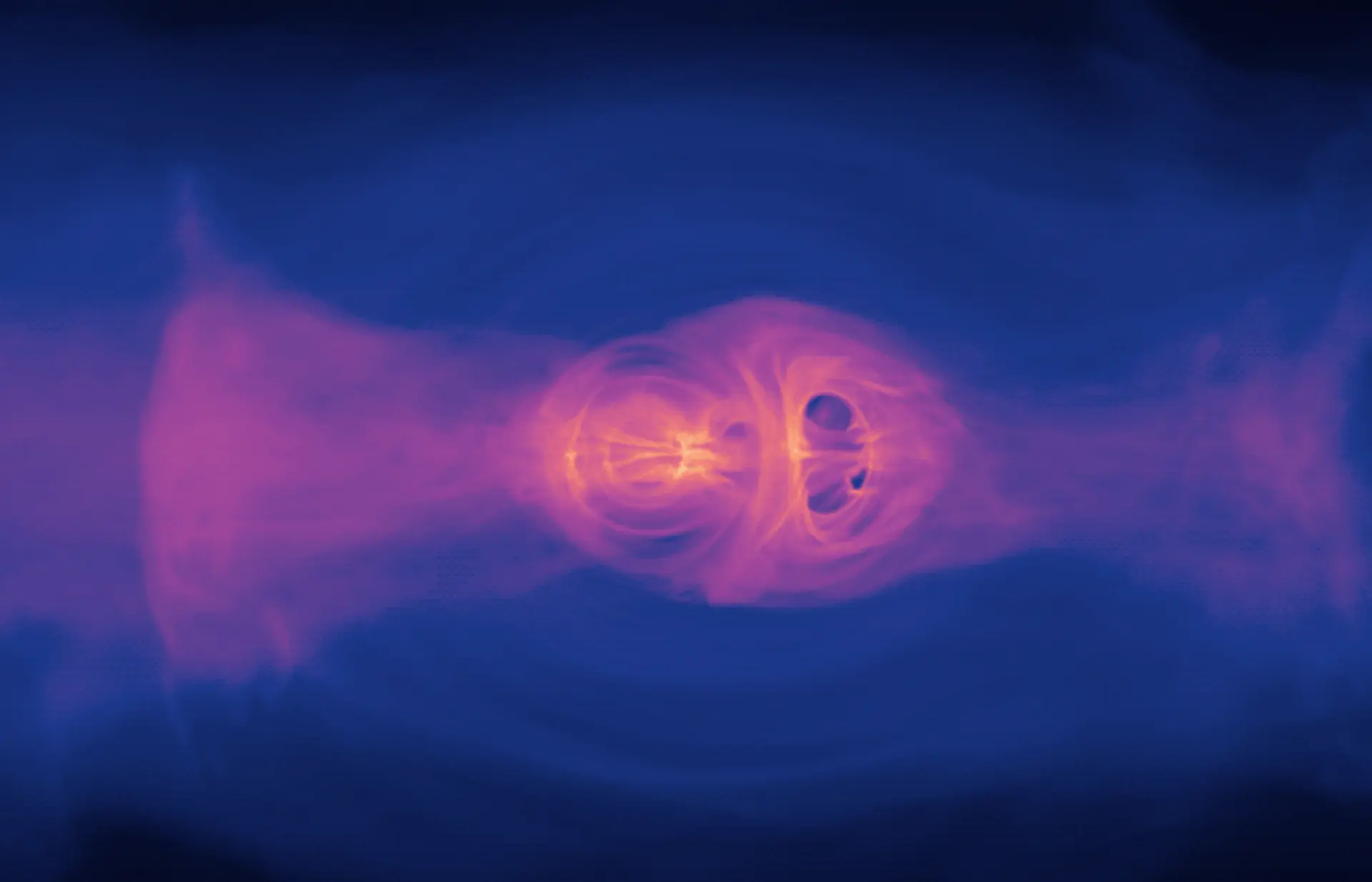
The truly harder question was the black hole. A black hole may appear as a solution to Einstein’s equations, but merely appearing as a solution is not enough. If a black hole existed only under perfectly symmetric, perfectly still, entirely undisturbed ideal conditions, and collapsed at the slightest perturbation, it could not be an object in the real universe. It would be, at most, a mathematical ghost within the equations. A genuine physical black hole must be stable in some sense. It must be able to endure disturbance while retaining its fundamental structure.
This is the problem Klainerman later pursued with his collaborators. They first dealt with the simplest Schwarzschild black hole: spherical, motionless and non-rotating. Even under such simplifying assumptions, the equations remain fearsomely complex. At the centre of a black hole, curvature tends towards infinity; the event horizon forms a peculiar boundary; ordinary intuition all but fails. To prove that such an object remains stable under perturbation is not a decorative addition to physics. It is a test of whether the object qualifies as physically real.
Later, Klainerman and his colleagues moved on to slowly rotating Kerr black holes. This result comes closer to reality, since almost everything in the universe rotates to some degree. Stability here has a special meaning: it joins mathematical solution to physical existence. If Kerr black holes were unstable, then even if the equations allowed them, they would be unlikely to exist as observable astronomical objects. Conversely, proving stability suggests that these strange and profound structures within general relativity are not paper phantoms, but may indeed correspond to things in the universe.
Here again we return to the relation between mathematical discovery and physical reality. Astronomers provide observational evidence for the existence of black holes; mathematicians explain, at the theoretical level, why such objects can exist stably. Observation tells us that the universe appears to contain black holes. Mathematics tells us that such existence does not contradict the inner structure of the equations. The two do not replace one another. They support one another. Physics without mathematics loses depth; mathematics without physics may not reveal the full extent of its power.
Inventing Tools, Discovering Truths
During the Covid pandemic, Klainerman found himself in a largely emptied Manhattan. The city had suddenly grown quiet; the rhythm of life had slowed by force; and he had more time to return to Wigner’s essay, which had occupied his thoughts for decades. After a lifetime working at the boundary between mathematics and physics, he felt the question more deeply than ever: why is mathematics so effective? Why do things proved in the abstract world so often become essential to our understanding of nature?
He agreed that Wigner had identified a genuine mystery, but he did not fully accept Wigner’s definition of mathematics. Wigner emphasised the “invention” of mathematical concepts and rules. Klainerman thought that word misleading. Human beings do indeed invent notation, algorithms, methods and techniques. We invent coordinate systems, calculating devices, proof strategies, and long division as a way of computing pi. But pi itself was not invented. So long as there are circles, the ratio of circumference to diameter is that number. It does not exist because human beings know it, nor cease to exist because human beings are ignorant of it.
Likewise, five plus five equals ten is not a result that some civilisation simply agreed upon. We may express it in different languages, record it in different symbols, and teach it by different methods, but its truth does not depend on those expressions. The mathematician’s creativity lies in finding the road, not in manufacturing the destination. An explorer must design a route, prepare equipment and overcome danger in order to reach the South Pole; but the South Pole is not created by the explorer. Mathematical proof is similar. Methods of proof may be invented, and the path towards a theorem may require tremendous creativity, but the theorem itself is more like a discovered fact.
This view does not deny human agency in mathematics. Quite the reverse: mathematical discovery demands imagination, intuition and technical invention of the highest order. When Klainerman and his collaborators proved the stability of Minkowski space, they had to invent new estimates, design intricate frameworks of argument, and find structures hidden within the equations. Without those creative tools, they could not have reached the result. But the result itself was not manufactured by their proof. Proof made visible a truth that had previously been hidden.
The distinction matters. If mathematics is treated entirely as invention, it is tempting to see it as a sophisticated game, a system of internal deduction after human beings have set the rules. Yet what is so striking about mathematics is precisely that it so often exceeds the boundaries of any game. It is not merely self-consistent; it describes stars, spacetime, particles, heat and the structure of the cosmos. It does not merely work on paper; it finds echoes in nature. If mathematics were only arbitrary invention, why would it so accurately reach places we had never expected?
This does not mean that the question of how mathematical objects exist has been settled. Platonist realism in mathematics remains controversial. Does the ideal circle truly exist? Is mathematical space more real than the world given to the senses? Such questions are not solved by the convictions of any one mathematician. But Klainerman’s experience reminds us that mathematics has a power that is difficult to reduce to human convention. At times, it seems to know what the world is before we do; only later do we learn how to read it.
Where Nothing Can Be Seen, Mathematics Becomes the Only Eye
Modern physics sharpens this sense still further. In earlier science, the objects under study could usually be observed, at least in principle: planets moved, pendulums swung, electromagnetic phenomena could be measured. Equations described objects, and the objects in turn checked the equations. Today, many of theoretical physics’s central objects lie far beyond direct experience. Quarks cannot be observed in isolation; the strings of string theory are smaller than ordinary imagination can manage; and the interior of a black hole, because of the event horizon, can never send information back out.
In such domains, mathematics is no longer merely an auxiliary instrument of description. It is almost the only means of understanding the object at all. We cannot enter the interior of a black hole. We cannot directly see a spacetime singularity. We cannot grasp high-dimensional manifolds or extreme curvature through ordinary perception. But we can study equations, analyse structures, prove stability, and infer which objects may exist and which are only mathematical apparitions. Mathematics here is not just a language; it is an eye. Not an eye that sees appearances, but one that sees structure.
This is the power of mathematics that Klainerman values. It allows human beings to move beyond the narrow range of the senses and enter regions that cannot be directly touched. The senses may deceive us, intuition may fail, images may be impossible to form, but logical reasoning applied to rigorously defined objects can continue. Once an object has been mathematically formulated with sufficient clarity, we can search for its laws, prove its properties, and determine whether it is stable. Mathematics does not abolish mystery. It gives mystery a form in which it can be thought.
This also explains why Klainerman, though he works in general relativity, remains more strongly drawn to mathematics than to physics. He does not need to satisfy physicists’ intuitions, nor does he have to pursue immediate experimental confirmation above all else. What concerns him is the structure of the equations themselves, the hidden order within general relativity that only arduous proof can reveal. In his eyes, the universe is not a building constructed by mathematicians, but a terrain waiting to be explored. The mathematician is not an architect, but an explorer.
Such exploration is never achieved in isolation. Klainerman’s path was shaped by chance encounters: the informal study group in Bucharest that brought him to partial differential equations; the teachers at Courant who taught him to understand the inner motivation of mathematical problems; the conversation with Yau that drew him towards general relativity; the collaborations with Christodoulou, Szeftel, Giorgi and others that carried him into the depths of empty spacetime and black-hole stability. Mathematical truth may exist independently, but the human journey towards it depends on conversation, inheritance, accident and collective effort.
In the end, Klainerman’s story is not simply the story of a mathematician proving that black holes are stable. It is also a story about why human beings seek, in mathematics, something more durable than the age in which they live. A young man who once lived among political falsehoods devoted his life to truths that politics could not command and time could not alter. The objects of his study grew ever more remote: from equations to spacetime, from the empty universe to the boundary of a black hole. But the conviction beneath them remained much the same: truth is not granted by power, nor arbitrarily manufactured by human beings. It is there, waiting to be revealed with sufficient patience and rigour.
Mathematics may not be a lamp we made in order to illuminate the world. It may be something closer to a light that was already there. What we do, over the long course of history, is slowly learn how to turn towards it and see.