Why Is Science So Obsessed with Precise Measurement?
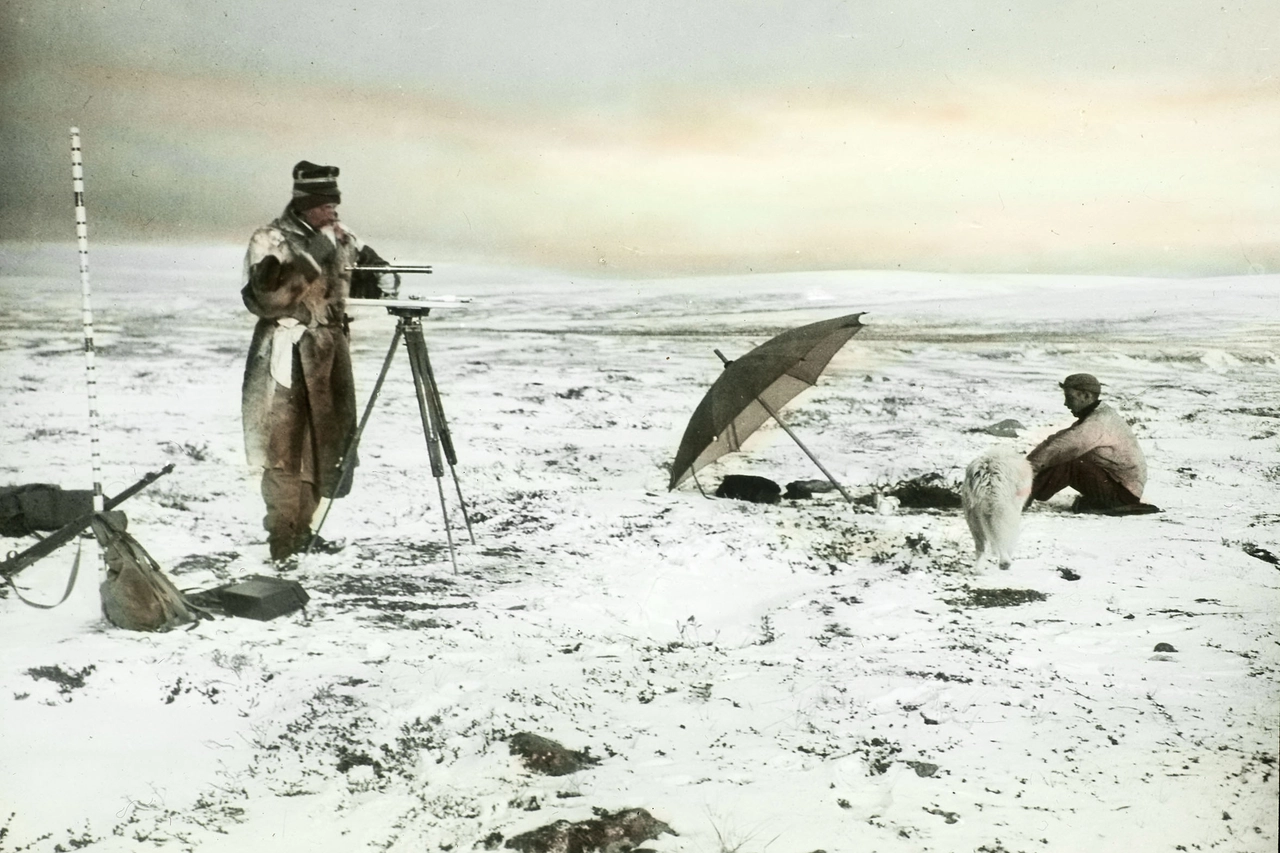
Around 1852, the Swedish astronomer Nils Haqvin Selander traveled north beyond the Arctic Circle to help complete one of the most ambitious scientific measurement projects of the nineteenth century: determining the shape of the Earth.
Today, we know that Earth is not a perfect sphere. Because of its rotation, it bulges slightly at the equator and flattens near the poles. But in the nineteenth century, the question of exactly how much the Earth was flattened was a major scientific problem.
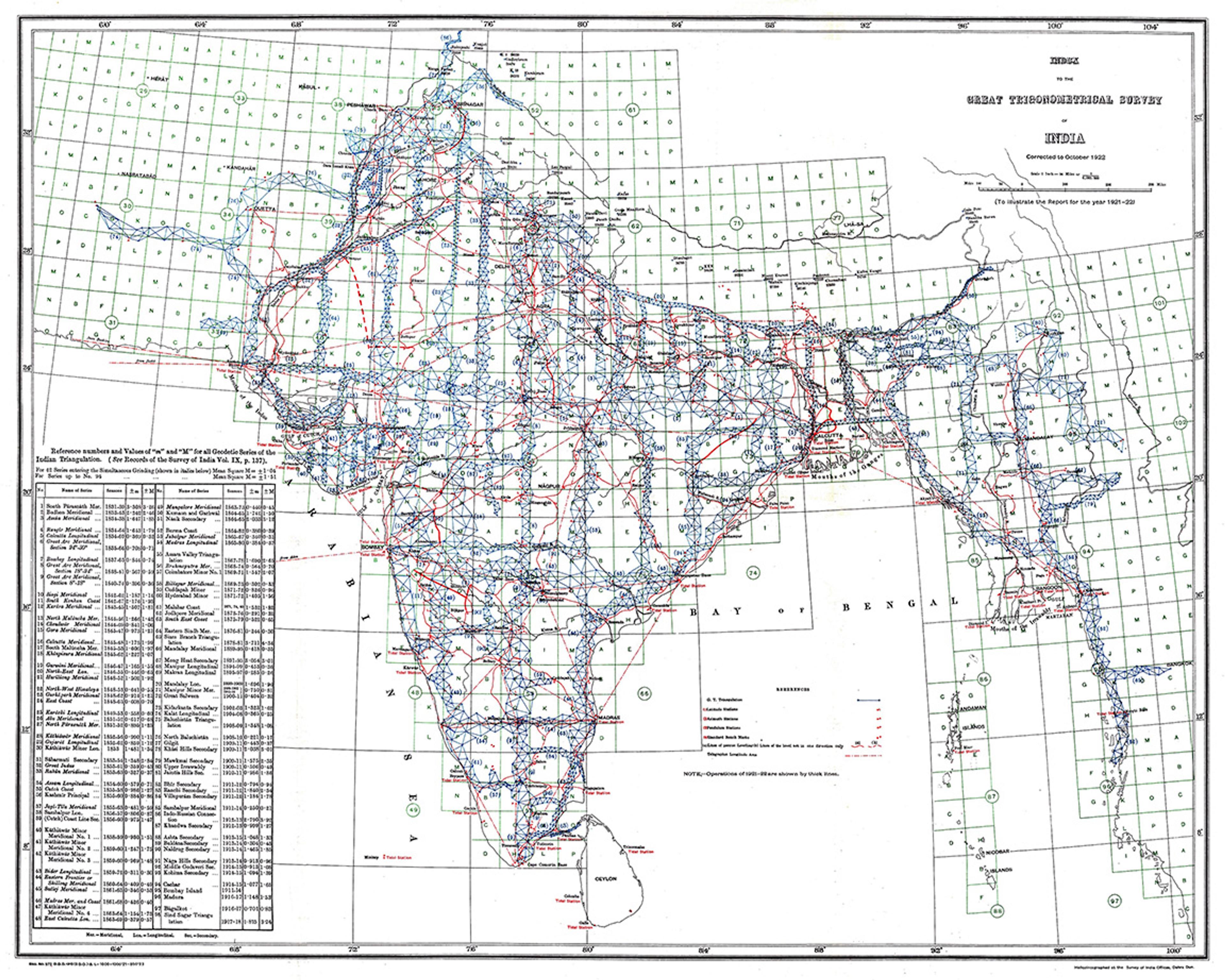
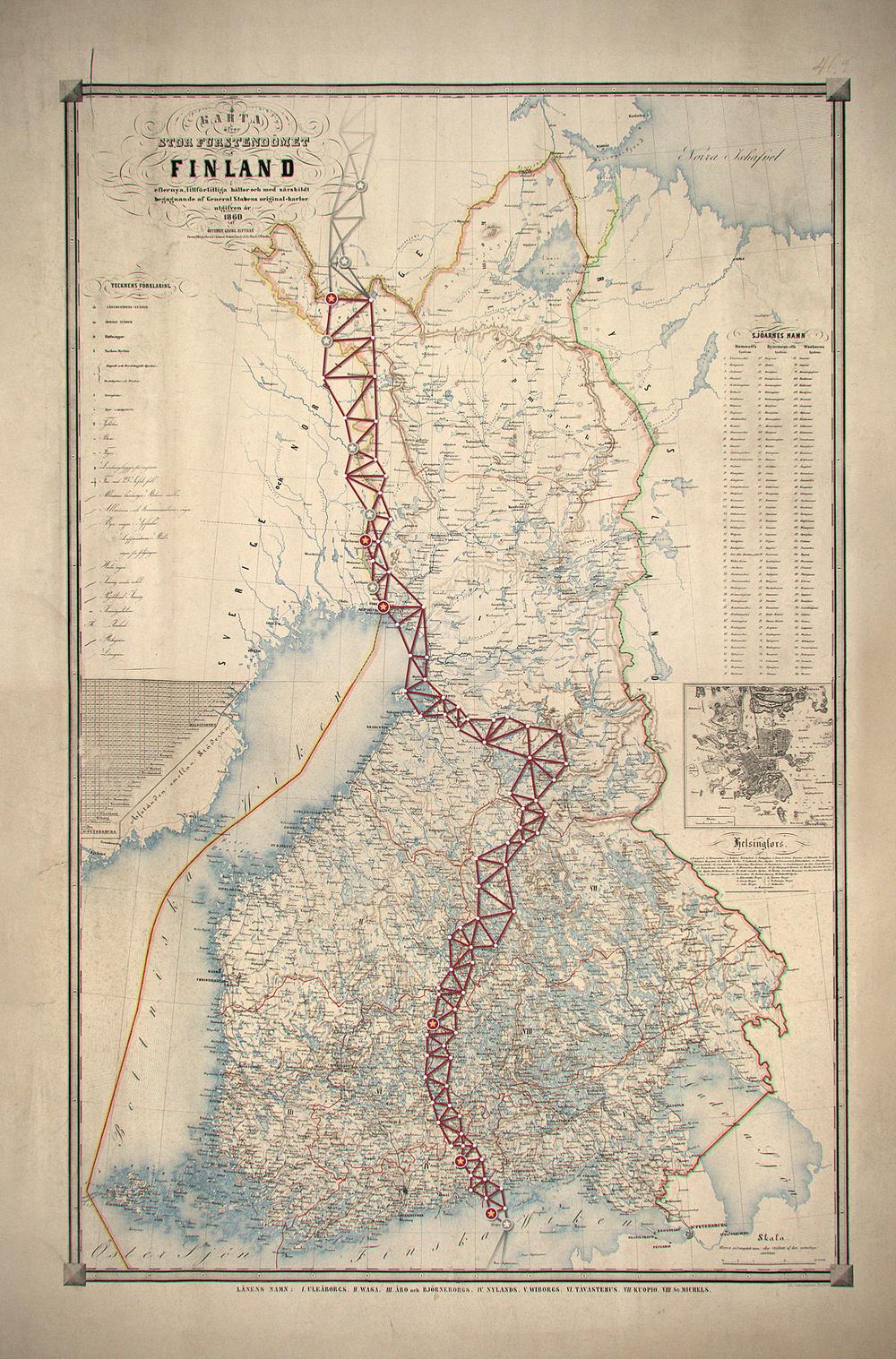
To find the answer, Selander and his predecessors measured a long arc of meridian stretching from the Black Sea to the Arctic Ocean. This line crossed more than twenty degrees of latitude and extended for over 2,800 kilometers. To measure it as accurately as possible, they divided the entire route into 258 connected triangles. By repeatedly measuring the angles and sides of those triangles, they could calculate the curvature of Earth’s surface.
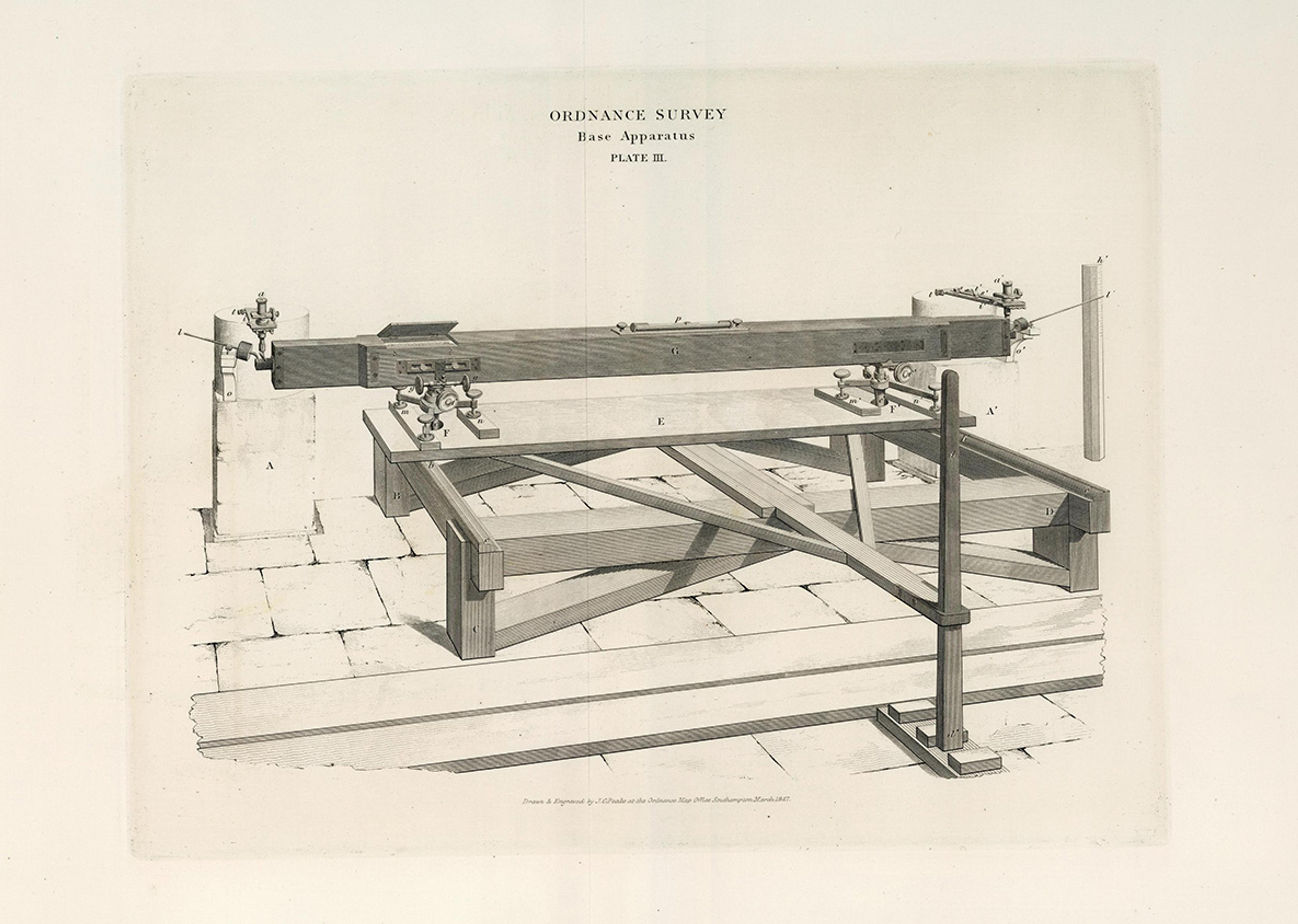
The work was far more difficult than it sounds. Surveyors used light signals to establish directions, theodolites to measure angles, spirit levels and barometers to determine altitude, and standardized measuring rods to calculate key distances. Every number had to be checked, corrected, and recalculated. A small error in one place could affect the final result. Similar projects were later carried out across Europe, North America, Britain, Japan, and India.
This raises an important question: why would people devote so much effort to finding out exactly how “flat” the Earth is?
Of course, accurate maps had practical uses. They were valuable for navigation, military planning, land management, and state administration. But practical usefulness alone cannot fully explain why scientists have repeatedly invested enormous energy in measuring things that seem extremely small, abstract, or obscure.
Scientists do not only measure the shape of the Earth. They measure the magnetic properties of particles, the motions of galaxies, the speed of light, variations in gravity, and countless other details that may appear distant from everyday life.
This suggests that the value of measurement is not simply that it produces useful data. Its importance goes much deeper.
Measurement Is Not Just Reading a Number
We use quantitative concepts all the time: temperature, speed, earthquake magnitude, economic growth, reading ability, health scores, sustainability ratings, and more. These numbers often feel natural, as if the world simply presents itself in numerical form and we only need to read the values.
But that is not how measurement works.
For a quantity to be meaningful, there must first be a set of rules for measuring it. A thermometer tells us how to assign numbers to heat and cold. An earthquake magnitude scale tells us how to compare the energy released by different earthquakes. A reading comprehension test uses questions, answers, and statistical models to estimate a person’s ability to understand a text.
These rules are what we call scales. In many ways, measurement is the process of building, calibrating, and improving scales.
So measurement is not merely the act of attaching a number to something. It is a complex practice. We design instruments, create standards, correct errors, build models, and constantly ask whether those models truly capture the thing we are trying to study.
This is why measurement is so difficult. A reliable scale is rarely created overnight. It often takes decades, or even centuries, of repeated testing and refinement.
Why Early Thinkers Were Not Always Convinced by Precision
Because modern science depends so heavily on numbers, it is easy to assume that quantitative measurement has always been central to science. Historically, however, this was far from obvious.
From Aristotle to the early modern period, many thinkers believed that not everything could be properly quantified. “Quantity” was usually associated with things extended in space or time, such as length, area, volume, and duration. Concepts such as temperature, density, electric charge, intelligence, or economic performance were not always regarded as things that could be measured in a strict sense.
Even Galileo and Descartes did not treat precision measurement in the same way modern scientists do. Galileo believed that nature could be understood mathematically, and Descartes emphasized the quantitative structure of the material world. Yet they were still aware that the real world is messy.
Friction, air resistance, irregular shapes, and imperfect materials all cause real experiments to deviate from mathematical models. For this reason, early modern thinkers often treated measurement as something that could roughly illustrate a theory, rather than as something that needed to achieve extreme precision.
Galileo’s work on pendulums offers a useful example. He observed that pendulums swinging through small arcs seemed to keep a stable period, and he concluded that the period did not depend on the size of the swing. But when a pendulum swings through a larger arc, its period does change. Today, we understand this difference mathematically. It is not just irrelevant noise. It is a real effect that can be studied, modeled, and measured.
For Galileo, however, such deviations looked more like minor disturbances caused by the complexity of nature.
This marks an important difference between early science and modern science. Modern science does not simply dismiss deviations as noise. Instead, it asks: why did this deviation occur? Is it telling us something new?
The Real Power of Measurement: It Forces Theories to Improve
The value of measurement is not only that it tests existing theories. More importantly, measurement constrains our imagination. It forces theories to become more specific, more disciplined, and more closely connected to the real world.
A good scientific theory cannot remain purely abstract. It must explain how its key quantities can be observed, compared, and measured.
This was one of Newton’s great achievements. He did not merely speak about “force” as an abstract idea. He provided ways to measure force through the motions of planets, pendulums, and projectiles. In doing so, he turned a theoretical concept into something that could enter experiments and calculations.
Measurement also forces theories to change.
A theory may explain some phenomena well at first, but more precise measurements may reveal problems. Scientists can then either abandon the theory or revise it, add new conditions, and build more sophisticated models. This process is one of the main ways scientific knowledge advances.
Measurement, then, is not a shortcut to truth. It is a tool that helps us discover where our ideas are incomplete. It shows us when our concepts are too rough, our models too simple, and our assumptions too limited.
Why the Shape of the Earth Mattered So Much
The question of Earth’s shape became especially important in the seventeenth, eighteenth, and nineteenth centuries because it was closely connected to Newton’s theory of universal gravitation.
Newton argued that any two objects with mass attract each other. The strength of that attraction is proportional to their masses and inversely proportional to the square of the distance between them. Today, this idea is familiar. In Newton’s time, however, it was a bold claim.
Many people could accept that planets somehow influenced one another. But it was much harder to accept that every part of the Earth, and every piece of ordinary matter, also attracted every other part according to the same universal law.
How could this be tested?
The shape of the Earth offered a possible answer.
Because Earth rotates, it should bulge at the equator. But the exact amount of that bulging depends on how matter inside the Earth attracts other matter. If Newton’s theory was correct, Earth’s internal mass distribution should influence both its overall shape and the strength of gravity at its surface.
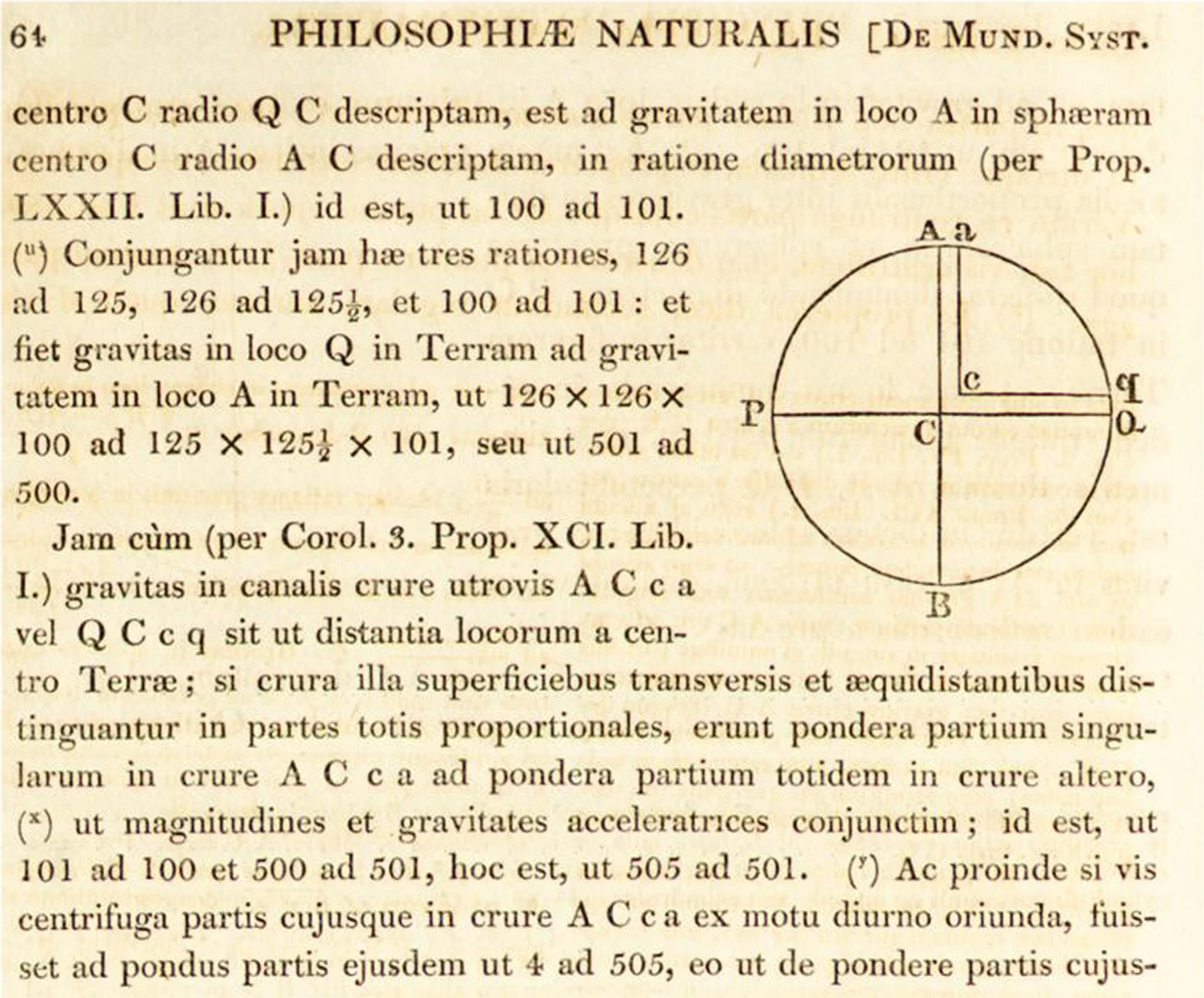
Newton predicted that Earth’s equatorial diameter would be slightly longer than its polar diameter. His estimate of Earth’s flattening was about 1/230. Competing assumptions led to a very different estimate, around 1/578. Measuring Earth’s flattening therefore became more than a geographical project. It became a way to test universal gravitation.
For more than a century, scientists such as Pierre-Louis Maupertuis, Émilie du Châtelet, and Pierre-Simon Laplace worked on this problem. As more data became available, the measurements increasingly supported Newton’s theory.
But that was not the end of the story.
Discrepancies Became Discoveries
Later measurements supported Newton’s theory, but they did not exactly match Newton’s original prediction. Newton’s estimate was around 1/230, while the measured values were closer to about 1/300.
Did that mean Newton was simply wrong?
Not necessarily.
Newton’s early calculation assumed that Earth had uniform density. But Earth is not uniform. Its interior varies greatly. The core is denser than the crust, and density changes with depth.
Scientists such as Laplace began to explain the mismatch between theory and measurement by developing new ideas about Earth’s internal structure. In other words, the discrepancy did not simply destroy the theory. It pushed scientists to ask a deeper question: what is the inside of the Earth actually like?
This was a major step forward. Humans cannot directly observe the deep interior of the planet. But by studying Earth’s shape, gravity, and rotational behavior, scientists could begin to infer its hidden structure quantitatively.
As measurements became more accurate, scientists also discovered that Earth’s gravitational field is not smooth. It contains many small irregularities. Some regions have gravity patterns that do not neatly match the visible landscape. Mountains do not always produce the gravitational effects one might expect, and lowland regions are not always simple either.
These mismatches suggested that Earth’s crust can sink, rise, and adjust toward balance. This idea became known as isostasy, and it later helped prepare the way for the theory of plate tectonics.
From this perspective, many important developments in modern geophysics began as “errors” or discrepancies in geodetic measurement. What first looked like a problem in the data later became a clue about Earth’s internal structure and dynamics.
We Are Still Measuring the Earth Today
Today, scientists no longer rely only on ground-based triangulation to study Earth’s shape. Satellites, gravity meters, GPS systems, and advanced computer models allow us to observe the planet with unprecedented precision.
Modern science often describes Earth using the geoid. Unlike a perfect ellipsoid, the geoid is a complex and uneven surface that roughly corresponds to mean sea level. It changes slightly because of plate motion, earthquakes, melting ice, sea level change, and movements deep inside the planet.
Sometimes these changes are only a few centimeters. But to scientists, a few centimeters can matter. They may record the adjustment of Earth’s crust after an earthquake, the redistribution of mass caused by melting ice sheets, or slow movements in the planet’s interior.
This shows that measuring Earth’s shape is no longer mainly about proving whether Newton was right. It helps us understand the composition, structure, movement, and long-term transformation of the planet itself. It has also opened paths for geology, seismology, geodynamics, and other fields.
Measurement Is Not Authority. It Is Learning.
Measurement matters not because it instantly gives us absolute truth. In fact, serious measurement often does the opposite. It introduces doubt, correction, and revision.
One measurement leads to another. One error raises a new question. One discrepancy forces us to examine our theories, instruments, and concepts again. Science advances through this repeated process.
This should also make us cautious about the way numbers are used in society. When we try to measure intelligence, education quality, economic performance, or social progress, it is tempting to think that a score, ranking, or index gives us an objective truth.
But numbers do not automatically produce truth. Every measurement depends on a scale, a model, a set of assumptions, and often a set of values. If we forget this, measurement can become a way of giving false authority to our existing beliefs.
The most valuable measurements are not those that make us more confident in what we already think. They are the ones that reveal the weaknesses in our ideas.
From Selander’s nineteenth-century survey of Earth’s shape to today’s satellite measurements of gravity, precision measurement has remained central to science because it makes inquiry sharper, more honest, and more responsive to the world.
The point of measurement is not to reduce the world to numbers. It is to use numbers to keep learning what the world is really like.