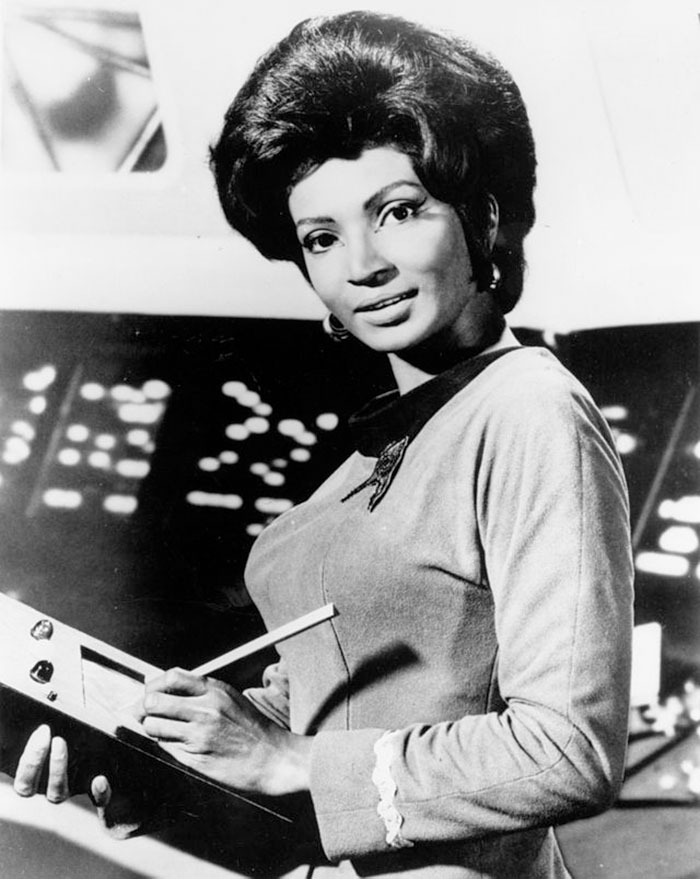
Nichelle Nichols had already decided to leave.
The letter was written. The conversation with the producers was coming. After one season on Star Trek, she was ready to walk away from the role of Lieutenant Uhura and return to the stage, where she hoped the work would feel more alive, more serious, and more worthy of what she knew she could do.
It was not an unreasonable decision.
She was a singer, a dancer, and an actress with real range. Broadway had always felt like home. Television, by comparison, had started to feel smaller than she expected. Her role on Star Trek was visible, but not always substantial. She stood on the bridge of the starship Enterprise, yet too often her lines were reduced, her presence softened into the background.
From where she stood, the choice seemed clear. If the show would not give her enough room to grow, she would go somewhere that would.
Then she met Martin Luther King Jr.
The Night Everything Shifted
It happened in 1967 at an NAACP fundraiser in Beverly Hills.
The Civil Rights Movement was at a tense and historic point. The country was arguing over what equality meant, who belonged in public life, and what kind of future America was willing to imagine. In the middle of that moment, Nichols turned around and saw Dr. King smiling at her.
He knew exactly who she was.
To her surprise, he told her that he was a fan of Star Trek. Not casually. Not politely. He watched the show with his family and understood something about her role that Nichols herself had not fully seen.
When she mentioned that she planned to leave, King interrupted her. He told her she could not go.
Not because she was merely part of a television show. Not because Hollywood needed her. Not because the role was perfect. He wanted her to stay because, in his eyes, Uhura was doing something television had rarely done before.
She was a black woman on screen who was not a maid, not a servant, not a joke, not a symbol of someone else’s comfort. She was an officer. She was competent. She was composed. She belonged in the future.
For King, that image mattered.
The Role She Could Not See
There is a strange thing that happens when you are close to your own work.
You feel all of its limits. You know the compromises. You remember the conversations that disappointed you, the scenes that were cut, the opportunities that did not arrive. You know how much more you wanted to give than the work allowed you to show.
Other people do not always see those frustrations.
They see what reached them.
Nichols saw a role that had become too small. King saw a black woman in command on the bridge of a starship. Nichols saw the lines she did not get. King saw the millions of people who had never before seen someone like her placed inside a future that treated her as necessary.
Both views were true.
That is what makes the story powerful. Nichols was not wrong to want more. King was not wrong to ask her to stay. Sometimes a role can be incomplete for the person performing it and still revolutionary for the person watching it.
A Child in Front of the Television
Years later, Whoopi Goldberg told Nichols what Uhura had meant to her.
Goldberg was nine years old when she saw Star Trek. She saw Nichols on screen and ran through the house calling for everyone to come look. There was a black woman on television, and she was not playing a maid.
That sentence is simple, but it carries the weight of an entire cultural education.
Children learn what is possible partly by what they are allowed to see. They learn from parents and teachers, but also from screens, books, uniforms, offices, advertisements, stages, and the quiet background images that tell them where people like them are expected to stand.
Before a child chooses a dream, the world often teaches them which dreams are available.
Uhura widened the available future.
She did not need to deliver a speech to do it. She did not need to be the main character in every episode. Her presence alone changed the room. She existed in the story as someone intelligent, trusted, and essential. For a young girl watching from home, that was enough to open a door.
The Work That Travels Without Telling You
Most of us will never know the full distance our work travels.
A teacher may never know which lesson stayed with a student long after graduation. A nurse may never know how much her calm voice meant to a terrified family. A shop owner may never know that one small act of patience softened someone’s terrible day. A parent may never know which ordinary moment became a child’s lifelong memory of safety.
We tend to measure work by the feedback we receive.
How many people praised it? How many noticed? How much did it earn? Did anyone say thank you? Did anyone tell us it mattered?
But impact often moves quietly. It does not always report back. It does not always send a message, leave a review, write a letter, or stop you at a fundraiser and explain what your presence has meant.
Sometimes the person most changed by your work is someone you never meet.
This is why it is dangerous to dismiss your contribution too quickly. You may be measuring it only from the inside, where everything feels familiar and imperfect, while someone else is experiencing it from the outside as permission, comfort, encouragement, or proof.
Small Is Not the Same as Meaningless
We often confuse visibility with significance.
The person with the most lines must matter most. The person with the biggest title must be most important. The person with the largest audience must be making the greatest difference.
Life is not always arranged that neatly.
Some people change a room without dominating it. Some roles matter because they appear in exactly the place where someone needed to see them. Some examples become powerful not because they are loud, but because they are rare.
Nichols was not simply acting in a science fiction show. She was helping place a new image into the public imagination.
And imagination is not a small thing.
Before people build a different world, they usually have to picture one. Before they believe they belong somewhere, they often need to see someone like them already standing there.
That is what King understood. He knew that the future is not shaped only by laws and marches and speeches. It is also shaped by images. It is shaped by stories. It is shaped by who gets to appear as intelligent, capable, dignified, and free.
The Ordinary Work in Front of You
It is easy to hear Nichols’ story and think it belongs only to famous people.
Most of us are not on national television. Most of us are not part of a cultural moment so visible that civil rights leaders ask us to keep going. Most of us will not have a role that children remember decades later.
But the deeper lesson is not about fame.
It is about underestimating the work that is right in front of us.
If you think about your job long enough, you can find reasons to make it feel small. The task is repetitive. The audience is limited. The effort goes unnoticed. The role is not the one you imagined for yourself. The work does not always use the best parts of you.
Sometimes those feelings are real, and sometimes they are telling you something important. Maybe you do need to grow. Maybe you do need a new challenge. Maybe the next chapter is calling.
But before you decide your current role has no value, pause for a moment.
Ask whether someone else might be seeing something in it that you cannot see from where you stand.
Bring What You Have
The point is not to stay forever in a place that limits you.
The point is to stop assuming that limited work is automatically meaningless work.
You can want more and still honor what your current role is doing. You can dream of a bigger stage and still perform with care on the stage you have. You can outgrow a position without denying that it may have mattered to someone along the way.
Nichols stayed.
She returned to Star Trek and continued playing Lieutenant Uhura, not just for the remainder of the original series, but across decades of the franchise. Her role became part of television history. Her presence helped reshape what black women could be seen as on screen. And the girl who once ran through the house shouting about her would grow up to become Whoopi Goldberg.
That is how influence sometimes works.
It moves from one person’s ordinary day into another person’s entire future.
Final Thoughts
Nichelle Nichols almost walked away because she thought the role was too small.
Martin Luther King Jr. asked her to stay because he understood that the role was larger than the script.
Somewhere between those two views is a lesson most of us need.
You may not always know what your work means while you are doing it. You may only feel the frustration, the repetition, the missing lines, the limits of the role. But someone else may see courage where you see routine. Someone else may see possibility where you see compromise. Someone else may see a future opening because you chose to show up with dignity.
Do not be too quick to call your work insignificant.
You may be playing a role in someone else’s imagination that you cannot yet see.