
How Mozart Made Beauty Morally “Dangerous”
Fiordiligi at the Edge of Betrayal
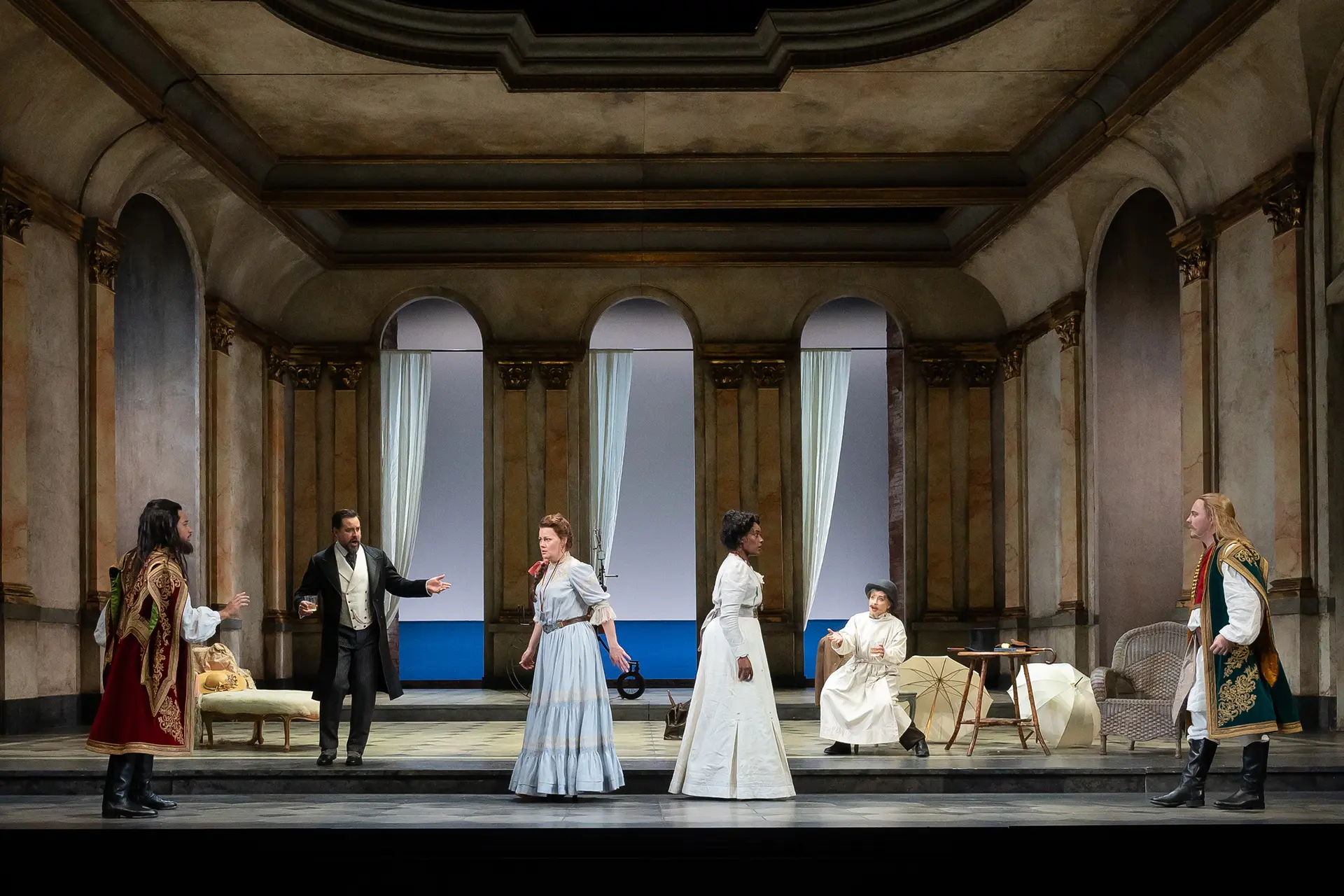
In the middle of Act II of Mozart’s 1790 opera Così fan tutte, the young Fiordiligi finds herself alone on stage, poised at the edge of a moral collapse. She is about to betray a promise that once seemed inseparable from her sense of self. Her fiancé, Guglielmo, has, or so she believes, been summoned away to war. She has vowed to remain faithful in his absence. Yet a charming stranger has begun to court her, and the force of that courtship has gradually unsettled the certainty on which her fidelity rested.
For much of the opera, Fiordiligi resists. She struggles against the stranger’s advances with an intensity that seems both comic and sincere. But by the middle of the second act, she can no longer deny the attraction growing within her. The aria she sings at this moment is at once a confession made in advance and a plea for forgiveness addressed to the man she is about to wrong:
In pity’s name, my darling, forgive
The error of my loving soul.
Amid these shadows and these groves,
Oh God, it will always remain hidden.
My courage, my constancy
Will drive away this wicked desire;
It will lose the memory
That shames and horrifies me.
To whom did my vain, ungrateful heart
Fail in its faithlessness?
Your trust, beloved,
Deserved a better reward.
Mozart sets these words to music of almost unbearable tenderness. The aria is graceful, restrained and tinged with resignation. It is one of the most beautiful moments in the opera. Nowhere before this point has Fiordiligi sounded so exposed, so defeated, or so worthy of sympathy.
The Cruel Irony Beneath the Music
Yet beneath the beauty of the music lies a current of merciless irony. In the orchestral accompaniment, two solo horns enter as Fiordiligi’s melody returns, interrupting her vocal line with elaborate interjections. To an 18th-century audience, these horn calls would have carried a familiar comic and sexual association: they evoked the image of the “horned” husband, the cuckold whose wife has betrayed him. The effect is devastating. Just as Fiordiligi gives voice to her shame with the greatest sincerity, the orchestra seems to mock the very seriousness of her confession.
For generations, audiences have found Così fan tutte difficult to settle morally. Its plot is built on confusion, deception and emotional cruelty, while its music is often ravishingly beautiful. In Mozart’s hands, beauty itself becomes a dramatic weapon. Perhaps he is simply portraying a woman who is both genuinely tormented and, in some sense, guilty. But perhaps he is doing something more unsettling: using music to laugh at her, to foreshadow the infidelity toward which the plot will soon push her. He may even be mocking us, the listeners, for the sympathy we feel. At the very moment we are most moved by Fiordiligi’s pain, Mozart fractures the sincerity of the scene and reminds us that these characters, whom we come to love, are also puppets in the hands of an omnipotent artist.
That tension — between sympathy and judgment, tenderness and unease — is one of the defining features of Mozart’s mature operas. Indeed, it is a tension he seems to delight in creating. From 1781 until his death in 1791, Mozart produced a series of operatic masterpieces in which the medium was pushed to its expressive limits. Again and again, he draws listeners into troubled, unstable and morally ambiguous points of view. Opera, for him, becomes a machine for generating sympathy.
Sympathy as an Eighteenth-Century Moral Problem
But sympathy here should not be understood merely as pity or benevolent feeling. It belongs to a more rigorous 18th-century discourse about moral imagination, one explored most famously by the Scottish philosopher Adam Smith.
Smith’s first book, The Theory of Moral Sentiments, appeared in 1759, when Mozart was still a child. In it, Smith describes sympathy as an imaginative faculty. Through sympathy, we place ourselves in another person’s situation, model their predicament, weigh their actions against the responses we imagine we might have had, and arrive at moral judgment. Smith writes that we “enter as it were into” another person’s body and become, in some measure, the same person. He also proposes a related mechanism of self-understanding: the “impartial spectator,” an imagined observer who judges our conduct as we judge the conduct of others.
This emphasis on imaginative movement marked a departure from older philosophical traditions that treated moral judgment as the application of rational principles, almost as if ethics were a branch of geometry. For Smith, moral life was less orderly, less absolute and far more provisional. The problem of how one mind understands another became one of the central intellectual questions of the mid- and late-18th century, a question that crossed the boundaries of philosophy, economics, literature and the arts.
Mozart’s genius as an opera composer lies in the way he treats his listeners as sympathetic spectators. He does not simply tell us how to judge the figures on stage. Instead, he compels us to feel with them, then leaves us to confront the moral confusion that feeling produces. His operas do not merely present philosophical problems; their musical structures enact them.
Before Mozart: Opera and Moral Certainty
Opera had not usually worked this way. From its origins at the end of the 16th century, the genre had drawn heavily on mythology and ancient history. In the 18th century, one of the dominant forces in shaping operatic narrative was the Italian poet Pietro Metastasio, whose libretti were set by nearly every major composer of the period. Metastasian plots typically revolve around rulers and heroes subjected to tests of virtue. Betrayal, conspiracy and emotional conflict appear, but the ending usually restores moral order: virtue is rewarded, vice is punished, and justice resumes its rightful place.
Composers working within this tradition often served as moral guides. Their music helped lead audiences toward the proper response. This applied not only to the moral design of an opera as a whole, but also to the treatment of individual arias, where music generally reinforced the emotions and ideas expressed by the text. By Mozart’s lifetime, these conventions were deeply established. Even well-known mythological stories could be reshaped to conform to them. Gluck’s Orfeo ed Euridice, for example, contrives a happy ending in which the gods restore Euridice to life as a reward for Orpheus’ noble constancy.
Mozart grew up within this tradition and knew its conventions intimately. He could use them with extraordinary skill. He often wrote music that projected the psychological essence of a character with astonishing precision. In a letter to his father from September 1781, he describes the construction of a rage aria for Osmin, the comic villain of Die Entführung aus dem Serail:
As Osmin’s rage grows and grows — just when one thinks the aria is over — the allegro assai, in an entirely different meter and key, is bound to make a tremendous effect. I have not chosen a key foreign to F, the key of the aria, but one related to it; not the closest one, D minor, but the more distant A minor.
Here Mozart sounds like a strategist of musical expectation. Tempo, key, meter and rhythm are all available to him as dramatic instruments. He calculates the listener’s assumptions and then disturbs them.
When Music Begins to Contradict Words
As his dramatic technique matured, however, Mozart relied less and less on inherited formulas. Beginning with Le nozze di Figaro in 1786, and continuing through Don Giovanni and Così fan tutte, he explored possibilities that made operatic viewpoint far more unstable and visceral. A great writer can do much with words alone; a great composer can do much with music alone. But Mozart grasped that opera, as a hybrid art form, could set music and text in tension. Music could comment on words, contradict them, ironize them, or reveal what the words conceal.
This opened a vast expressive space. By allowing the music to tell a story different from the one apparently told by the libretto, Mozart placed both characters and listeners in ethically unstable positions. We can no longer simply trust what a character says. Nor can we stand safely outside the scene and judge. Instead, we are suspended in the ambiguity between spoken intention, musical revelation and moral consequence.
Zerlina and the Music of Seduction
A clear example appears in the famous seduction duet “Là ci darem la mano” from Don Giovanni. Giovanni — the Italian Don Juan — is attempting to seduce the peasant girl Zerlina shortly after her marriage to Masetto. In the dialogue before the duet, he promises wealth and marriage. Zerlina answers with caution: noblemen, she knows, often deceive young women. When the duet begins, Giovanni continues to entice her, while Zerlina continues to insist that she is undecided.
Giovanni sings:
There we will join hands,
There you will say “yes” to me.
Look — it is not far.
Let us leave from here, my beloved.
Zerlina replies:
I want to, and I do not want to;
My heart trembles a little.
It is true, I would be happy,
But he may be deceiving me after all.
Giovanni opens with a melody of extraordinary charm. It is so seductive that it later took on an afterlife beyond the opera, inspiring composers such as Beethoven and Chopin. Yet the real complexity begins with Zerlina’s response. In words, she hesitates. In music, she adopts Giovanni’s melody. Mozart thus tells us something Zerlina herself has not fully admitted: beneath her verbal uncertainty, she has already begun to yield.
The text presents a young woman who knows enough to distrust male manipulation. The music reveals something else: desire has moved faster than self-knowledge. Zerlina is still narrating herself as undecided, but her musical language has already betrayed her inclination.
This not only gives Zerlina psychological depth; it also complicates the listener’s moral experience. We know Giovanni is dangerous. We know he is a predator. Yet the music does not present the scene as a simple confrontation between guilty aggressor and innocent victim. Instead, we hear two people drawn into an increasingly tender exchange. As the duet unfolds and the opening tune returns, Mozart intertwines their vocal lines. Zerlina begins to complete Giovanni’s phrases with growing eagerness, even as her words retain the surface of hesitation. The orchestration changes too. What began against a quiet background of pulsing strings expands into a more sensual world of wind writing.
In terms of plot, Giovanni is undoubtedly a villain. By the end of the opera, he will be dragged down to Hell. But during this duet, Mozart brings us inside the erotic charge of the encounter. He invites us to feel Zerlina’s attraction from within. The music amplifies her excitement and turns that excitement into something almost irresistible. Without quite knowing when it happens, we are drawn away from the moral position we occupied at the beginning of the scene. When the duet is interrupted by one of Giovanni’s outraged former lovers, we may even feel, against our better judgment, a faint disappointment.
Returning to Così fan tutte
Fiordiligi’s situation is more wrenching still. The scene from Così fan tutte carries an additional layer of irony. The stranger who is courting her is not truly a stranger at all. He is Ferrando, her fiancé’s best friend, disguised as part of a cruel experiment designed to prove that women cannot be trusted.
Fiordiligi and her sister Dorabella are engaged to two soldiers. Under the influence of the cynical philosopher Don Alfonso, the men pretend to leave for war, return disguised as Albanians, and attempt to seduce each other’s fiancée. Shortly before Fiordiligi sings her agonized aria, the audience has seen Guglielmo, her own fiancé, successfully seduce Dorabella. Fiordiligi knows nothing of this. We do.
The horn calls in her aria therefore become even more complicated. They mock her guilt and suggest the cuckoldry toward which she is moving. But they also remind us that she too is a victim of betrayal. The “faithful” beloved she addresses so passionately is, at that very moment, flirting with her sister.
It has often been fashionable to blame the cruelty of Così fan tutte on Lorenzo da Ponte, the librettist who also supplied Mozart with the texts for Le nozze di Figaro and Don Giovanni. But it is Mozart’s music that most powerfully implicates us in the mechanism of mutual destruction set in motion by male vanity, arrogance and suspicion. Fiordiligi’s aria draws us into her suffering and repels us from it at the same time. It forces us to experience beauty in the midst of moral wreckage.
Sympathy Distributed in Every Direction
If “Là ci darem la mano” shows how manipulation of viewpoint can make the audience complicit in a comparatively simple seduction scene, Così fan tutte distributes sympathy in every direction at once. We feel for Fiordiligi in her anguish. We understand that the temptation must be profound if it can shake a commitment so deeply rooted in her identity. At the same time, we see that the men who arranged the test have already betrayed the trust they claim to be examining.
They too are betrayed, both by their partners and, in a different sense, by one another. Each man succeeds in winning over the woman promised to his friend. Even more unsettling, the new couples often seem, musically and dramatically, better matched than the original pairs. This does not clarify the situation; it deepens the confusion. The opera refuses to let us convert these contradictions into a clean verdict. We cannot remain outside the scene and judge from a position of moral safety. We are made to feel Fiordiligi’s pain, the men’s wounded pride, Dorabella’s desire, Alfonso’s cynicism and the strange coherence of the new emotional alignments. That kaleidoscopic disorder is precisely the point.
Mozart and Adam Smith: Two Responses to the Same Problem
Mozart never read Adam Smith, so there is no direct line of influence to trace between them. Yet both men were responding to a central problem of the later 18th century: how can we know another mind, and how far can we understand the forces that shape human choice?
Smith’s account of sympathy and spectatorship remains compelling, but he is careful to stress the limits of perception. Our senses cannot carry us outside ourselves. It is only through imagination that we form any conception of what another person feels.
This does not mean that Mozart’s music simply illustrates Smith’s philosophy. The value of the operas does not lie in their serving as examples of a theory. Rather, what is striking is that Mozart and Smith arrived, in the same broad historical moment, at a similar insight: to understand another person is not merely to observe them and perform moral arithmetic. It is to enter imaginatively, uncertainly and sometimes dangerously into their situation, and to feel the pressures acting upon them.
For Smith, this insight would help shape the broader social vision of The Wealth of Nations, where moral sentiments, imagination and sympathy are reframed within the systems of exchange and coordination that we now associate with economic incentives. For Mozart, the same kind of concern led to an intensified interest in the inner life of characters, especially at moments of difficult choice.
Feeling the Forces Behind Human Choice
Fiordiligi’s romantic crisis and Zerlina’s wavering before Giovanni both reveal this interest. Both Così fan tutte and Don Giovanni track how characters change as new information becomes available to them: when the women in Così learn that they have been deceived, or when Zerlina discovers the full extent of Giovanni’s treachery and resists his further advances. Mozart’s aim is not simply to determine whether a character is blameless. He is more interested in making us feel the forces that pull at them.
That he can generate sympathy not only for virtuous characters but also for compromised and even villainous ones is not a sign of moral relativism. These operas are not indifferent to right and wrong. Rather, Mozart acknowledges that human motivation is tangled, layered and often resistant to simple judgment.
Even a villain must be given music that allows the listener to enter his perspective.
Even Villains Must Be Given Beautiful Music
This capacity to inhabit another mind is one of the reasons Mozart is such a powerful dramatist. In the same 1781 letter in which he describes the construction of Osmin’s rage aria, he adds that passions, whether violent or not, must never be expressed to the point of disgust. Music, even in the most terrible situations, must never offend the ear; it must continue to please the listener. In other words, it must never cease to be music.
Even a villain, even a character possessed by murderous rage, must be granted music that makes his perspective theatrically intelligible. Mozart is not saying that evil deserves aesthetic reward. He is suggesting that the purpose of operatic music is to project a psyche so fully that the listener can follow the drama as a play of decisions, desires and conflicts.
He demanded a similar imaginative discipline from performers. When sending an aria he had composed for Aloysia Weber, his future sister-in-law, for the role of Andromeda, he urged her to place herself seriously in Andromeda’s state and situation — to imagine that she truly was that person. The instruction sounds almost like a theory of method acting. As a composer, Mozart appears to have followed it himself. His music suggests a mind able to slip in and out of identities with astonishing ease, modelling interior worlds so completely that the boundary between creator and creation can seem to dissolve.
The Listener as Moral Judge
Unlike many operatic composers who observe their characters from above, Mozart projects their viewpoints from within. He does not hurry to pronounce judgment from an authoritative distance. The Count in Le nozze di Figaro, despite his predatory designs on Susanna, is not always given music of menace. More often, his music is touched by vulnerability, frustration and wounded pride. When, at the beginning of Act III, we watch him awkwardly attempt to flirt with Susanna, Mozart asks us, briefly, to feel what it is like to be thwarted.
Don Giovanni is treated in a similar, though darker, fashion. He is far more evil than the Count, yet Mozart himself does not musically condemn him in any simple way. The final punishment comes from supernatural forces. While Giovanni is alive, his music crackles with vitality. After his death, we feel relief and justice, but perhaps also something like loss. The final scene seems emptier without him, as though Mozart has quietly conscripted us as his accomplices.
In all these cases, Mozart gives full voice to desire. He does not complete the work of moral judgment for us. Instead, he makes us do it ourselves, after ensuring that we cannot contemplate these charged situations from a safe and detached distance. Whether the horns in Così fan tutte laugh at Fiordiligi or mourn for her, Mozart is still issuing the same challenge: now it is our turn to decide.