The Creative Process: How Great Ideas Are Really Born
Nearly every original idea begins in a familiar way. It does not usually arrive as a perfect lightning strike from nowhere. More often, creativity grows out of attention, curiosity, frustration, patience, and the quiet ability to connect things that other people have not yet connected.

This matters because creative thinking is not only useful for artists, writers, designers, or inventors. It is useful for anyone who has to solve problems. Work requires it. Business requires it. Relationships require it. Even ordinary life often asks us to look at old problems from a new angle.
The good news is that creativity is not reserved for a rare group of naturally gifted people. You can train it. You can practice it. You can learn to recognize the conditions that make original ideas more likely to appear.
That does not mean creativity is easy. Good ideas still require courage, discipline, and a willingness to sit with uncertainty. But when you understand the creative process, the mystery becomes less intimidating. You begin to see that great ideas often follow a pattern.
A Problem Waiting for a Better Answer
In the 1870s, newspapers had a problem that was both simple and expensive: people wanted to see photographs in print, but printing photographs was slow, difficult, and costly.
Photography was still a young and exciting medium. Readers were fascinated by images, and publishers knew that pictures could make newspapers more powerful and more appealing. But the technology had not caught up with the demand.
If a newspaper wanted to print a photograph, it could not simply place the photo on the page the way we do today. Someone had to manually engrave a version of the image onto a plate. This took time, required skill, and often produced materials that wore out quickly.
The process was too slow for a fast-moving newspaper business and too expensive to use freely. The world wanted images, but the printing industry needed a better way to deliver them.
One of the people who helped solve this problem was Frederic Eugene Ives. His work would later make him an important figure in the history of photography and printing. But like many creative breakthroughs, his solution did not appear by accident. It came from years of exposure, experimentation, and mental struggle.
The Quiet Work Before the Breakthrough
Ives began his career as a printer’s apprentice in Ithaca, New York. For two years, he learned the details of the printing trade from the inside. He became familiar with the machines, the materials, the limitations, and the daily problems of the craft.
Later, he worked at Cornell University, where he managed a photographic laboratory. This gave him another kind of education. He was no longer only thinking like a printer. He was also learning the language of photography, optics, cameras, and image-making.
This combination mattered. Ives was standing between two worlds: printing and photography. He understood the pain of one field and the promise of the other. That position gave him the raw material for a creative solution.
For years, he experimented. He tested techniques. He adjusted processes. He looked for ways to translate photographic images into something printers could reproduce more efficiently.
Then, after long effort, the answer came to him in a sudden moment of clarity. He later described waking up with the process and the necessary equipment seemingly laid out in his mind. What looked like a flash of insight was actually the result of years of preparation.
Creativity Is Not Magic
Stories like this often make creativity seem magical. A person wrestles with a problem, goes to sleep, wakes up, and suddenly sees the answer.
But the breakthrough is only the most visible part of the process. It is the moment people remember because it feels dramatic. What we often miss is everything that happened before it: the training, the collecting of information, the failed attempts, the confusion, the boredom, the repetition, and the long period of thinking without reward.
A creative idea rarely appears in an empty mind. It needs material to work with. It needs experience, examples, problems, facts, and fragments. Your brain cannot connect dots it has never collected.
This is why creative people often seem curious about many things. They are gathering ingredients. They may not know exactly how those ingredients will be used, but later, when a problem appears, the mind begins to combine them in unexpected ways.
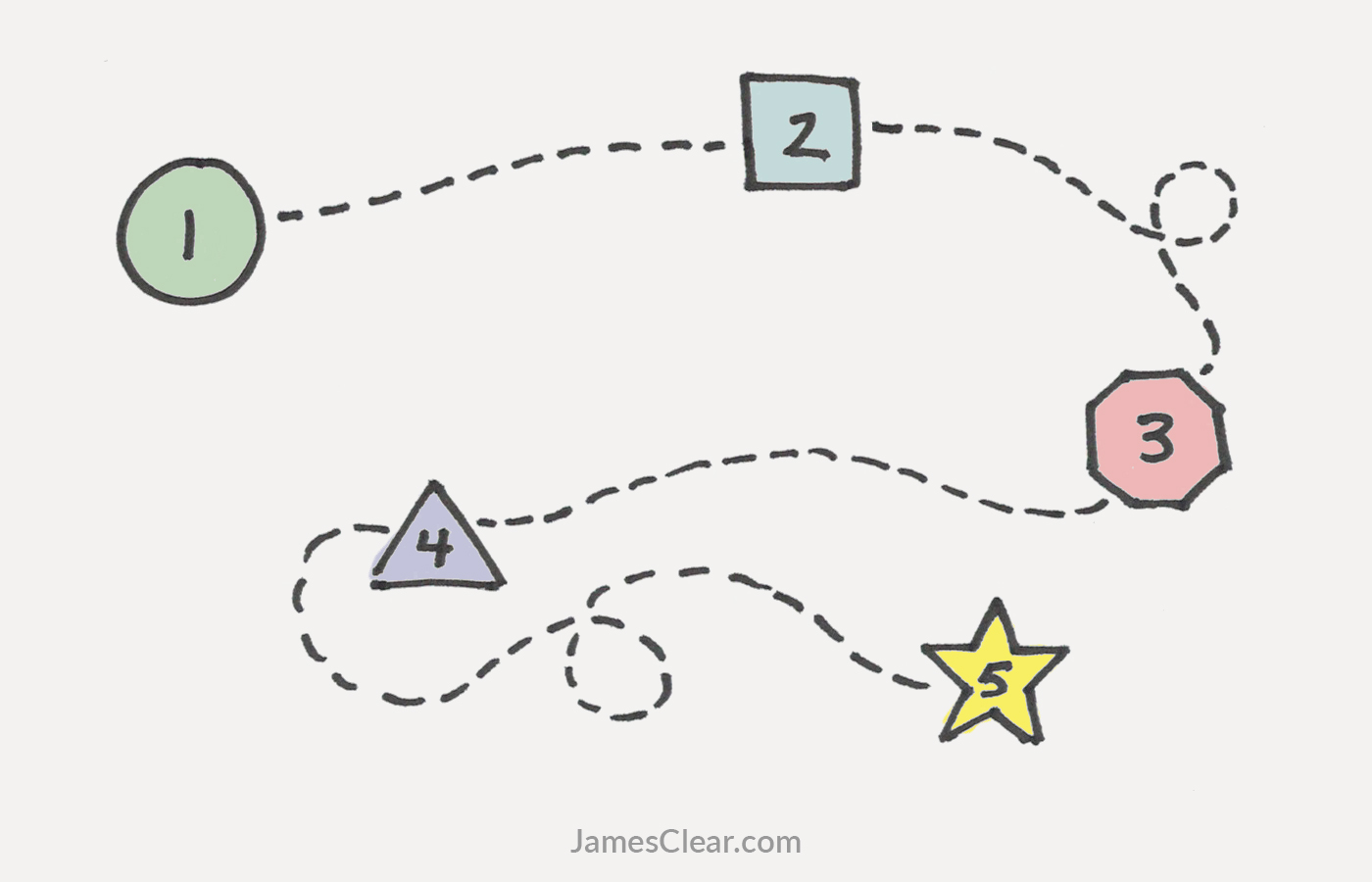
The picture from JamesClear.com
The First Stage: Gather Material
The creative process begins with gathering material.
Some of this material is specific. If you are trying to solve a business problem, you study the customers, the market, the product, and the numbers. If you are writing an article, you collect stories, arguments, examples, and observations. If you are designing something, you study the function, the user, and the constraints.
But another kind of material is general. This is the material that comes from reading widely, having conversations, paying attention to different industries, studying history, noticing patterns, and becoming interested in things outside your immediate task.
Many people underestimate this second kind of learning. They want creativity to be efficient, so they only consume information directly related to the problem in front of them. But unusual ideas often come from unusual combinations.
The broader your mental library, the more possible connections you can make.
The Second Stage: Work the Problem Over
After you gather material, you need to think deeply about it.
This is the stage where you turn the facts around in your mind. You compare one idea with another. You look at the same problem from different angles. You ask what is missing, what is unnecessary, what could be combined, and what assumption might be wrong.
It is not always pleasant. In fact, this stage often feels messy. You may feel stuck. You may produce bad drafts, weak sketches, unfinished plans, or ideas that clearly do not work.
That does not mean the process is failing. It means your mind is working through the material. You are testing combinations. You are discovering dead ends. You are learning which parts do not belong together.
Creative work often feels unclear before it becomes obvious.
The Third Stage: Step Away
Once you have studied the problem and wrestled with the material, the next step may feel strange: stop thinking about it.
Step away. Take a walk. Sleep. Cook. Exercise. Read something unrelated. Do work that uses a different part of your mind. Let the problem leave the center of your attention.
This does not mean you are abandoning the work. It means you are giving your brain space to continue processing beneath the surface. Often, when you stop forcing the answer, your mind begins to reorganize the material in a quieter way.
This is why ideas often arrive in the shower, during a walk, while driving, or just before sleep. These moments are not empty. They are spacious.
Creativity needs effort, but it also needs release.
The Fourth Stage: Let the Idea Return
At some point, if you have done the earlier work, an idea may return with surprising force.
It may feel sudden, but it is rarely random. The insight is often the visible result of invisible processing. Your mind has been arranging the pieces while you were no longer staring directly at them.
This is the stage people love to romanticize. It feels like inspiration. It feels like a gift. And in a way, it is. But it is a gift that usually comes after preparation.
The flash of insight belongs to the person who has filled the mind with enough material, worked hard enough to understand the problem, and then created enough space for the connection to appear.
The Fifth Stage: Shape the Idea in the Real World
A creative idea is not finished when it first appears.
This is one of the easiest mistakes to make. Because the first version of an idea can feel exciting, we may want to protect it. We may want to believe the original insight is already complete.
But great ideas almost always need shaping. They need to be tested. They need feedback. They need contact with reality. They need to survive questions, criticism, practical limitations, and the needs of other people.
Ives did not stop with his first breakthrough. He continued refining his process for years. He improved it, simplified it, and made it more useful. That continued development is part of creativity too.
The first idea opens the door. The real work is walking through it.
Creativity Is Connection
The simplest way to understand creativity is this: creativity is the act of making new connections between existing ideas.
You do not always need to invent something from nothing. In fact, most creative ideas are not born from a blank page. They come from combining old elements in a new way.
A business idea may come from applying a model from one industry to another. A writing idea may come from linking a personal story to a broader truth. A design idea may come from bringing together function, beauty, and a constraint that forces simplicity.
The more relationships you can see, the more creative you become.
Final Thoughts: Give Your Ideas Time to Form
Creativity is often misunderstood because we only notice the final moment. We see the invention, the article, the painting, the product, the strategy, or the breakthrough. We rarely see the long quiet process that made it possible.
But if you look closely, the pattern appears again and again.
Gather material. Think deeply. Step away. Let the idea return. Then shape it through feedback and use.
This process does not guarantee brilliance every time. No process can do that. But it gives creativity a place to begin. It gives your mind the conditions it needs to make connections.
Being creative is not always about being the first person to have an idea. More often, it is about seeing the relationship that everyone else has missed.