Why Do Mobile Payments Make It Easier to Spend Money?
Article Summary: Mobile payments make it easier to spend not because they are “bad,” but because they make paying feel too fast, too light, and almost invisible. In the past, paying with cash meant seeing money leave your hand. Paying by card still required a physical action: taking out the card, entering a PIN, signing, or confirming. But mobile payment can happen with a scan, a tap, a fingerprint, facial recognition, or automatic deduction. The smoother payment becomes, the easier it is to ignore the real weight of spending. Combined with food delivery, shopping apps, livestream sales, subscriptions, buy-now-pay-later options, coupons, and instant delivery, spending no longer feels like a careful decision. It begins to feel like a casual gesture. Understanding how mobile payment affects spending is not about rejecting convenience. It is about recovering awareness: what did I spend, why did I spend it, did I truly need it, and does this purchase still support the life I want?
Some money does not disappear in one big purchase.
It disappears quietly through countless small taps that never feel serious enough to notice.
In the morning, you scan your phone for a coffee. At lunch, you order delivery with a few taps. In the afternoon, you see a small item online, and the coupon countdown says there are only ten minutes left. At night, a livestream host says this is the final deal. Before bed, a subscription renews automatically, and you barely notice the payment alert.
None of these purchases seem large.
But at the end of the month, you open your payment history and feel a familiar confusion:
I did not buy anything major. Where did all the money go?
The Core Idea
Mobile payment does not force people to spend. It simply removes so much friction from spending that money can leave before we fully feel the decision.
The Biggest Change: Paying No Longer Hurts as Much
When people spend money, there is usually a psychological feeling attached to it.
We can call it the pain of paying.
With cash, that pain is obvious. You take bills out of your wallet and see them leave your hand. The movement from “mine” to “not mine anymore” is visible.
With a card, the feeling becomes weaker. You do not see cash disappear, but there is still a physical action: taking out the card, swiping or tapping, entering a PIN, signing, or confirming the payment.
Mobile payment goes even further.
Modern Payment Can Be Almost Invisible
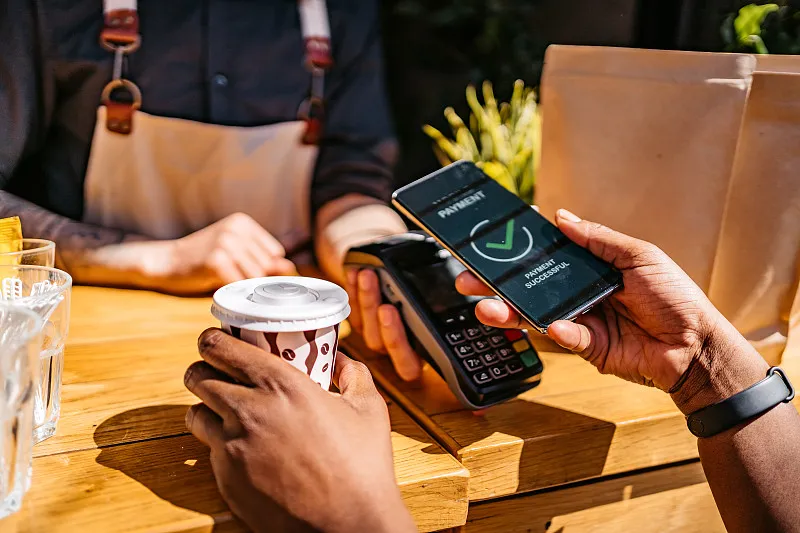
Scan
A QR code turns payment into a quick gesture rather than a conscious handover of money.
Tap
One confirmation can complete a transaction before you have time to reconsider.
Auto-Pay
Money leaves quietly, sometimes without a new decision at all.
This is why mobile payment can make people spend more easily. It is not because people suddenly become more greedy. It is because the resistance around payment becomes smaller.
From “Taking Out Money” to “Just Tapping”
One of the most important moments in spending is not the payment itself.
It is the small hesitation before payment.
Do I really need this? Is the price worth it? Should I buy it now or later? Do I already own something similar? Does this fit my budget this month? Would I feel differently if I had to pay in cash?
Traditional payment methods created small pauses. You took out your wallet, counted cash, waited in line, checked the amount, handed over money, or confirmed the card transaction.
The Missing Speed Bump
Those small inconveniences were not only annoying. They were also tiny speed bumps that gave reason a chance to step in before money left.
Mobile payment removes many of those speed bumps. Platforms want you to move from interest to purchase quickly. Merchants want fewer moments of hesitation. Payment systems are designed to make the process smooth.
The smoother the path, the fewer chances there are to ask whether the purchase actually belongs in your life.
Small Payments Are the Easiest to Ignore
The biggest danger of mobile payment is not always large purchases.
It is small spending.
A cup of milk tea. A delivery add-on. A small online gadget. A short video product recommendation. An app membership. A ride-hailing trip. A game top-up. A livestream flash deal.
Small spending feels harmless because each payment looks too minor to question.
But a budget is rarely weakened by one small purchase. It is weakened by the repeated belief that each small purchase does not count.
“It is only a few dollars.” “It is just this once.” “I worked hard today.” “The amount is not worth worrying about.”
These thoughts are understandable. But when they repeat many times, small expenses become a quiet background drain.
When Money Becomes Numbers, Spending Feels Less Real
In the age of mobile payment, money often exists as numbers on a screen.
Balance is a number. Spending history is a number. Bills are numbers. Coupons are numbers. Points are numbers. Installment payments are also numbers.
Numbers are convenient, but they are abstract.
The Digital Payment Paradox
Mobile payment creates better records, but it can make the actual moment of spending feel lighter and less emotional.
Spending 100 dollars in cash may feel significant. But spending 19.90, 26.80, 35.50, 49.90, and 68.00 through a phone may feel acceptable each time. Only later do those numbers reveal their total weight.
Coupons and Discounts Can Make Spending Feel Like Saving
Mobile payments are often connected to promotional systems.
Full-reduction discounts, coupons, limited-time offers, new-user deals, member prices, second-item discounts, free delivery thresholds, livestream-only benefits — all of these mechanisms shift attention.
Instead of asking, “How much am I spending?” people begin asking, “How much am I saving?”
When Discounts Push Extra Spending
Buying More to Reach a Discount
The original need may be small, but the discount threshold encourages a larger order.
Using Coupons Before They Expire
An expiring coupon can turn “I do not need anything” into “I should not waste this deal.”
Mistaking Spending for Saving
A discount only saves money if the purchase was truly needed in the first place.
Auto-Renewal Makes Spending Silent
Another quiet spending channel is automatic renewal.
Music memberships, video platforms, cloud storage, editing apps, learning tools, fitness apps, office software, delivery memberships, shopping memberships — many subscriptions begin with a small amount.
First month discount. Free trial. Cheaper continuous billing. Cancel anytime.
Auto-renewal turns active spending into default spending.
You make the decision once, but the payment keeps repeating unless you actively stop it.
One subscription may not matter. But ten small subscriptions can become a fixed monthly burden. Mobile payment makes consumption easy to begin; auto-renewal makes it harder to end.
Installments Make “Expensive” Feel Less Obvious
Mobile payment is often connected to installment plans, credit payment, and buy-now-pay-later options.
A product may feel expensive at full price. But when the platform says “only a few dollars a day,” “small monthly payments,” “interest-free installments,” or “pay later,” the price becomes easier to accept.
Installment Illusion
Installments do not always make something cheaper. They often make the price feel smaller by spreading the pain across the future.
The danger is not installment payment itself. The danger is forgetting the total cost. When too many small monthly payments stack up, future cash flow becomes crowded by past decisions.
Instant Gratification Makes Impulse Buying Easier
Mobile payment is not only a payment method. It is part of a wider consumption environment that includes instant delivery, short-video recommendations, livestream shopping, targeted ads, and algorithmic feeds.
You see it. You want it. You tap. You pay. You wait briefly. It arrives.
Desire and ownership are now separated by very little time.
When Shopping Becomes Emotional Regulation
Stress
Buying something small can feel like a quick reward after pressure.
Loneliness
Ordering food or buying something online can briefly create comfort and anticipation.
Boredom
Browsing and buying can become an easy way to fill emotional emptiness.
Many impulse purchases happen at night, when people are tired, anxious, lonely, or emotionally drained. Those are exactly the moments when judgment is softer and comfort feels urgent.
Mobile Payment Makes Shopping Available Everywhere
In the past, spending had clearer locations.
You went to the mall to shop. You went to the supermarket for daily goods. You went to a restaurant to eat. You went to a bank to handle money.
Now, spending can happen anywhere.
The phone carries the mall, the bank, the wallet, the ad screen, and the checkout counter.
Consumption no longer waits for you to enter a store. It appears while you scroll, chat, commute, rest, or try to fall asleep.
When shopping becomes available everywhere, people need stronger personal boundaries. Otherwise, life quietly turns into a store that never closes.
Why Mobile Payment Can Make Budgeting Harder
Budgeting needs visibility.
You need to see how much money you have, where it goes, which expenses are necessary, which are impulsive, and which automatic deductions are still running.
Mobile payment provides records, but spending often becomes fragmented.
Fragmented Spending
Different apps, cards, wallets, credit accounts, subscriptions, installments, and delayed payments can make it difficult to feel your total spending in real time.
You may think you spent only a little today. But another app renewed a membership, a credit payment is due next week, an installment is still active, and a delivery membership was just purchased. The money flow becomes scattered, and the budget loses its full shape.
Easy Buying Can Weaken the Feeling of Ownership
There is another issue that is rarely discussed:
When buying becomes too easy, owning can also feel lighter.
You order quickly, receive quickly, open quickly, and forget quickly. Some things are used only a few times before they sit in a corner.
The value of an item is not only in getting it.
It is in whether it is truly needed, used, appreciated, and able to improve daily life after the excitement of purchase fades.
Mobile Payment Is Not the Problem — Losing Awareness Is
Mobile payment itself is not bad.
It makes life more convenient. You do not need to carry cash. Transfers are easier. Bills can be checked. Online shopping becomes smoother. Small businesses can collect payments more efficiently.
The problem is not the tool.
The problem is whether we still feel money clearly.
Tool or Habit?
If you know what you spend, why you spend it, and whether it brings value, mobile payment is a useful tool. If every month’s bill surprises you, the tool may be quietly shaping your habits.
How to Recover Awareness Around Money
The goal is not to reject convenience. The goal is to add back a little awareness.
Practical Ways to Spend More Consciously
Add Some Payment Friction
Turn off unnecessary password-free payments, add confirmation for larger purchases, and reduce automatic deductions where possible.
Review Bills Weekly
Monthly review is often too late. A weekly check helps you notice spending drift before it becomes serious.
Cancel Unused Subscriptions
Check payment apps, app stores, and platform memberships. If you are not using it now, cancel it first.
Use a 24-Hour Pause
For nonessential purchases, wait one day. If you still need it, the decision will be clearer.
Separate Discounts From Needs
Ask yourself: would I still buy this if there were no coupon? If not, the coupon may be creating the need.
In the Mobile Payment Era, We Need to Live More Intentionally
Mobile payment makes consumption smoother.
But people should not hand their entire financial life over to smooth systems.
Platforms want faster purchases. Merchants want less hesitation. Algorithms want more attention. Payment tools want shorter processes.
The Power of Pause
A conscious pause is one of the most important financial habits in a world designed to remove hesitation.
Am I buying this because I need it, or because I feel bad right now? Do I truly like this, or am I afraid of missing a deal? Will this improve my life, or create more clutter? Am I buying value, or just a moment of comfort? Will I feel lighter or regretful after paying?
Conscious spending does not mean never buying. It means knowing why you buy and why you choose not to.
Final Thoughts
Why do mobile payments make it easier to spend money?
Because they make payment faster, lighter, and less visible.
They reduce the pain of paying, remove the speed bumps before purchase, turn money into screen numbers, make small payments feel harmless, and connect spending with coupons, auto-renewals, installments, instant delivery, and emotional buying.
Mobile payment is not wrong. Convenience is not wrong.
What deserves attention is the moment when spending becomes so easy that we forget what it feels like for money to leave.
Every tap is a choice. It exchanges a small part of future freedom, savings, and security for something in the present. Some exchanges are worth it: necessary living costs, things you truly love, services that bring long-term value, and experiences that genuinely improve life.
But some exchanges are only emotional impulses disguised as needs.
Understanding mobile payment is not about returning to a world without phones. It is about rebuilding money boundaries in a world where paying has become almost weightless.
Convenience can stay.
But awareness must stay too.
Final Reflection: A good financial life is not about buying nothing. It is about knowing what is worth buying, what can wait, and what does not need to enter your life at all.