
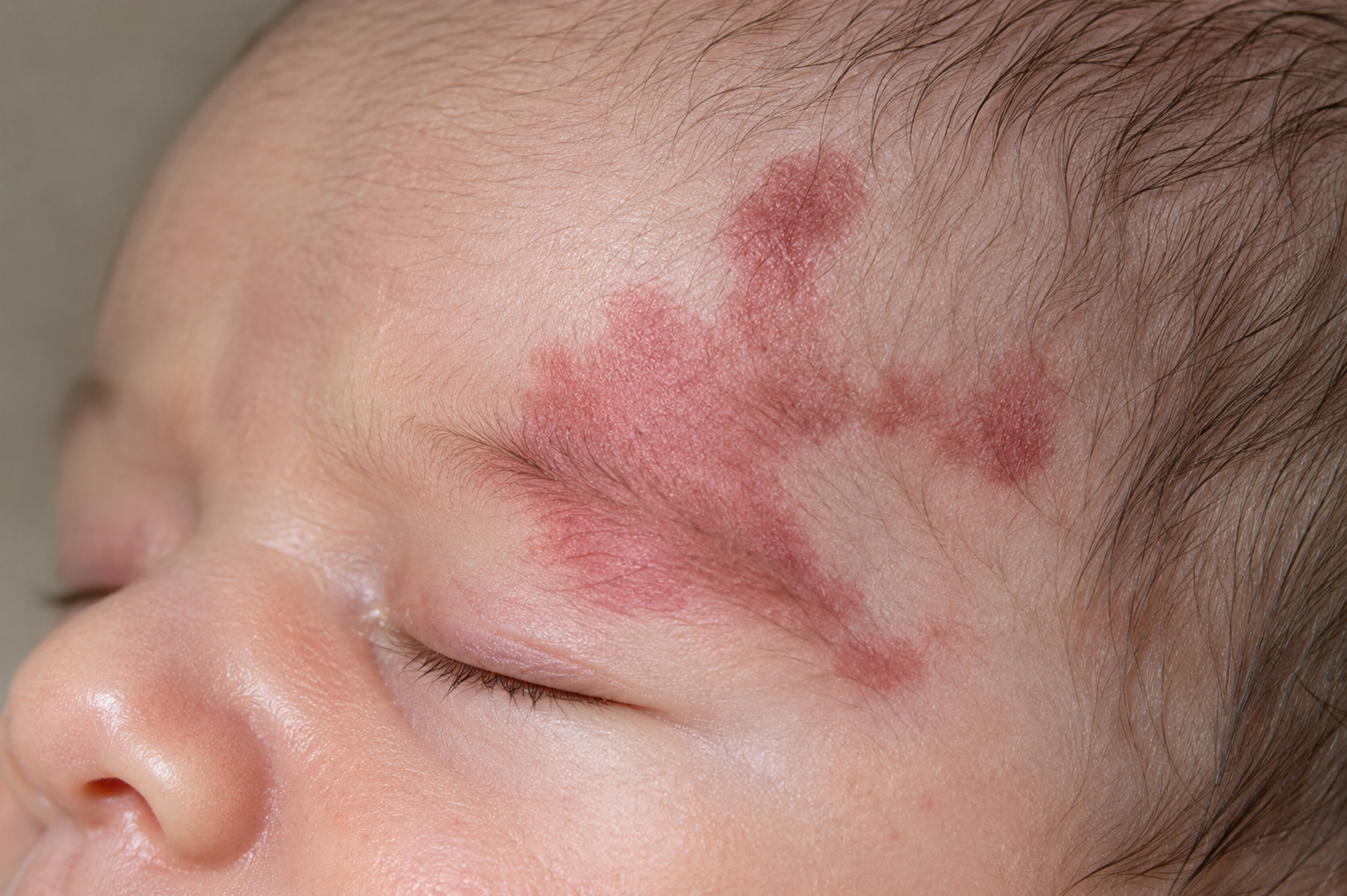
Understanding Port-Wine Stain Birthmarks: Causes, Changes, Treatment Options, and Emotional Support
Article Summary: A port-wine stain is a type of vascular birthmark caused by widened tiny blood vessels in the skin. It usually appears at birth as a flat pink, red, or purple patch and can occur anywhere on the body, though it is often seen on the face, head, arms, or legs. Unlike some birthmarks that fade with time, port-wine stains are usually permanent and may darken, thicken, or develop a bumpy texture as a child grows. Most are not dangerous, but marks near the eye, eyelid, forehead, or large areas of the face should be checked by a doctor because they may be linked to eye pressure problems or rare conditions such as Sturge-Weber syndrome. Laser treatment may help lighten the mark, while emotional support can help children feel confident and accepted.
Port-wine stain birthmarks can be striking, especially when they appear on a baby’s face. Their color may look like a splash of pink, red, or deep purple on the skin, which is why they are called “port-wine” stains. For many parents, the first reaction is worry: Is it painful? Did something cause it during pregnancy? Will it go away? Could it affect the child’s health?
In most cases, a port-wine stain is not caused by anything a parent did or did not do. It is not the result of food, stress, injury, medication, or a mistake during pregnancy. It is a vascular birthmark, meaning it involves blood vessels in the skin. Many port-wine stains are harmless from a medical point of view, but they can still matter deeply because of appearance, location, and the way other people respond.
The best approach is usually a mix of medical evaluation, practical skin care, treatment discussion if desired, and emotional support. A child with a visible birthmark does not need to be made to feel different or fragile. But they may need adults around them to answer questions calmly, protect them from teasing, and help them understand that the mark is only one small part of who they are.
Important Health Note: This article is for general educational purposes only. Any new birthmark, changing skin lesion, bleeding area, painful mark, or port-wine stain near the eye or forehead should be evaluated by a qualified healthcare professional.
What Is a Port-Wine Stain?
A port-wine stain is a permanent vascular birthmark. It is made up of small blood vessels, usually capillaries, that are wider than usual near the surface of the skin. Because more blood is visible in that area, the skin appears pink, red, purple, or darker than the surrounding skin tone.
Port-wine stains are usually present at birth, although they may become more noticeable as the baby grows. They are commonly flat and smooth in infancy. Over time, however, the affected skin may become darker, thicker, or slightly pebbled. Cleveland Clinic notes that port-wine stains can start as smooth pink or red patches and later become larger, darker, or thicker. :contentReference[oaicite:1]{index=1}
They can appear anywhere on the body. Many are located on the face, scalp, neck, arms, or legs, but there is no single “typical” location. The size can also vary widely, from a small patch to a large area covering part of the face or limb.
Simple Explanation
A port-wine stain is a birthmark caused by extra-visible blood vessels in the skin. It is usually not painful, not contagious, and not caused by anything parents did during pregnancy.
What Causes Port-Wine Stains?
Port-wine stains happen because tiny blood vessels in a specific area of skin stay widened instead of narrowing normally. This allows more blood to remain visible through the skin, creating the red or purple color.
Researchers have linked many port-wine stains to changes in genes that affect blood vessel development. These changes occur early in development and are not usually inherited from the parents. In other words, a port-wine stain is generally not something a mother caused by diet, exercise, stress, or behavior during pregnancy.
Although the mark itself is visible on the skin, the process begins beneath the surface. The blood vessels do not “turn off” or tighten as they normally would, so the area remains colored. This is why creams and ordinary skin care products cannot remove a true port-wine stain.
Parent Reassurance: Port-wine stains are not caused by something a parent ate, touched, felt, or did during pregnancy. They are vascular birthmarks related to how small blood vessels developed.
How Port-Wine Stains Change Over Time
Unlike some common newborn marks that fade during early childhood, port-wine stains usually do not disappear on their own. They tend to grow in proportion to the child’s body. This means the mark may look larger as the child grows, even though it is not spreading in the same way an infection or rash would.
The color may also deepen with age. A light pink mark in infancy may become redder, darker red, purple, or burgundy later in life. Some adults develop thickened skin, small raised areas, or nodules within the stain. DermNet describes port-wine stains as capillary vascular malformations that can persist and may respond to pulsed dye laser with variable results. :contentReference[oaicite:2]{index=2}
A port-wine stain should not usually itch, hurt, or bleed. If it becomes painful, frequently bleeds, develops sores, or changes suddenly, it should be checked. Dryness can happen, especially if the affected skin becomes thicker, and gentle moisturizing may help.
Are Port-Wine Stains Dangerous?
Most port-wine stains are not dangerous. Many people have them without any related health problem. A port-wine stain on the arm, leg, trunk, or another body area may be mainly a cosmetic concern, depending on size and location.
However, some locations require closer medical attention. A port-wine stain near the eye or on the eyelid may be associated with glaucoma, which is increased eye pressure that can affect vision. A large facial port-wine stain, especially one involving the forehead or eyelid, may require evaluation for Sturge-Weber syndrome.
Cleveland Clinic describes Sturge-Weber syndrome as a blood vessel condition involving the skin, brain, and eyes, with possible features including a facial port-wine stain, glaucoma, and abnormal blood vessels affecting the brain. :contentReference[oaicite:3]{index=3}
Medical Reminder: A baby with a port-wine stain on the eyelid, around the eye, or on the forehead should be evaluated by a doctor. An eye exam may be recommended to check for glaucoma risk.
Port-Wine Stains and Sturge-Weber Syndrome
Sturge-Weber syndrome is rare, and most children with a port-wine stain do not have it. Still, it is important enough that doctors pay attention to certain facial birthmark patterns. The condition can involve abnormal blood vessels in the brain and eyes, which may lead to seizures, glaucoma, developmental delay, headaches, or weakness on one side of the body.
The risk is not the same for every port-wine stain. Marks located on the forehead, upper eyelid, or midline face are generally considered more concerning than small marks on other parts of the body. If a doctor sees a higher-risk pattern, they may recommend referral to specialists such as a pediatric dermatologist, ophthalmologist, or neurologist.
How Doctors Evaluate a Port-Wine Stain
A doctor can often recognize a port-wine stain by appearance and history. They will look at the color, location, size, texture, and whether it has been present since birth. They may also ask whether the mark has bled, thickened, become painful, or changed quickly.
If the port-wine stain is near the eye or on the face in a higher-risk pattern, the doctor may recommend an eye exam or further evaluation. In selected cases, imaging may be discussed if there are symptoms such as seizures, developmental concerns, weakness, or signs suggesting brain blood vessel involvement.
Helpful Questions to Ask the Doctor
Is this definitely a port-wine stain or another type of birthmark?
Does the location suggest any eye or brain-related risk?
Should my child see an ophthalmologist?
Should we consider laser treatment now or wait?
How might the birthmark change as my child grows?
What signs would mean we should come back sooner?
How can we protect the skin and support my child emotionally?
Laser Treatment for Port-Wine Stains
Laser treatment is the most common treatment used to lighten port-wine stains. The goal is usually not to “erase” the birthmark completely, but to make it lighter, reduce contrast with surrounding skin, and sometimes prevent or reduce thickening over time.
Pulsed dye laser is often considered a standard treatment for many port-wine stains. DermNet notes that pulsed dye laser appears to be the treatment of choice for most port-wine stains, though results vary and multiple sessions are often needed. :contentReference[oaicite:4]{index=4}
Treatment works best for some people when started early, but timing depends on the child, location, skin type, anesthesia needs, family preference, and specialist recommendation. Some port-wine stains respond very well, while others lighten only partially or may darken again over time.
Treatment Perspective: Laser treatment is a personal decision. Some families choose early treatment, some wait, and some choose no treatment. The right choice depends on medical factors, expected benefit, cost, access, and the child’s well-being.
Daily Skin Care for a Port-Wine Stain
Most port-wine stains do not require complicated daily care. Gentle skin care is usually enough. If the area becomes dry, a mild moisturizer can help. If the mark is on sun-exposed skin, sunscreen is important because sunburn can irritate the area and may make contrast more noticeable.
Avoid harsh scrubbing, irritating products, or aggressive exfoliation over the birthmark. If the skin becomes raised, cracked, or bleeds easily, ask a dermatologist for guidance.
Moisturize
Use a gentle moisturizer if the area feels dry or tight.
Use Sun Protection
Sunscreen, hats, and shade can help protect sensitive or treated skin.
Avoid Irritation
Skip harsh scrubs, strong acids, or products that sting the area.
Emotional Support for Children With Port-Wine Stains
For many children, the medical side of a port-wine stain is only part of the experience. The social side can be harder. A visible mark on the face, neck, or arm may draw questions from strangers, classmates, or other children. Some questions may be innocent. Others may feel rude or hurtful.
Parents can help by giving the child simple words to use. Instead of forcing long explanations, prepare a short answer: “It’s my birthmark. I was born with it.” That may be enough. Older children may want more privacy or more control over how they talk about it.
It also helps to talk openly at home. The birthmark should not become a secret or a source of shame. At the same time, it should not be the only thing adults focus on. Children need to hear that they are funny, smart, kind, creative, strong, curious, and loved — not just “brave about their birthmark.”
Helpful Script for Kids: “It’s called a birthmark. I was born with it. It doesn’t hurt, and it’s just part of my skin.”
Helping With School, Friends, and Confidence
School can be a turning point because children may become more aware of differences. A child with a port-wine stain may hear repeated questions or comments. Even when the comments are not cruel, the repetition can be tiring.
Parents can speak with teachers before the school year begins if the child is comfortable with that. Some children may want the teacher to know quietly. Others may want to explain the birthmark to the class once and move on. The child’s preference should guide the approach whenever possible.
Cosmetic Coverage and Personal Choice
Some people choose cosmetic camouflage makeup to reduce the visibility of a port-wine stain for certain occasions, photos, performances, or everyday comfort. Others prefer not to cover it at all. Both choices are valid.
For children, adults should be careful not to send the message that the birthmark must be hidden. If makeup or coverage is used, frame it as an option, not a requirement. As the child grows, they should have more say in whether they want treatment, coverage, or neither.
Confidence Reminder: Treating or covering a port-wine stain is a personal choice. Leaving it visible is also a valid choice. The goal should be comfort, not pressure.
When to Seek Medical Advice
A port-wine stain should be discussed with a healthcare provider, especially when it is first noticed in a baby. Most are not urgent, but a doctor can confirm the diagnosis and decide whether any specialist evaluation is needed.
Call or Visit a Doctor If:
The birthmark is on the eyelid, near the eye, or on the forehead.
The mark bleeds, ulcerates, becomes painful, or changes suddenly.
The skin becomes thick, raised, or develops nodules.
The child has seizures, weakness, developmental concerns, or severe headaches.
The child’s eye looks enlarged, cloudy, painful, or unusually sensitive to light.
The birthmark is causing significant emotional distress or social difficulty.
Frequently Asked Questions About Port-Wine Stains
Do port-wine stains go away on their own?
Usually, no. Port-wine stains are generally permanent and tend to grow with the child. They may become darker or thicker over time.
Are port-wine stains painful?
Most are not painful. If the area hurts, bleeds, cracks, or develops sores, it should be checked by a doctor.
Can laser treatment remove a port-wine stain completely?
Laser treatment can often lighten a port-wine stain, but complete removal is not guaranteed. Many people need multiple sessions, and results vary.
Does a port-wine stain mean a child has Sturge-Weber syndrome?
Most children with port-wine stains do not have Sturge-Weber syndrome. However, certain facial patterns, especially involving the forehead or eyelid, need medical evaluation.
Final Thoughts: A Port-Wine Stain Is Medical, Visible, and Personal
A port-wine stain is more than a color difference in the skin. For some families, it is a medical question. For some children, it becomes a social experience. For some adults, it is simply part of their identity. All of these responses can be valid.
The most important first step is proper evaluation, especially when the birthmark is near the eye or on the forehead. After that, families can discuss treatment options, skin care, emotional support, and school or social strategies at a pace that feels right.
Whether a port-wine stain is treated, covered, or left exactly as it is, the child should receive the same message: this mark does not define their worth, personality, beauty, or future.
Final Reminder: Port-wine stains are usually harmless but permanent vascular birthmarks. Medical evaluation, possible laser treatment, gentle skin care, and strong emotional support can help children and adults manage both the health and confidence sides of living with one.