
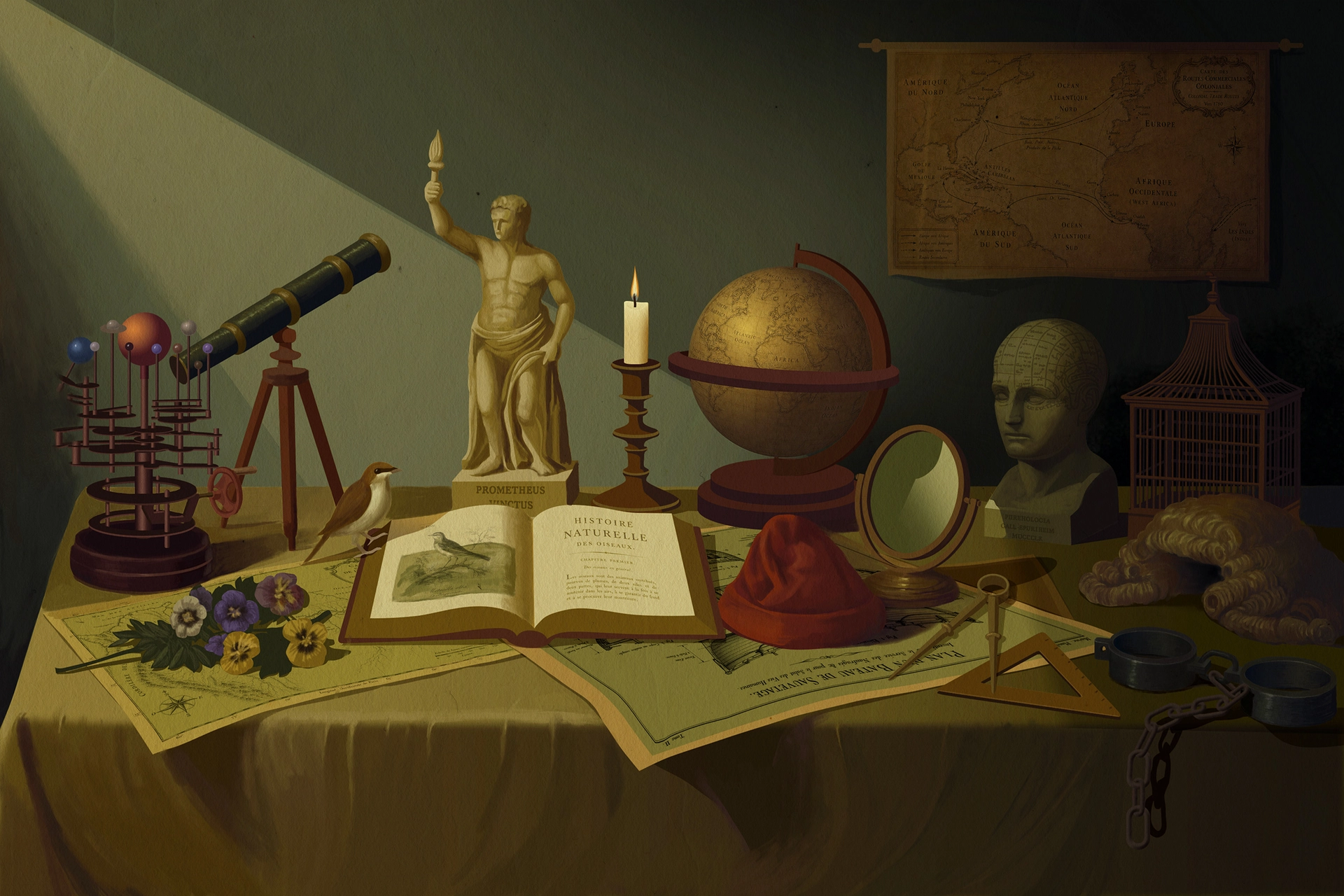
Flickering Enlightenment
The Enlightenment is passing through an awkward and dangerous moment. It was once treated as a source of light for the modern world: reason, science, liberty, human rights, progress, public discussion and suspicion of inherited authority all seemed to find some of their intellectual origins there. Today, however, that light is being questioned, dismantled and even mocked from several directions at once. Critics on the Left argue that the Enlightenment was never simply a story of reason and freedom. It was also entangled with colonialism, slavery, racial hierarchy and white European self-regard. Many thinkers celebrated as founders of modern thought spoke of universal humanity while failing to include Black people, women, the poor or colonised peoples within that universal category. They praised liberty while benefiting from a slave economy; they defended reason while placing white Europeans at the top of civilisation’s ladder.
This criticism is not groundless. David Hume once wrote that non-white races were “naturally inferior to the whites”; Kant wrote that the white race represented the highest perfection of humanity. Locke, Rousseau, Voltaire and others wrote about liberty, reason and human progress in ways that were often accompanied by assumptions of European superiority. The University of Edinburgh’s recent reckoning with its own history shows that the Enlightenment is not an innocent intellectual inheritance. Some leading figures of the Scottish Enlightenment did help spread ideas of racial hierarchy, and the university itself has admitted that it still holds bequests connected to donors linked with slavery and colonial conquest. In other words, the Enlightenment did not always stand outside empire in order to criticise it. At many moments, it provided empire with languages of classification, explanation and legitimacy.
But the Enlightenment is not attacked only from the Left. The populist Right also despises it, though for different reasons. What the Right attacks is not the Enlightenment’s imperial shadow, but its legacy of democratic institutions, expertise, international order, scientific inquiry and public reason. Those who defend facts, law, expert judgment and human rights are portrayed as arrogant liberal elites, as though they were not defending the fragile conditions of modern public life but conspiring against ordinary people. In this story, Enlightenment values no longer stand for liberation from tyranny and superstition. They become symbols of a hated power. Justice, accountability, social fairness, scientific progress and international cooperation — goals that once appeared almost self-evidently desirable — are pulled into the fury of anti-elite, anti-expert, anti-institutional politics.
More ironically still, Silicon Valley’s technological elites have seized the language of Enlightenment in another way. Some advocates of artificial intelligence now claim that large language models are bringing about a “second Enlightenment”, as though more data, stronger models and faster computation were the same as reason, knowledge and human progress. But if this so-called new Enlightenment merely encourages machines to repeat, amplify and package what we already believe, if what it produces is information sludge, clickbait, deepfakes and automated nonsense, then it is not the continuation of the Enlightenment but the exhaustion of its legacy. The true spirit of Enlightenment is not to stop judging and outsource thought to machines. It is to judge more clearly, argue more honestly and admit more humbly that we may be wrong.
So the question before us is not simply whether we should defend the Enlightenment. The real question is what in it we should defend, and what we should abandon. If we refuse to acknowledge the Enlightenment’s entanglement with racism, colonialism and gender exclusion, we turn it into an empty exercise in Western self-congratulation. But if, because of these failures, we discard the Enlightenment wholesale, we may surrender reason, facts, public argument and universal rights to post-truth politics, conspiracy thinking, authoritarian power and technological capital. The Enlightenment is not a sacred object to be inherited without reservation, nor a heap of ruins to be burned without remainder. It is more like a complicated site: marked by violence, blindness and arrogance, but also containing tools we still need.
The Light of Enlightenment and the Shadow It Casts
To discuss the Enlightenment, we first have to admit that it was not a single, neat or internally consistent project. Broadly speaking, it emerged in the 17th and 18th centuries alongside the establishment of scientific method, the growth of empirical inquiry, the weakening of religious authority and the expansion of secular knowledge. Francis Bacon and his circle rejected alchemy, mysticism and superstition in favour of experiment and observation. In 18th-century France, Voltaire, Diderot, d’Alembert and Montesquieu promoted secular knowledge and public reason. The Encyclopédie sought to organise knowledge for future generations and the improvement of humanity; Montesquieu argued for the separation of powers to prevent tyranny; Voltaire defended tolerance and reason; Kant defined Enlightenment as humanity’s release from self-incurred immaturity, the courage to use one’s own understanding without another’s guidance.
That spirit remains inspiring. It asks people not to submit blindly to tradition, authority, custom or collective agreement. It trusts that thought can free itself from prejudice, that knowledge can be discussed publicly, and that opinions should compete through argument rather than violence. It encourages human beings to stand up against dogma, to question the world, to question rulers, and to question the beliefs they have inherited. However sharply we criticise the Enlightenment today, this part of it should not be discarded lightly. Without this spirit of rational critique, it is difficult to imagine the emergence of modern science, public education, representative democracy, the rule of law, human rights and traditions of resistance to tyranny.
Yet the difficulty of the Enlightenment lies precisely here. It proclaimed universal reason while repeatedly excluding certain people from universality. It spoke of “man”, but that “man” was often assumed to be European and male. It spoke of freedom, but did not always recognise enslaved people or colonised peoples as subjects of freedom. It spoke of reason, but excluded women from full rational standing. It spoke of civilisational progress, but often placed non-European societies in positions of savagery, backwardness or childhood. Mary Wollstonecraft, in A Vindication of the Rights of Woman, had already exposed this contradiction: if reason and freedom are truly universal values, they must include women; if they do not, then universality is merely privilege in disguise.
Race science is one of the Enlightenment’s hardest shadows to avoid. Linnaeus’s classificatory system brought order to the natural world, but it also classified human beings by skin colour and physical traits, placing them within a hierarchical system of knowledge as though they were plants or animals. Voltaire accepted polygenism, the idea that different ethnic groups had different origins, and associated the maturity of reason with Western Europe. Kant’s writings on race placed whites at the highest level of human development even more directly. These were not harmless footnotes, and it is not enough to say that these thinkers were merely people of their time. Of course they were shaped by their age. But their thought also served the economic and political order of that age. So-called natural hierarchies were not natural at all. They gave colonial expansion, slavery and European domination the appearance of reason.
For that reason, the standard defence — that these thinkers may have been racist, but that their racism was separate from their moral philosophy — is insufficient. The problem is not only that some great thinkers happened to hold prejudiced views. It is that the Enlightenment’s language of reason, civilisation and progress often grew together with Eurocentrism. It turned some people’s experience into universal experience, some societies’ path of development into humanity’s path, and some groups’ domination into the result of rational maturity. In this way, the Enlightenment could liberate, but it could also discipline. It could oppose tyranny, but it could also help empire organise the world.
Still, to judge the Enlightenment entirely as a tool of colonialism would also be too simple. Within the Enlightenment there were always forces opposing slavery, despotism and inherited privilege, and defending common humanity and equal rights. Diderot wrote sharply against slavery in anti-colonial works. Condorcet insisted that Europeans must recognise people in other climates as equals and brothers by nature. The Haitian Revolution, abolitionist movements, anticolonial thinkers and W E B Du Bois all drew strength from Enlightenment claims about shared humanity and emancipation through reason. In other words, the Enlightenment was not only the language of oppressors. It also became a language with which the oppressed answered them.
This complexity matters. The Enlightenment was not a weapon pointing in only one direction, but a conflicted field of intellectual struggle. Its universalism was often betrayed, but precisely because it had proclaimed universalism, later generations could demand that it fulfil its promise. Its idea of reason was used to classify and dominate, but also to expose superstition, resist tyranny, criticise enslavement and demand freedom. What we need today is not to paint the Enlightenment white, nor to paint it black. We need to recognise it as a dangerous but still valuable inheritance.
Why We Still Need Reason and Public Argument
In today’s culture wars, reason occupies a strange position. To some critics on the Left, it seems to have become a tool of white male domination. To some populists on the Right, it is an excuse used by liberal elites to control the public. Experts, universities, media organisations, scientific communities, international institutions and cultural bodies are constantly portrayed as arrogant fortresses of power. But if we look closely at the real distribution of power, this story becomes absurd. Book editors, curators, university teachers and journalists certainly possess a kind of cultural capital, but they are not in the same universe of power as tech giants, billionaires, platform companies and authoritarian political figures. What truly reshapes public reality today is not a handful of terms used at academic conferences, but algorithms, capital, state violence, propaganda systems and data platforms.
This is why abandoning Enlightenment values altogether is so dangerous. Newspaper circulation is falling, attention is fragmented, public discussion is being sliced into emotional echo chambers, and the basis of shared fact is collapsing. Misinformation, conspiracy theories, deepfakes and AI-generated content are multiplying, making it harder to distinguish what is true from what has merely been manufactured. If we no longer defend facts, evidence, argument and public reason, what remains is not a more equal order of knowledge, but a more naked struggle for power. Whoever controls the platform, the money, the violence and the machinery of distribution will define reality.
Of course, reason is not omnipotent. Overconfident reason can become arrogant. It can look down on habit, emotion, embodied experience, religious tradition and tacit knowledge. It can also suppress voices that cannot yet be accommodated within dominant systems of knowledge in the name of “science”. In Dialectic of Enlightenment, Adorno and Horkheimer warned that the Enlightenment’s extreme insistence on reason could turn into domination, instrumentalisation and violence. Foucault reminded us that “reason” often defines who counts as normal and who is mad, criminal, vagrant or dangerous. Rousseau suspected even earlier that civilisation and reason might not make human beings better, but might instead corrupt something more innocent in human nature.
These criticisms deserve to be taken seriously. Defending reason does not mean treating every disagreement as stupidity, nor does it mean turning expert opinion into a new dogma. Someone hesitant about vaccination, for example, is not necessarily simply “irrational”. Their fear may come from anxiety about bodily autonomy, from genuine fear of medical harm, from mistrust after long experience of institutional betrayal, or from doubts planted by misleading information. If we merely strike them with the phrase “science has proved it”, we often make them more defensive. True rational discussion does not humiliate the other person. It tries to understand why they believe what they believe, and then uses facts, sympathy and patience to change judgment.
Similarly, populism should not be dismissed as pure irrationality. Many people turn to populist politics not because they naturally hate facts, but because they have long felt that politics does not work, that life is stagnant, that elites do not listen and institutions do not respond. When a candidate promises total change, that promise can be powerfully attractive. The problem is that frustration can be directed towards democratic reform, but it can also be directed towards hatred, exclusion and authoritarian worship. If reason is to matter again, it cannot simply stand above the crowd and declare people stupid. It must explain real pain and offer more credible answers than conspiracy theory and strongman politics.
What we need, then, is humble reason rather than self-glorifying reason. Reason should be an aspiration, not a form of self-deification. It asks us to believe that evidence is more reliable than emotion, that argument is better than abuse, and that open discussion is more legitimate than secret manipulation. But it also asks us to admit that human understanding is limited, that experts can be wrong, that institutions can be corrupted by power, and that claims of objectivity can hide prejudice. The part of the Enlightenment most worth preserving is not the attitude that says, “I already possess the truth.” It is the spirit and structure of constant testing, revision and public challenge.
If our world is undergoing de-enlightenment, the problem is not only that people no longer believe in reason. It is also that they believe too firmly that they already know. Every person can find online material to support their own prejudices. Every conspiracy theory can be packaged as “another truth”. Every emotion can be instantly confirmed. We do not lack confidence; we lack humility. We do not lack expression; we lack discernment. We do not lack information; we lack judgment. If the Enlightenment still matters, it is because it reminds us that free thought does not mean believing whatever we like, and resistance to authority does not mean refusal of knowledge.
Tolerance, Universalism and the Difficulty of Living Together
One of the most easily misunderstood values of the Enlightenment is universalism. It claims that all people should be understood as members of the same human community, possessing certain shared rights and dignity. This ideal is certainly dangerous, because historical universalism has often been defined by dominant groups, who then demanded that others assimilate in the name of the universal. St Paul’s embrace of the Jews may be warm, but it can also erase the boundaries of Jewish identity. French republicanism claims religious neutrality and equality, yet many Muslims have experienced it as a suppression of their particular identity. Universalism, if it does not recognise difference, can easily become the disguise of the majority culture.
But abandoning universalism completely is just as dangerous. If every group insists only on its own particularity, if every individual appeals only to “my truth”, if shared standards are treated as oppression, then public life becomes almost impossible. We still need a genuinely egalitarian universalism: one that does not erase difference, but insists that different people can argue within the same public world; one that does not require everyone to become the same kind of person, but demands that everyone possess the same basic dignity; one that does not treat peaceful disagreement as failure, but as a condition of political maturity. A society that can demand recognition but cannot tolerate opposition will quickly become tribalised in a new way.
Voltaire said that discord is the great illness of humankind, and tolerance its only remedy. The tolerance at stake here is not weakness, nor is it the belief that all opinions are equally good. It is the recognition that living together is difficult. Eighteenth-century Europe was emerging from the shadow of religious war, and one central Enlightenment question was how people with fundamentally different beliefs might live together without destroying one another. That question remains urgent today. The danger of culture war is that opponents cease to be people who must be answered and become people who must be expelled, shamed or destroyed. Once public argument becomes a ritual of exclusion, Enlightenment has already failed.
This does not mean we should tolerate everything. Racism, sexism, authoritarianism, incitement to violence and lies must be opposed. But opposition is not always the same as cancellation. If a culture knows only how to block, expel and label, but no longer how to argue, criticise and persuade, it loses the ability to distinguish error from enemy. A public reason confident in itself does not need to treat every uncomfortable idea as a contaminant. It should be able to explain why a view is wrong, why an argument fails, and why a political programme is dangerous. Otherwise, anti-prejudice itself can become another form of dogma.
One modern institutional achievement of universalism is the Universal Declaration of Human Rights. It certainly has a Western intellectual background, and it has certainly faced challenges from non-Western traditions. Confucian traditions, for example, often emphasise the self as defined by communal relations rather than by isolated individual rights. But this does not mean we should allow universal human-rights institutions to collapse. On the contrary, precisely because the international order is under attack from neo-totalitarianism, nationalism and strongman politics, we need to preserve institutions that can protect the weak, constrain the strong and subject power to scrutiny. They are imperfect, often hypocritical and frequently manipulated by powerful states. But without them, the world will not become fairer. It will become more naked.
Today, many people attack the so-called liberal elite without seeing where real elite power lies. Real concentrated power belongs to tech companies, financial capital, billionaires, data platforms, authoritarian governments and political strongmen. They can reshape the information environment, influence elections, determine labour conditions, and steer policies on war and energy. By comparison, universities, publishers, museums, newsrooms and scholarly communities are largely on the defensive. To direct most of our anger at these fragile institutions is often not to weaken power, but to help greater power escape scrutiny.
Defending Enlightenment universalism, then, is not the same as defending Western narcissism. It is defending a language through which the weak can make demands of the strong. It is precisely because there exists a universal claim that “all people have rights” that the excluded can say: that includes us too. Women, enslaved people, colonised peoples, ethnic minorities, stateless persons and the poor have all used universalism against rulers who failed to honour their own promises. The history of universalism is full of betrayal. But its betrayals do not cancel its power.
Morality Is What Keeps Reason from Becoming Cold
Reason alone, however, is not enough. The accumulation of knowledge does not automatically produce progress, and scientific method does not automatically produce justice. If the Enlightenment is to avoid becoming a cold instrumental reason, it must be joined to morality. What may be more urgent today than defending reason in the abstract is defending a basic moral sense. Lies are dangerous not only because they contradict facts, but because they express disrespect for other people. When governments or corporations lie, they are usually concealing a project that cannot be morally defended. If a plan could be publicly justified, deception would not be necessary.
In this respect, the later Enlightenment language of sympathy, empathy and care deserves renewed attention. Adam Smith was not only a thinker of markets; he also wrote The Theory of Moral Sentiments, stressing the human capacity to feel the suffering of others. Burke, too, cared about custom, relation and emotional bonds. Kant, in a cosmopolitan context, wrote that a violation of rights in one part of the world is felt everywhere. Such ideas remind us that reason cannot mean only calculation, classification and control. It must be restrained by an ability to feel the pain of others. Otherwise reason can serve the most immoral projects.
This is also why counter-Enlightenment narratives are no more reliable than Enlightenment myths. Pandora opening the box and Eve eating the apple express an ancient fear: that knowledge brings disorder, that inquiry destroys order, that human beings are punished for crossing boundaries. But reality often suggests the opposite. Chaos comes not from knowledge, but from ignorance; not from critique, but from blind belief; not from excessive understanding, but from the refusal to understand. Climate crisis did not emerge because we knew too much, but because too many people refused to accept what was already known. Public-health crises are not the result of too much science, but of rumour and mistrust eroding public judgment. Authoritarian politics does not grow because people are too rational, but because they are too easily driven by fear, resentment and false promises.
Of course, we must maintain epistemological humility. Human knowledge is limited, and future generations will judge our blind spots just as we judge those of the past. We should not too quickly sort historical figures into simple categories of good and bad. Some Enlightenment thinkers wrote racist sentences; others opposed slavery. Some defended liberty while limiting it to a few; others genuinely tried to widen the boundaries of human community. History is not a moral scorecard. It is a complex storehouse from which we must learn, discern and choose.
The Enlightenment spirit most worth preserving may not be a naive belief in progress, but an attitude of permanent critique. In “What Is Enlightenment?”, Foucault described Enlightenment as a philosophical ethos: a permanent critique of the historical era in which we live. This definition is more powerful than reducing Enlightenment to reason, science and progress. It requires us not only to criticise the world, but also to criticise ourselves; not only to expose other people’s superstitions, but to examine our own prejudices; not only to oppose power, but to notice how we reproduce it.
Neither the contemporary Left nor the contemporary Right is particularly good at such self-critique. Parts of the Left too easily fall into moral superiority, treating recognition of identity as the whole of politics while neglecting larger structures of economic power, class and technological capital. Parts of the Right are trapped in nostalgia for Western greatness, concealing their own ideological agenda under the language of “balance” and defending the status quo as tradition. Both evade the deeper Enlightenment demand: to argue patiently, to doubt oneself seriously, and to direct critique towards the power structures on which one depends.
What Is Still Worth Saving from the Ruins
We do not need a beautified Enlightenment, nor do we need a wholly cancelled one. We need discernment: the ability to recognise which parts of the inheritance are no longer acceptable and which parts remain necessary for the future. Racial hierarchy, Eurocentrism, gender exclusion and colonial arrogance should not be defended. They are not charming remnants of an old age, but intellectual structures that caused real harm. But reason, fact, public discussion, intellectual humility, tolerance, universal human rights, criticism of authority and open inquiry should not be thrown away with them. To hand all of these to conservatives or technological capital would be a political and intellectual failure.
We should be especially wary of the tendency to equate expertise, cultural capital and high intellectual standards with privilege as such. Knowledge can certainly serve power; universities and media institutions certainly carry class, racial and gender biases. But a world without standards of knowledge will not automatically become democratic. It is more likely to become a world in which truth is decided by traffic, money, manipulation and authority. Experts are not saints, but anti-expert politics often does not liberate the public. It deprives the public of tools for resisting lies. What we need is not the destruction of expertise, but expertise that is more transparent, more self-critical and more accountable to the public.
The complexity of the Enlightenment is actually useful in our age of binaries. It reminds us that people and ideas in history are rarely wholly clean, and rarely wholly useless. We can take from the past what remains valuable while clearly refusing what no longer belongs to us. We can say that certain ideas may have been acceptable to some people then, but they are not acceptable to us now. We can also say that some values, though used hypocritically, are still worth realising more honestly. This is a more mature attitude than either simple worship or simple cancellation.
The Enlightenment’s true legacy may not be a fixed set of answers, but a method: do not fear knowledge, do not submit to authority, do not treat tradition as truth, do not treat personal feeling as the final judge, do not replace argument with group identity, and do not let power monopolise reality. It asks us to keep reading our own age, to keep examining public language, to keep asking who is excluded, who benefits, who lies and who is silenced. This kind of Enlightenment is not complacent centrism. It is a radical discipline of thought.
So we should rescue the Enlightenment baby from the muddied bathwater. Not because it is pure, but because we still need it. We need reason, but as an aspiration rather than an absolute. We need universalism, but one that actually includes the excluded. We need experts, but experts who can be criticised. We need free discussion, but also moral responsibility. We need opposition to prejudice, but not the replacement of old dogmas with new ones. The best part of the Enlightenment is not that it once claimed to possess the light. It is that it taught people to keep looking for sources of light, and to distrust anyone who says the light belongs only to them.
Future generations will judge us, just as we judge the thinkers of the Enlightenment. They will see our blind spots, hypocrisies and self-interest. They will also judge what we preserved and what we abandoned in a time of confusion. We cannot guarantee that we will be innocent. But we can try not to abandon discernment. We can admit that the Enlightenment of the past was not universal enough, not equal enough and not humble enough, while still insisting that without facts, reason, public discussion and a minimal commitment to common humanity, we will not move towards a freer world. We will move towards one that is easier to manipulate, more cruel and darker.