The Ocean Is Sending a Warning: From Coral Bleaching to Food Chain Pollution
Article Summary: The ocean does not always warn us with storms, waves, or dramatic disasters. Sometimes the warning is quieter: a coral reef turning white, plastic fragments drifting across the surface, microplastics entering fish, or mercury and other pollutants moving through the food chain. Coral bleaching tells us that warming seas are reshaping the foundations of marine ecosystems. Food chain pollution reminds us that what humans release into the ocean may eventually return to our plates in another form. The ocean is not a distant blue background. It is part of the climate system, food security, coastal economies, biodiversity, and human health. When the ocean becomes warmer, more acidic, more polluted, and less alive, it is telling us something simple but difficult to ignore: there is no true “away” on this planet.
Many people imagine the ocean as something too vast to be wounded.
It receives rivers, absorbs storms, carries ships, and stretches beyond the horizon. For a long time, it was easy to believe that the ocean could also absorb our waste, our plastic, our chemicals, and our mistakes.
We throw plastic packaging into bins, send wastewater into pipes, release emissions into the sky, and let industrial pollution, agricultural runoff, disposable products, and invisible particles drift toward somewhere far away.
The ocean seems to remain there: wide, silent, blue.
But the most unsettling truth is that the ocean does not erase everything. It stores many problems more slowly, more deeply, and more quietly. Then, one day, we see coral reefs turning white, seabirds with plastic in their stomachs, pollutants accumulating in large fish, and seawater becoming warmer and more acidic.
The Core Idea
The ocean is not the end point of human waste. It is a living system that eventually returns our choices to us through ecosystems, food chains, weather, coastlines, and health.
Coral Bleaching: When the Ocean’s Most Beautiful Places Lose Their Color
The phrase “coral bleaching” can sound almost gentle, as if it were only a change in color.
But coral bleaching is not simply a visual change. It is a biological warning.
Healthy corals often live in partnership with microscopic algae. These algae help provide food to the coral and give reefs much of their color. When ocean temperatures rise too high or environmental stress becomes too intense, corals can expel these algae. What remains is a pale, white, vulnerable structure.
Bleached coral is not always dead. If conditions improve quickly enough, some corals can recover. But if heat stress continues too long, the coral may starve and die.
A white reef is not a blank canvas.
It is a stressed living community, pushed close to the edge by heat, pollution, and environmental pressure.
In recent years, this warning has become global. NOAA and the International Coral Reef Initiative confirmed the fourth global coral bleaching event in 2024. From January 2023 to September 2025, bleaching-level heat stress affected about 84.4% of the world’s coral reef area, with mass bleaching documented in at least 83 countries and territories.
This is not a small local event. It is the ocean showing a fever across reef systems around the world.
Coral Reefs Are Not Decorations. They Are Underwater Cities.
If you only know coral reefs from photographs, it is easy to think of them as scenery: colorful, beautiful, and perfect for diving.
But coral reefs are not ocean decorations. They are more like underwater cities.
Fish hide there. Young marine life grows there. Species feed, reproduce, compete, and form complex relationships around reef structures. Although coral reefs cover a relatively small part of the ocean, they support an extraordinary share of marine biodiversity.
When a Reef Declines, More Than Coral Is Lost
Habitat Disappears
Fish and young marine organisms lose shelter, feeding grounds, and nursery spaces.
Food Webs Shift
Predator-prey relationships and reef-dependent species can be disrupted.
Human Communities Feel It
Tourism, fisheries, coastal protection, and local economies can all be affected by reef loss.
When a reef dies, it is not only a beautiful view disappearing underwater. It is the collapse of a living community.
Warming Seas Are Not Just a Number
When people talk about global warming, they often think first about air temperature: hotter summers, heat waves, and uncomfortable cities.
But the ocean has absorbed enormous amounts of heat from the climate system. Warmer seawater affects coral, fish, plankton, seagrass, shellfish, and entire marine food webs. For coral reefs, even a period of unusually high temperature can trigger bleaching.
This is why a seemingly small temperature increase can become a survival crisis in the ocean.
Marine life can adapt to some change. Nature has always changed. But the problem now is speed, intensity, and overlap. Warming, acidification, pollution, overfishing, habitat destruction, and extreme weather are not arriving one by one. They are pressing on the same ecosystems at the same time.
Ocean Pressure
Coral is not facing heat alone. It is trying to survive in an ocean that is becoming warmer, more acidic, more polluted, and less stable.
Ocean Acidification: The Invisible Chemical Warning
Another pressure on the ocean is acidification.
It is less visible than coral bleaching. The water does not suddenly change color. Fish do not rise to the surface and announce a shift in pH. But the chemistry of the ocean is changing.
As the ocean absorbs carbon dioxide, seawater chemistry changes and pH decreases. This can make it harder for organisms such as corals, oysters, mussels, and other shell-building creatures to form and maintain calcium carbonate structures.
Corals are being asked to rebuild in harder conditions.
Heat can cause bleaching, while acidification can make growth and recovery more difficult. The window for resilience becomes narrower.
Plastic Pollution: Humanity’s Floating Legacy
If coral bleaching is a sign of the ocean overheating, plastic pollution is a visible trace of human consumption.
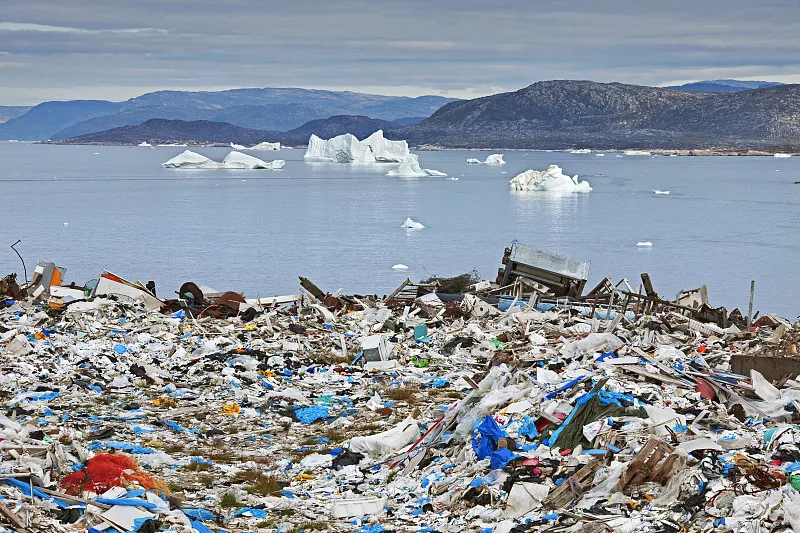
Plastic pollution is not only ugly. Its real danger is persistence. Plastic can last, drift, fragment, and spread across ecosystems. Bottles, bags, packaging film, fishing gear, takeout containers, bottle caps, synthetic fibers, and countless disposable items enter rivers, coastlines, and seas.
They do not simply disappear. Sunlight, waves, and friction break larger plastics into smaller and smaller pieces.
Plastic Truth
When plastic becomes smaller, the problem does not become smaller. It becomes harder to see, harder to collect, and easier to enter living systems.
A plastic bag on the shore is visible. A microplastic particle inside a food web is much harder to track. What begins as packaging may become debris, fragments, fibers, particles, and finally a form of pollution distributed through water, sediment, and marine life.
Why Microplastics Feel So Unsettling
Microplastics are unsettling not only because they are small.
They are unsettling because they can move through many levels of the marine environment.
Plankton may ingest them. Shellfish may filter them. Fish may encounter them through food or water. Larger predators may eat smaller fish. Humans may then encounter microplastics through seafood, water, or other exposure pathways.
Scientists are still studying the long-term health effects of microplastics on humans, and it would be irresponsible to exaggerate every exposure into immediate danger. But it is already clear that microplastic pollution is widespread and that plastics can affect marine organisms and ecosystems in complex ways.
Why Microplastics Matter
They Are Hard to Remove
Once plastic fragments become tiny and widely dispersed, cleanup becomes extremely difficult.
They Can Enter Food Webs
Small particles can be encountered by organisms at the base of marine food systems.
They May Carry Other Problems
Plastics may contain additives or interact with other pollutants, making their ecological role more complicated.
Food Chain Pollution: What We Put Into the Ocean Can Come Back
The deepest lesson of marine pollution is simple: nothing truly disappears.
Mercury is one example. Mercury can enter the environment through natural processes and human activities. In aquatic systems, it can be transformed into methylmercury, a form that can accumulate in living organisms and move through food webs.
As small organisms are eaten by small fish, small fish by larger fish, and larger fish by top predators, certain pollutants can become more concentrated at higher levels of the food chain. This process is called biomagnification.
How Food Chain Pollution Moves
Step 1: Pollution Enters Water
Chemicals, metals, plastics, and other pollutants enter rivers, coasts, sediments, and marine ecosystems.
Step 2: Small Organisms Are Exposed
Plankton, shellfish, and small aquatic organisms may encounter or accumulate contaminants.
Step 3: Predators Eat Prey
Pollutants can become more concentrated as they move upward through the food web.
Step 4: Humans Are Connected
Some pollutants may eventually intersect with seafood systems, public health guidance, and food safety concerns.
The ocean is not a closed container that holds pollution away from us forever. It is a system of movement, exchange, and return.
Seafood Is Not the Enemy. Pollution Is.
When discussing food chain pollution, it is important not to turn seafood into the enemy.
Fish, shellfish, seaweed, and other marine foods are important sources of nutrition, culture, livelihoods, and identity for many communities. Seafood supports coastal economies and provides protein for millions of people.
The problem is not seafood itself. The problem is that humans rely on the ocean for food while also asking the ocean to absorb pollution.
A More Mature Approach
The goal is not to fear the ocean’s food. The goal is to reduce pollution at the source, follow local food safety guidance, support responsible fisheries, and make marine food systems cleaner and more transparent.
Coral Bleaching and Food Chain Pollution Are Part of the Same Story
At first, coral bleaching and food chain pollution may look like separate issues.
One is about climate-driven ecological stress. The other is about contaminants moving through marine life.
But underneath, they tell the same story: human activity is changing the basic conditions of the ocean.
The ocean is facing layered pressure.
Greenhouse gases warm and acidify the sea. Plastics fragment into particles. Industrial pollutants enter sediments and food chains. Overfishing weakens food webs. Habitat loss removes natural protection.
A reef already weakened by warming may be less able to withstand pollution and disease. An ecosystem disrupted by overfishing may recover more slowly. A polluted sea has a harder time supporting a healthy food web.
The ocean is not sending one warning. It is sending many warnings at once.
The Most Dangerous Collapse Is Often Slow
Ocean decline does not always look like a sudden catastrophe.
Sometimes it is chronic.
Coral bleaches more often. Sea temperatures rise little by little. Plastic fragments become smaller. Pollutants accumulate over time. Fish populations shift. Coastlines erode. Shellfish farming becomes harder. Plankton communities change quietly.
Slow change is easy to ignore because it does not always look like a disaster movie. One year is a little worse. One reef is a little paler. One beach has more debris. One fishery becomes less reliable.
Slow Collapse
The crisis often begins before total collapse. It begins when we get used to the decline.
Ocean Problems Do Not Belong Only to Coastal People
People who live far from the coast may feel that the ocean has little to do with them.
They may not fish, dive, live near beaches, or see the sea every day. But distance does not mean separation.
Seafood may come from the ocean. Plastic waste may travel through rivers toward the sea. Carbon emissions affect ocean warming and acidification. Goods move across oceans through global shipping. Weather and climate systems are deeply linked to ocean conditions.
You do not need to live beside the sea to depend on it.
The ocean is not an empty blue space on a map. It is part of the hidden infrastructure of modern life.
What Can We Do Beyond “Use Fewer Plastic Bags”?
When people talk about protecting the ocean, the first suggestion is often to use fewer plastic bags.
That matters, but it is not enough.
Ocean protection cannot depend only on individual guilt. It requires individuals, companies, cities, industries, and policies to change together.
Ocean Protection Needs Action at Every Level
Personal Choices
Reduce unnecessary single-use plastics, choose reusable containers, handle waste properly, and avoid pouring oils, chemicals, or medicines into drains.
Business Responsibility
Reduce overpackaging, design materials for reuse or recovery, and take responsibility for pollution at the production stage.
City Systems
Improve wastewater treatment, stormwater management, recycling, river protection, and coastal planning.
Policy Change
Limit pollution, protect marine habitats, reduce greenhouse gas emissions, support ocean monitoring, and create stronger plastic governance.
Coral bleaching cannot be solved only by planting more coral. Plastic pollution cannot be solved only by beach cleanups. Food chain contamination cannot be solved only by telling consumers to avoid certain fish.
Real solutions must begin at the source.
Protecting the Ocean Is Protecting the Human Future
The ocean is not outside human life.
It regulates climate. It provides food. It supports biodiversity. It protects coastlines. It connects continents. It holds livelihoods, cultures, memories, and economies.
When coral reefs die, marine biodiversity suffers. When plastic enters food webs, pollution becomes harder to manage. When seas warm, extreme weather and species migration may intensify. When acidification increases, shell-building organisms face pressure. When food chains are contaminated, public health and fisheries trust are affected.
Human Future
If the ocean becomes unhealthy, humanity cannot remain healthy while standing safely on the shore.
Final Thoughts
The ocean is sending a warning.
Through coral bleaching, it tells us that heat has reached the boundary of life. Through acidification, it tells us that changes in the atmosphere are entering the water. Through plastic fragments, it tells us that there is no true “throwing away.” Through microplastics, it tells us that pollution can become smaller without disappearing. Through food chain contamination, it tells us that what humans release into nature may eventually return to humans.
From coral bleaching to food chain pollution, these are not separate environmental topics. They are parts of one connected loop.
We change the air, and the ocean absorbs the heat and carbon. We produce waste, and the ocean receives it in fragments. We release pollutants, and the ocean carries them into sediments and food webs. We think seawater dilutes the problem, only to discover that it has returned in another form.
The ocean’s warning is not meant to create despair. It is reminding us that Earth systems still respond, living systems still have limits, and humanity still has choices.
We can continue treating the ocean as a silent landfill, heat sink, and endless resource bank. Or we can begin treating it as a living system that needs respect, repair, and shared protection.
The most frightening thing is not that the ocean is warning us.
It is that we may hear the warning and pretend it is only the sound of waves.
Final Reflection: The ocean is not far away. It is the hidden rhythm behind climate, food, coastlines, trade, biodiversity, and human survival. To protect the ocean is not only to protect beauty — it is to protect the conditions that allow life to continue with dignity.