Scoliosis: Symptoms, Causes, Types, Treatment Options, and Living With a Curved Spine
Article Summary: Scoliosis is a condition in which the spine curves sideways, often forming a C-shaped or S-shaped curve. A curve greater than 10 degrees on an X-ray is usually considered scoliosis. It often appears during the growth years, especially between ages 10 and 15, although adults can also develop scoliosis as spinal joints and discs age. Some people notice uneven shoulders, a tilted waist, one hip sitting higher, a rib hump, or a visible curve in the back. Many mild cases only need monitoring, while moderate curves in growing children may require bracing. Severe or worsening curves may need surgery. This guide explains the symptoms, causes, types, diagnosis, curve degrees, treatment choices, exercises, complications, and everyday living tips for people with scoliosis.
Scoliosis is one of those conditions people may hear about during a school screening, a sports physical, or a routine doctor visit. For some families, the diagnosis comes as a surprise because the child feels completely fine. There may be no pain, no obvious disability, and no reason to suspect a spine issue until someone notices uneven shoulders or a curve during a forward bend test.
The word “scoliosis” simply means that the spine curves sideways more than expected. But the real-life experience can vary widely. Some curves are small and never cause meaningful problems. Others progress during growth, affect posture, create visible body asymmetry, or cause pain and nerve symptoms later in adulthood.
The goal of scoliosis care is not always to make the spine perfectly straight. In many cases, the goal is to watch the curve carefully, prevent it from getting worse, reduce discomfort, maintain mobility, and help the person continue daily life with confidence.
Medical Reminder: This article is for general educational purposes only. If you or your child has back pain with numbness, weakness, trouble walking, breathing difficulty, fever, unexplained weight loss, or rapidly worsening posture, speak with a healthcare professional.
What Is Scoliosis?
Scoliosis is a sideways curvature of the spine. When viewed from behind, a healthy spine should look mostly straight. In scoliosis, the spine bends to the left or right, and in many cases, it also rotates. This rotation can make the ribs or shoulder blade appear more prominent on one side.
Doctors usually confirm scoliosis with an X-ray. If the spinal curve measures more than 10 degrees, it is generally classified as scoliosis. Smaller curves may be described as spinal asymmetry but may not meet the diagnostic threshold.
Simple explanation
Scoliosis means the spine curves sideways instead of staying straight when seen from the back. A doctor measures the curve in degrees on an X-ray to decide whether it is mild, moderate, or severe.
How Common Is Scoliosis?
Scoliosis is not rare. Many cases appear during adolescence, often around the growth spurt before or during puberty. Mild curves may be found in both boys and girls, but girls are more likely to develop curves that progress enough to need treatment.
A teenager diagnosed with scoliosis may continue to have the curve into adulthood. Whether it gets worse depends on several factors, including curve size, remaining growth, curve location, sex, and whether treatment is needed. Adults may also develop a different form called degenerative scoliosis, usually related to aging changes in the lower spine.
Common Age
Many cases are found between ages 10 and 15, when children are growing quickly.
Treatment Risk
Girls are more likely than boys to have curves that progress and require bracing or surgery.
Adult Changes
Adult scoliosis may come from untreated teen scoliosis or age-related wear in the spine.
Common Signs and Symptoms of Scoliosis
Scoliosis often shows up through appearance before it causes pain. A parent may notice one shoulder seems higher, one shoulder blade sticks out more, clothes hang unevenly, or the waist looks shifted to one side. In mild cases, these changes can be subtle.
Teenagers with scoliosis often do not feel pain. If a teenager has severe back pain, numbness, weakness, or other neurological symptoms, doctors usually look for another cause rather than assuming scoliosis is the only explanation. Adults, especially after age 40 or older, may experience pain as discs and joints in the spine wear down.
Visible signs people often notice
✓ One shoulder sits higher than the other.
✓ One shoulder blade sticks out more.
✓ The waist appears uneven or shifted.
✓ One hip looks higher than the other.
✓ Ribs stick out more on one side.
✓ Clothes fit unevenly across the shoulders or waist.
✓ The body leans slightly to one side.
✓ A visible C-shaped or S-shaped curve appears in the back.
Can Scoliosis Cause Pain?
Pain depends heavily on age, curve severity, curve location, and whether nerves are affected. In teenagers, scoliosis is often painless. A teen may be active in school, sports, and daily life without discomfort. That is why school screenings and routine physical exams can be useful.
Adults are more likely to report symptoms. Degenerative changes in the spine can cause lower back pain, stiffness, nerve compression, leg pain, numbness, or fatigue from muscle strain. A large curve in the upper back may also affect breathing in severe cases, though this is much less common.
Pain warning
Severe back pain, numbness, weakness, walking trouble, fever, unexplained weight loss, or loss of bladder or bowel control should not be dismissed as “just scoliosis.” These symptoms need medical evaluation.
How Scoliosis Is Diagnosed
Scoliosis diagnosis usually begins with a physical exam. The most familiar screening method is the Adam’s forward bend test. The person stands with feet together and bends forward at the waist. From behind, the doctor checks whether one side of the back or rib cage rises higher than the other.
A forward bend test can suggest scoliosis, but it does not confirm the diagnosis. An X-ray is usually needed to measure the curve. Doctors measure the curve using the Cobb angle, which helps determine whether the curve is mild, moderate, or severe.
Common diagnostic steps
| Physical exam | Checks posture, shoulders, hips, rib prominence, flexibility, and balance. |
| Adam’s forward bend test | Looks for rib hump or uneven back shape when bending forward. |
| X-ray | Confirms the curve and measures the Cobb angle. |
| MRI or CT scan | May be used if symptoms suggest nerve, spinal cord, bone, or disc problems. |
| Follow-up imaging | Tracks whether the curve is stable or getting worse over time. |
Scoliosis Degrees: Mild, Moderate, and Severe
The degree of the spinal curve is one of the most important factors in treatment planning. A small curve may only need observation. A moderate curve in a growing child may need a brace. A severe curve, especially one that continues to progress, may require surgical discussion.
Main Types of Scoliosis
Scoliosis is grouped by cause and age of onset. The most common type is idiopathic scoliosis, which means doctors do not find a clear underlying cause. Other types are related to spinal development before birth, neurological or muscular conditions, or aging changes in the spine.
Idiopathic Scoliosis
The most common type. It has no clearly identified cause and often appears during adolescence.
Congenital Scoliosis
Begins before birth when the vertebrae form abnormally or fail to separate properly.
Neuromuscular Scoliosis
Caused by conditions that affect muscles or nerves, such as cerebral palsy, spina bifida, muscular dystrophy, or spinal cord injury.
Degenerative Scoliosis
Usually affects older adults as spinal discs, joints, and supporting structures wear down with age.
Structural vs. Nonstructural Scoliosis
Doctors may also describe scoliosis as structural or nonstructural. This distinction matters because it affects treatment. In structural scoliosis, the curve is fixed and involves changes in the spine itself. In nonstructural scoliosis, the spine may appear curved because of another issue, but the spine itself is still flexible and structurally normal.
What Causes Scoliosis?
In many cases, doctors do not know the exact cause. Idiopathic scoliosis is diagnosed when other known causes have been ruled out. It may involve a combination of genetics, growth patterns, hormones, and environmental factors, but no single cause explains every case.
Some forms do have clearer causes. Congenital scoliosis develops when spinal bones form differently before birth. Neuromuscular scoliosis happens when muscles cannot support the spine evenly. Degenerative scoliosis develops as spinal joints and discs wear down over time.
Common myth check
Poor posture, heavy backpacks, and playing sports do not directly cause scoliosis. They may cause back, shoulder, or neck pain, but scoliosis itself is usually related to growth, spinal structure, neuromuscular conditions, or aging changes.
Is Scoliosis Genetic?
Scoliosis often runs in families, but it is not usually caused by one simple gene. If a parent or sibling has scoliosis, other children in the family may have a higher chance of developing it. Still, family history does not guarantee that a child will have scoliosis or that a curve will become severe.
Because family patterns are possible, it is wise to have children checked during growth, especially if one child already has scoliosis. Early detection gives doctors more time to monitor the curve and act if it begins to progress.
Family screening tip
If one child has scoliosis, ask the pediatrician whether siblings should be checked during routine visits, especially during the preteen and teen growth years.
Treatment Options for Scoliosis
Scoliosis treatment depends on the curve size, location, symptoms, age, and whether the person is still growing. A small curve in a child who is nearly finished growing may only need monitoring. A moderate curve in a younger child may require bracing. A severe curve may need surgical evaluation.
Treatment is not the same for everyone. Doctors look at the whole picture: curve degree, skeletal maturity, family history, progression speed, appearance concerns, pain, lung function, and daily life impact.
Observation: Watching the Curve Carefully
Observation is often recommended for mild scoliosis. This does not mean doing nothing. It means the doctor monitors the curve at regular intervals, often with physical exams and occasional X-rays. The purpose is to catch progression early, especially while a child is still growing.
How often follow-up is needed depends on the person’s age, curve degree, and growth stage. A fast-growing teenager may need closer monitoring than an adult with a stable mild curve.
Observation may be enough when:
The curve is mild.
The child is close to finishing growth.
The curve has not changed over time.
There is no pain, nerve symptom, breathing problem, or major appearance concern.
The doctor believes progression risk is low.
Scoliosis Bracing: What It Does and What It Cannot Do
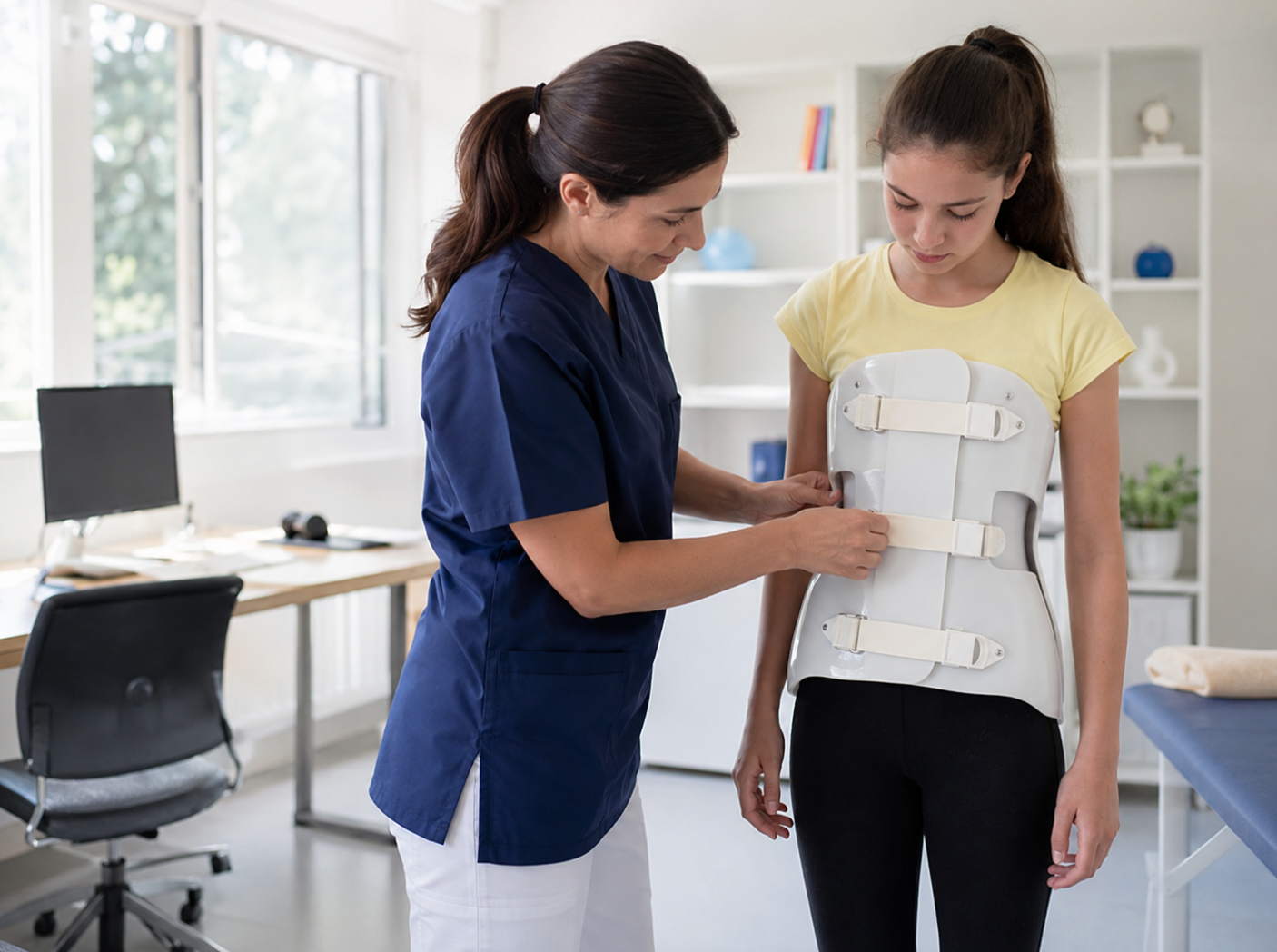
Bracing is commonly used for children and teens who are still growing and have a curve that is moderate or at risk of worsening. A brace does not usually “cure” scoliosis or permanently straighten the spine by itself. Its main purpose is to stop or slow progression while the skeleton is still developing.
Many braces are made of lightweight plastic and fit around the torso. They are often worn under clothing. Depending on the doctor’s recommendation, some children may need to wear the brace many hours a day. The more consistently the brace is worn as instructed, the better the chance of preventing progression.
Brace reality check
| What it can do | Help stop a curve from getting worse during growth. |
| What it cannot always do | Completely erase the curve or guarantee surgery will never be needed. |
| Biggest challenge | Wearing it consistently, especially during school, sleep, and social activities. |
| Best support | A good fit, clear instructions, family encouragement, and regular follow-up. |
Surgery for Scoliosis
Surgery is usually considered when the curve is severe, worsening, or likely to create long-term problems. The most common operation is spinal fusion. In this procedure, surgeons use bone graft material and hardware such as rods, screws, or hooks to hold the spine in a corrected position while the bones fuse together over time.
Surgery can reduce the curve and prevent it from progressing, but it is a major decision. Families and patients should discuss benefits, risks, recovery time, activity limits, flexibility changes, and long-term expectations with a spine specialist.
Before choosing surgery
Ask about the expected correction, recovery timeline, risks, activity restrictions, flexibility changes, future sports, pain control, and whether more than one surgical opinion would be useful.
Exercises and Physical Therapy for Scoliosis
Exercise is helpful for strength, flexibility, posture, and pain control. However, general exercise usually does not “cure” scoliosis or make a structural curve disappear. That said, a stronger core and back can make daily life more comfortable and may help reduce muscle fatigue.
Some physical therapists use scoliosis-specific exercise approaches tailored to the person’s curve pattern. These may focus on breathing mechanics, posture awareness, spinal alignment, core control, and balanced muscle use. The best plan depends on age, curve type, symptoms, and treatment goals.
Common exercises doctors or therapists may discuss
Pelvic tilt
Helps activate abdominal muscles and reduce low back tension.
Cat-cow stretch
Encourages gentle spinal mobility and body awareness.
Bird dog
Builds core control, balance, and back strength.
Modified plank
Strengthens the trunk when done safely and with good form.
Exercise safety note
If you have pain, nerve symptoms, a severe curve, recent surgery, or a brace plan, ask your doctor or physical therapist before starting new exercises. The safest routine is one matched to your curve and body.
Sports and Activities With Scoliosis
Many people with scoliosis can play sports and stay active. Movement is often beneficial for strength, confidence, flexibility, and overall health. Swimming, walking, Pilates, and low-impact conditioning can be good options for many people, though the best choice depends on symptoms and doctor guidance.
Certain activities may need modification, especially after surgery or with severe curves. Contact sports, repetitive twisting, heavy spinal loading, or activities that strain one side of the body may need discussion with a clinician.
Possible Complications of Untreated Scoliosis
Many mild curves never cause major issues. However, larger or progressive curves can lead to complications, especially if not monitored or treated when needed. The risks depend on curve size, location, age, and whether the curve continues to worsen.
Pain and stiffness
Adults with untreated or degenerative scoliosis may develop chronic low back pain, stiffness, or muscle fatigue.
Nerve symptoms
Spinal narrowing or disc changes may cause leg pain, numbness, tingling, or weakness.
Breathing issues
Very severe upper spine curves may affect rib cage movement and lung function.
Self-image concerns
Visible posture changes may affect confidence, clothing choices, or social comfort.
Scoliosis vs. Kyphosis vs. Lordosis
Not every unusual back shape is scoliosis. There are other spinal curvature patterns that affect the body differently. Scoliosis is a sideways curve. Kyphosis is an excessive rounding of the upper back. Lordosis is an excessive inward curve of the lower back.
Living With Scoliosis Day to Day
Most people with scoliosis can live active, normal lives. The right habits can help protect the back, reduce strain, and support confidence. This is especially important for teens wearing braces and adults managing pain or stiffness.
Daily scoliosis care checklist
Keep regular follow-up appointments to track the curve.
Wear the brace exactly as prescribed if bracing is part of treatment.
Stay active with doctor-approved exercise.
Build core and back strength safely.
Maintain a healthy weight to reduce spinal stress.
Choose supportive shoes for daily walking and standing.
Use good desk and screen ergonomics.
Speak up if pain, numbness, or posture changes worsen.
Emotional Side of Scoliosis
Scoliosis is not only a spine issue. For many teens, it becomes part of body image, clothing choices, sports participation, confidence, and social life. Wearing a brace can feel frustrating, especially when classmates do not understand why it is needed.
Families can help by treating scoliosis as a medical condition, not a personal flaw. Encourage questions, involve the child or teen in decisions, and avoid making every conversation about the curve. Support groups, counseling, and connecting with other teens who wear braces can also help.
Helpful message for teens
“Your brace is not who you are. It is a tool to help your spine while you are growing. You can still be active, stylish, social, and confident.”
Questions to Ask Your Doctor
What type of scoliosis do I or my child have?
What is the Cobb angle of the curve?
Is the curve mild, moderate, or severe?
Is the curve likely to get worse?
How much growth is still remaining?
Do we need observation, bracing, physical therapy, or surgery?
How often should follow-up X-rays be done?
Are there activities that should be avoided?
What symptoms should make us call sooner?
Would a second opinion from a spine specialist be helpful?
Frequently Asked Questions About Scoliosis
Can scoliosis be cured?
Scoliosis does not usually disappear completely on its own. Bracing can help stop progression in growing children, and surgery can reduce a severe curve, but the goal depends on the individual case.
Can I live normally with scoliosis?
Yes. Many people with mild or moderate scoliosis live normally, play sports, work, travel, and exercise. Severe cases may need closer monitoring, bracing, or surgery.
Does scoliosis get worse with age?
It can. Curves that are larger during adolescence are more likely to progress later. Adults may also develop degenerative scoliosis as spinal discs and joints age.
Does bad posture cause scoliosis?
No. Poor posture does not cause structural scoliosis. However, scoliosis itself may make posture look uneven or tilted.
Is scoliosis a disability?
Mild scoliosis usually is not disabling. Severe scoliosis with major pain, walking difficulty, nerve symptoms, or functional limits may qualify for disability support depending on local rules and medical documentation.
Final Thoughts: Scoliosis Is Manageable With the Right Plan
Scoliosis can sound intimidating, but many people with curved spines live active, full lives. The most important step is understanding the curve: how large it is, whether it is changing, and whether treatment is needed.
For children and teens, early detection gives families more options. A brace may prevent a curve from worsening during growth, while regular monitoring can help avoid unnecessary treatment. For adults, the focus may shift toward pain control, mobility, posture, nerve symptoms, and maintaining independence.
The best scoliosis care is practical and personal. It may include observation, bracing, physical therapy, exercise, surgery, emotional support, or simply regular checkups. What matters most is choosing the right plan for the specific person, not chasing a one-size-fits-all answer.
Final Reminder: Scoliosis is a spinal curve that should be measured, monitored, and managed based on severity. Mild curves may only need observation, moderate curves may need bracing during growth, and severe curves may require surgical discussion. With the right care, most people with scoliosis can stay active, confident, and functional.