Understanding Bone Fractures: Types, Symptoms, Treatment, Healing, and Prevention
Article Summary: A bone fracture is the medical term for a broken bone. It happens when a bone is exposed to more force than it can safely handle, whether from a fall, sports injury, car accident, repeated stress, or weakened bone strength. Fractures can be simple or complex, closed or open, displaced or non-displaced, and each type requires a different level of care. This guide explains the main types of fractures, warning signs, diagnosis, treatment options, healing timelines, possible complications, and practical ways to reduce fracture risk.
A fracture may sound like a dramatic injury, but broken bones are actually very common. Children break bones while playing or falling. Athletes may develop fractures from collisions, twisting injuries, or repetitive training. Older adults may fracture a wrist, hip, or spine after a fall that seems minor. Sometimes, a bone can even break because an underlying disease has weakened it.
Even though fractures are common, they should never be dismissed as “just a break.” Bones protect organs, support movement, store minerals, and work closely with muscles, joints, nerves, and blood vessels. When a bone breaks, the surrounding tissues may also be injured. That is why proper evaluation and treatment matter.
The good news is that most fractures can heal well with the right care. Some need only immobilization, such as a splint or cast. Others require realignment, surgery, plates, screws, rods, or physical therapy. Healing depends on the type of fracture, the bone involved, the person’s age, overall health, and how closely the treatment plan is followed.
Important Health Note: This article is for general educational purposes only. A suspected fracture should be evaluated by a healthcare professional. Seek urgent medical care if there is severe pain, visible deformity, numbness, heavy bleeding, an open wound near the bone, or inability to move or bear weight.
What Is a Fracture?
A fracture is a break or crack in a bone. It occurs when the force placed on the bone is stronger than the bone’s ability to resist that force. The break may be tiny and difficult to see at first, or it may split the bone into two or more pieces. In severe injuries, the bone may shift out of place or pierce the skin.
Fractures can happen suddenly, such as during a fall, direct blow, sports collision, or traffic accident. They can also develop slowly from repeated stress, especially in runners, dancers, military recruits, and athletes who increase training too quickly. In people with osteoporosis or bone tumors, a bone may fracture with much less force than expected.
Simple Explanation
A fracture means a bone has cracked, bent, split, or broken. The seriousness depends on where the break is, how many pieces are involved, whether the bone moved out of place, and whether the skin was opened.
Why Age Affects Fracture Risk
Fracture risk changes throughout life. Children are active, curious, and more likely to fall while playing, climbing, or participating in sports. Their bones are still growing, which means some childhood fracture patterns are different from adult fractures.
In adults, fractures often happen because of higher-energy injuries, repetitive stress, or weakened bone strength. In older adults, bone density tends to decrease, balance may change, and falls become more dangerous. A fall that might have caused only bruising at age 25 may cause a hip, wrist, or spine fracture later in life.
Main Types of Bone Fractures
Doctors describe fractures in several ways because the description helps guide treatment. A fracture may be described by whether the skin is broken, whether the bone pieces are aligned, the direction of the fracture line, and whether the break is complete or incomplete.
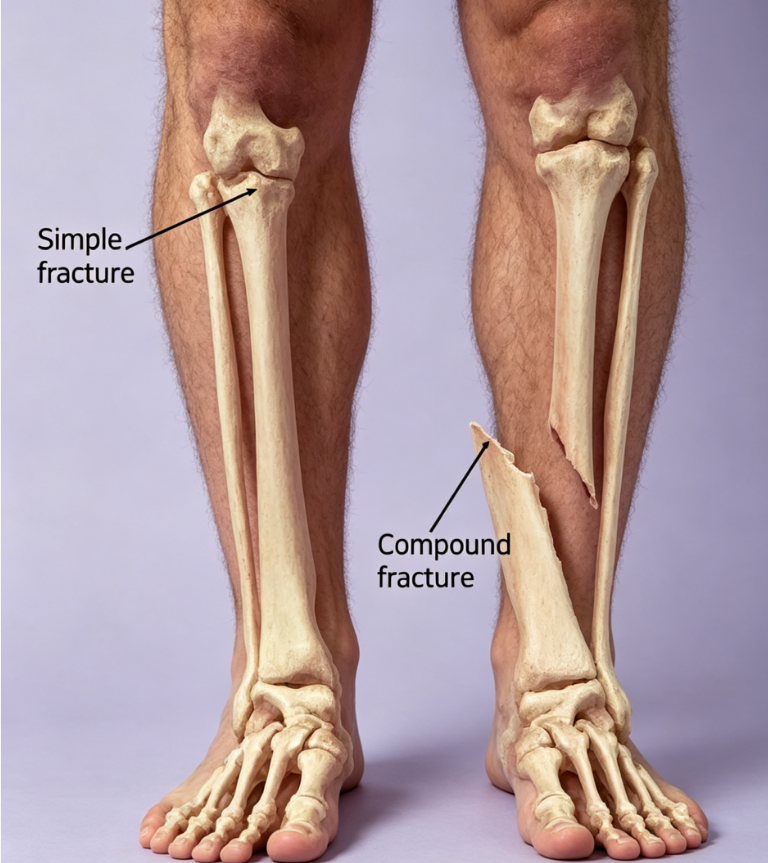
The basic categories many patients hear first are closed, open, displaced, and non-displaced fractures. A closed fracture means the skin is not broken. An open fracture means there is a wound near the fracture, and the broken bone may have pierced the skin. Open fractures need urgent care because bacteria can enter the wound and cause infection.
Safety Reminder: An open fracture is a medical emergency. Do not push the bone back into place. Cover the wound with a clean dressing if possible and seek emergency care.
Fracture Patterns: How the Bone Breaks
Beyond the basic categories, fractures are also described by their pattern. This helps the medical team understand how the injury happened, how stable the broken bone is, and what kind of treatment may be needed.
Transverse Fracture
The break runs straight across the bone, often at a right angle to the long part of the bone.
Oblique Fracture
The fracture line runs at an angle through the bone.
Comminuted Fracture
The bone breaks into several pieces and may require more complex treatment.
Stress Fracture
A small crack that often develops from repeated stress or overuse.
Fractures More Common in Children
Children’s bones are different from adult bones. They are often more flexible and still growing, which can create fracture patterns that are less common in adults. This is why pediatric fractures should be assessed carefully, especially when the injury is near a growth plate.
Common Symptoms of a Fracture
Fracture symptoms can vary depending on the bone involved and the severity of the injury. Some fractures are obvious because the limb looks bent or deformed. Others are more subtle and may feel like persistent pain that worsens with use.
Common signs include pain, swelling, bruising, tenderness, difficulty moving the injured area, inability to bear weight, deformity, or a grinding sensation. With stress fractures, pain may begin gradually and worsen during activity. With open fractures, there may be bleeding or a visible wound near the broken bone.
Get Urgent Help If: The bone appears deformed, the skin is broken, there is heavy bleeding, the injured area is numb or blue, pain is severe, or the person cannot move or bear weight after an injury.
How Fractures Are Diagnosed
A healthcare professional usually begins by asking how the injury happened, where the pain is, and whether there is numbness, weakness, swelling, or difficulty moving. They may check circulation, sensation, skin condition, joint movement, and the position of the injured limb.
X-rays are the most common imaging test for fractures. They help show where the bone is broken and whether the pieces are aligned. In some cases, especially with stress fractures, spine fractures, wrist fractures, or complex joint injuries, additional imaging such as CT scan, MRI, or bone scan may be needed.
Treatment Options for Bone Fractures
Fracture treatment has one main goal: help the bone heal in the best possible position while protecting nearby tissues. The right treatment depends on the fracture type, location, alignment, stability, and the patient’s health.
Some fractures are treated without surgery using a splint, cast, brace, sling, or walking boot. These tools keep the broken bone from moving while it heals. If the bone pieces are out of place, the doctor may need to perform a reduction, which means moving the bone back into better alignment.
More serious fractures may require surgery. Surgical fixation can involve plates, screws, rods, pins, wires, or external frames. Surgery may be needed when the fracture is unstable, displaced, open, near a joint, or unlikely to heal well with immobilization alone.
First Aid for a Suspected Fracture
If you suspect a fracture, the safest first step is to keep the injured area still and get medical help. Do not try to straighten a visibly deformed limb. Do not push exposed bone back into the wound. If there is bleeding, apply gentle pressure around the wound with a clean cloth, but avoid pressing directly on exposed bone.
Basic First-Aid Steps
Keep the injured area still.
Remove jewelry or tight items before swelling increases, if it is safe to do so.
Apply a cold pack wrapped in cloth to reduce swelling.
Elevate the injured area if possible.
Cover open wounds with a clean dressing.
Seek medical care, especially if pain is severe or movement is limited.
Call emergency services for major trauma, open fractures, deformity, numbness, or heavy bleeding.
How Long Does a Fracture Take to Heal?
Healing time is not the same for every fracture. A small fracture in a healthy child may heal within a few weeks. A serious fracture in an older adult, a fracture near a joint, or a break that required surgery may take months or longer to fully recover.
Many broken bones begin to heal enough for gradual movement in several weeks, but full strength, flexibility, and confidence may take longer. Some severe fractures can take a year or more to recover fully. Cleveland Clinic notes that fracture healing time depends on factors such as the cause, the bone involved, the fracture type, treatment needed, and other injuries. :contentReference[oaicite:1]{index=1}
Recovery Tip: Do not rush back to sports, heavy lifting, or high-impact activity before your provider clears you. Pain-free movement does not always mean the bone has fully regained strength.
Possible Complications of Fractures
Most fractures heal with proper care, but complications can happen. Open fractures carry a higher risk of infection. Some fractures may damage nearby nerves or blood vessels. Others may heal slowly, heal in the wrong position, or fail to heal completely.
Joint stiffness and muscle weakness are also common after weeks of immobilization. That is why rehabilitation may be part of recovery. Physical therapy can help restore movement, strength, balance, and confidence.
How to Support Bone Healing
Healing is something the body does naturally, but healthy habits can support the process. Following the treatment plan is one of the most important steps. If you are told not to bear weight, avoid walking on the injured bone too soon. If you have a cast, keep it dry and do not insert objects inside to scratch the skin.
Nutrition matters too. Protein, calcium, vitamin D, and overall adequate calories help the body rebuild tissue. Smoking can slow bone healing, so quitting or reducing tobacco use is especially important during recovery.
Follow Restrictions
Use crutches, slings, boots, or braces exactly as instructed.
Eat Enough Protein
Protein helps repair tissue and maintain muscle during recovery.
Protect Bone Health
Ask about calcium, vitamin D, osteoporosis screening, and fall prevention if appropriate.
Preventing Fractures
Not every fracture can be prevented, but many risks can be reduced. For children and athletes, proper protective gear, safe training, and avoiding overuse are important. For older adults, fall prevention and bone health screening become especially valuable.
At home, simple changes can reduce fall risk. Good lighting, secure rugs, handrails, non-slip bathroom surfaces, supportive shoes, and removing clutter can make a real difference. Exercise that improves balance, strength, and coordination may also help prevent falls.
Frequently Asked Questions About Fractures
Is a fracture the same as a broken bone?
Yes. “Fracture” is the medical term for a broken bone. The break may be small, partial, complete, displaced, or open.
Can a fracture heal without a cast?
Some fractures can heal with a brace, boot, sling, splint, or activity restriction instead of a full cast. The right treatment depends on the bone and fracture stability.
Why do open fractures need urgent care?
When the skin is broken, bacteria can enter the wound and reach the bone. This raises the risk of serious infection, so urgent cleaning, antibiotics, and surgical care may be needed.
What slows fracture healing?
Smoking, poor nutrition, diabetes, poor blood supply, infection, certain medications, severe displacement, and not following activity restrictions can slow healing.
Final Thoughts: A Broken Bone Needs More Than Time
A fracture may begin with a sudden accident, but healing is a process. The bone needs proper alignment, stability, blood supply, nutrition, and time. The surrounding muscles and joints may also need rehabilitation before normal movement fully returns.
If you suspect a broken bone, getting medical evaluation early is the safest choice. The sooner a fracture is diagnosed and treated correctly, the better the chances of proper healing and fewer complications.
Whether the injury is a child’s buckle fracture, an athlete’s stress fracture, or an older adult’s hip fracture, the same principle applies: protect the bone, follow the treatment plan, and give the body the support it needs to heal.
Final Reminder: Bone fractures are common, but every fracture deserves the right care. Proper diagnosis, treatment, follow-up, rehabilitation, and prevention habits can help protect long-term strength, mobility, and quality of life.